
Drain cleaning in Philadelphia, PA - Philadelphia County - 172 ZIP codes covered
Drain Cleaning in Philadelphia, PA
Philadelphia is the oldest housing stock in this flagship set, and it is not close. The median home here was built in 1949, and 64.9 percent of homes predate 1960, most of them rowhouses whose laterals have been draining into city sewers since before the Second World War. Some 64.1 percent of homes are single family, which in Philadelphia usually means a rowhouse with its own lateral, its own basement, and its own exposure when the combined sewer outside surcharges in a storm. The city also runs two of the most useful homeowner programmes in this set, one that installs backwater protection and one that lends at zero interest for lateral repairs. DrainFlowed connects you with an independent local contractor. Call (866) 555-0134.
1949: what a median build year does to a lateral
Sit with the Philadelphia numbers for a moment, because they set the terms for everything else. A median year built of 1949 means half the city's 748,270 housing units are older than that, and the pre 1960 share of 64.9 percent is the highest in this set alongside a post 2000 share of just 9.7 percent. These are not houses with old drains. These are houses whose drains are antiques, clay and iron systems that have carried three quarters of a century of wastewater, grease, and root pressure.
Rowhouse construction concentrates both the risk and the responsibility. The typical Philadelphia home is attached, so excavation options are narrow, neighbours are close, and a lateral failure is something the whole party wall can smell. At the same time, the rowhouse lateral is usually a short, legible run from basement to street, which makes camera diagnosis unusually conclusive here. There is rarely mystery about where a Philadelphia lateral goes. The only question is what condition it is in.
That is why this page will keep prescribing the same instrument. In a newer city, a camera inspection at $125-$500 is one option among several. In a city of 1949 laterals, it is close to a civic duty for any owner whose line has misbehaved twice, because the difference between a coating problem and a collapsing clay pipe is the difference between a cleaning bill and a financed repair, and no amount of symptom watching can tell them apart from the kitchen sink.
Drain problems we handle in Philadelphia
The problems Philadelphia's own housing, ground and weather produce most. The full symptom list is on the problems hub; these are the ones that earn their place here.
Multiple Drains Backing Up in Philadelphia
Several drains failing together is the main line or sewer until proven otherwise. Stop the water, protect the floor, make the call..
Recurring Clogs in Philadelphia
A clog that returns is not bad luck. It is an undiagnosed cause - roots, scale, a belly, or a cleaning that never removed the material..
Drain Odors in Philadelphia
Sewer smell, rotten-egg smell, sour buildup smell.
Gurgling Drains in Philadelphia
Gurgling is air moving where it should not - displaced by a partial blockage or a vent problem. It is one of the earliest main-line warnings..
Your lateral, your defect notice: the PWD rule
Philadelphia Water Department regulations assign the lateral without ambiguity. The property owner owns, and shall maintain and repair, the property's entire drainage system and the sewer connection, keeping each intact, unobstructed, properly configured and functioning at all times. There is no public way carve out of the Chicago kind. From the basement wall to the city sewer, the pipe is the owner's, and so is every root, crack, and collapse along it.
The department enforces that ownership actively. PWD's own flood guidance explains that detection of a cracked lateral results in a Notice of Defect, after which it is the homeowner's responsibility to fix the lateral, with licensed plumbers offering the repair options. A defect notice comes with a short clock, which is why discovering your lateral's condition voluntarily, on your own schedule, beats discovering it through the city's inspection programme with a deadline attached.
None of this makes Philadelphia ungenerous, as the next section shows. It makes it structured. The city expects the lateral to be yours, inspects for failures that endanger neighbours and the network, and then offers specific financial tools, a protection programme and a zero interest loan, to help owners meet an obligation it does not pretend is small. Owners who understand that structure early can use the tools in the right order instead of meeting them in a crisis.
About Philadelphia: the local snapshot
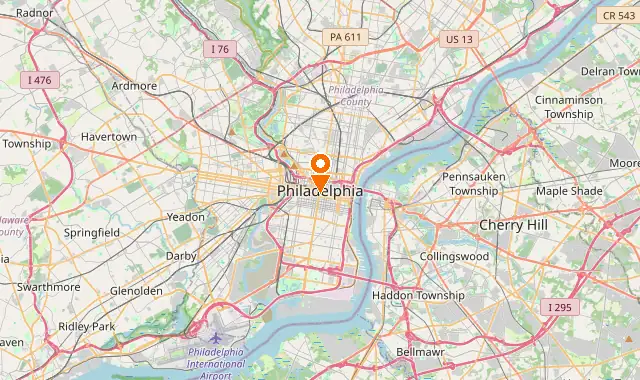
Local facts from Wikipedia and Wikidata, retrieved 2026-10-25. Population and area describe the city itself; the drain coverage counted on this page spans the wider area around it.
Two programmes that change the maths: BBPP and HELP
The Basement Backup Protection Program, run by the Philadelphia Water Department, addresses the storm side of the problem. For homeowners whose basements back up through fixtures during wet weather, the programme provides backwater valve installation at no charge, with downspout modifications where they are needed, carried out by licensed contractors with a one year warranty. A backwater valve lets wastewater leave the house and closes against water trying to return, which is precisely the combined sewer failure mode described below.
There is a condition hidden in the programme that ties this whole page together. PWD explains that the pipe connecting your home to the sewer must be in good condition for the protection to work, and that if it is broken or leaking, the repair comes first, through a zero interest Homeowner Emergency Loan Program loan, known as HELP, or a plumber you hire yourself. A backflow device can be installed as part of that repair work. In other words, the city's free protection sits downstream of your lateral being sound, and the city will lend you the money at no interest to make it sound.
HELP deserves its own sentence because it is rare. The loan is available to property owners who receive a defect notice or face qualifying emergency repairs, a PWD contractor does the exterior work, and the owner repays over five years at zero interest, with longer terms for low income customers. For a Philadelphia owner staring at a lateral replacement, that financing can matter as much as the repair price itself, and it is worth asking about before signing anything with a private lender.
Eligibility for the protection programme turns on a phrase owners should prepare for: documented wet weather backups. PWD's programme exists for homes that flood through basement fixtures during rain, and the application process will ask its version of when, how often, and what was affected. Owners who have lived through such an event should treat its paperwork as part of the cleanup: photographs with dates, the plumber's invoice describing the work, any defect correspondence, kept together. That file is what converts a miserable memory into a qualifying record, for the backwater valve programme now and for any future conversation about the property, including a sale, where a documented and addressed backup history reads very differently from an undocumented one. Philadelphia's system, for all its age, rewards the owner who keeps records as diligently as the owner who keeps cleanouts clear.
Combined sewers over 60 percent of the city, and Green City, Clean Waters
Philadelphia had one of the first sewer systems in the United States, with portions dating to the second half of the 19th century, and much of it still works today. About 60 percent of the city, some 64 square miles, sits in the combined sewer area, where a single pipe carries sewage and stormwater together to a treatment plant. In moderate to heavy rain the system reaches capacity and overflows through 164 permitted combined sewer overflow outfalls into local streams and rivers. Inside the house, the same surcharge is what arrives, uninvited, through basement fixtures.
The city's answer is Green City, Clean Waters, a 25 year, multibillion dollar programme that manages stormwater with green infrastructure, rain gardens, tree trenches, and porous surfaces, aiming to keep the first flush of a storm out of the combined pipes entirely. It is one of the most watched programmes in American water management, and it is genuinely reducing the volume that reaches the sewers. It does not, and cannot, reline the private lateral between your basement and the street, which remains the last unmodernised stretch of the system for most older homes.
For the homeowner, the combined sewer reality translates into two habits. First, wet weather discipline: during the worst of a storm, the 48.4 inches of annual rain arriving all at once, limiting water use reduces what your household adds to a surcharged system. Second, backflow protection, through the BBPP route above, is not an exotic upgrade in the combined area. It is the standard local answer to a known, mapped risk, and Philadelphia will help you install it.
81 freeze days, odors in old traps, and winter signals
Philadelphia averages 81 freeze days a year and 22.1 inches of snow, a real winter by any measure, acting on the oldest pipes in this set. The freeze and thaw cycle worries clay joints here as it does in Chicago, with the added factor that many Philadelphia laterals were already old when modern bedding practices arrived. A joint that has survived eighty winters has survived them by narrowing its margin each time, and root entry at those joints is the single most common camera finding in this stock.
Winter also manufactures the city's most misread symptom. A roof vent terminal can frost closed in a cold snap, and a rowhouse system will gurgle and drain slowly until the thaw, mimicking a blockage it does not have. The Philadelphia tell is breadth and timing together: several fixtures, suddenly, in the coldest week, in a house whose drains were fine in November. Mention the timing when you call. A contractor who hears it will check the vent theory before quoting a main line cleaning you may not need.
Odors deserve a Philadelphia footnote of their own. In a city of basements, the floor drain trap that dries out over a dry month is the most common source of a sewer smell indoors, and PWD's flood guidance treats basement fixtures as the system's front line for good reason. Before paying anyone to hunt a smell, pour a bucket of water into every little used floor drain and wait a day. If the smell leaves with the trap refilled, you have performed the cheapest repair in this entire document.
The party wall problem: doing lateral work between neighbours
A Philadelphia rowhouse lateral does not fail in private. It fails between two party walls, in a strip of ground that may be eighteen inches from a neighbour's identical pipe, in a house whose basement shares air with the houses on both sides. That density shapes every stage of a serious drain job. Excavation options narrow to the width of a small yard or a basement floor. Equipment arrives through the house rather than around it. And the smell of a neighbour's failing lateral, or the water from it, can present in your basement, which means the first diagnostic question in a rowhouse is sometimes whether the problem is yours at all.
The counting method answers most of that question. If your fixtures misbehave when your household runs water, the cause is likely in your system. If your basement takes water or odor when your house is quiet and the neighbour is running laundry, the shared environment deserves a look before you pay for a cleaning of a healthy line. Camera work settles it definitively, because the camera enters through your cleanout and reports on your pipe, and a sound pipe on film redirects the conversation, politely and with evidence, to where the problem actually lives.
There is a cooperative upside to the same density. Rowhouse laterals were often laid in the same year, by the same builder, to the same sewer, and they age in rough synchrony. When one house on the row cameras its line and finds clay at the end of its life, the finding is statistical news for the whole row. Neighbours who share those findings, and who time their own inspections accordingly, are not being nosy. In a city built wall to wall, they are practising the only form of infrastructure planning the housing stock allows.
Philadelphia pricing, sequenced the PWD way
Standard ranges apply here as everywhere on DrainFlowed. A single line cleaning runs $99-$450, main line cleaning $200-$650, sewer line cleaning $250-$900, hydro jetting $300-$900, a camera inspection $125-$500, and an emergency visit $150-$700. What Philadelphia adds to the arithmetic is financing and protection that other cities do not: a possible zero interest HELP loan for the repair itself, and a no charge backwater valve programme once the lateral is sound. The out of pocket story for the same physical job can therefore differ sharply between two owners who sequence their steps differently.
DrainFlowed is a connection service, not a contractor and not a city programme. Call (866) 555-0134 describing the fixtures affected, any storm link, and any defect notice you have received, and you will be connected with an independent local contractor. Verify their licence and insurance, agree the range before work begins, and tell them plainly if you intend to involve PWD programmes, because programme work has its own contractors and paperwork and is best coordinated early.
The sequence this city rewards is worth stating as a rule. Camera the lateral before it fails completely. If it needs repair, price the repair and the HELP loan together. Once the line is sound, take the backwater protection the city offers for the combined sewer area. Owners who run that sequence convert Philadelphia's age problem from a recurring emergency into a managed, financed, and largely finished project.
Drain services available in Philadelphia
The services that answer Philadelphia's lead problems, from the independent contractors who cover the city. Ranges are the national typical ranges used across this site.
| Service | Typical range | What it is |
|---|---|---|
| Drain Cleaning | $99-$450 | The core service: mechanical cleaning that clears the clog and scrapes the pipe walls, not just a hole poked through the blockage.. |
| Main Line Cleaning | $200-$650 | When every drain in the house slows at once, the problem is the main line. |
| Sewer Line Cleaning | $250-$900 | The buried line from your house to the street: root cutting, scale removal and jetting, with camera proof of the pipe's condition.. |
| Hydro Jetting | $300-$900 | High-pressure water that scours pipe walls clean - the answer for grease, scale and lines that keep re-clogging after cabling.. |
| Drain Camera Inspection | $125-$500 | See inside the pipe before you spend on the fix: roots, cracks, bellies and blockages located precisely, with footage to decide on.. |
| Emergency Drain Cleaning | $150-$700 | Sewage backing up, water rising, guests arriving: what counts as a drain emergency, what to do in the first ten minutes, and how the visit works.. |
Full detail on every service, with signs and causes, is on the services hub, and every range on the site is collected in the cost guide.
Philadelphia coverage snapshot
Nearby covered cities: Pittsburgh, Allentown, Harrisburg, Lancaster.
Philadelphia sewer and water resources
The city and utility pages this page's local facts rest on, worth bookmarking if you own a home in Philadelphia:
Sources for this page
- housing age and mix: Median year built 1949, 64.9 percent pre 1960, 9.7 percent post 2000, 64.1 percent single family, 748,270 units (source)
- climate: 48.4 in precipitation, 22.1 in snow, 81 freeze days, 9.6 heavy rain days per year (source)
- sewer lateral responsibility: Property owner owns and shall maintain and repair the entire drainage system and sewer connection (source)
- combined sewer: About 60 percent of the city (64 square miles) is in the combined sewer area with 164 permitted CSO outfalls; Green City, Clean Waters is the 25 year control plan (source)
- city programs: Basement Backup Protection Program provides backwater valve installation at no charge to qualifying homeowners; HELP offers zero interest loans over five years for lateral repairs (source)
- Housing age: median year built and build-era shares (US Census Bureau ACS)
- Weather averages: 2014-2023 daily record (Open-Meteo archive, ERA5)
Coverage around Philadelphia
Nearby cities we cover in Pennsylvania
- Drain cleaning in Pittsburgh, PA
- Drain cleaning in Allentown, PA
- Drain cleaning in Harrisburg, PA
- Drain cleaning in Lancaster, PA
- Drain cleaning in Scranton, PA
- Drain cleaning in Reading, PA
The full list for the state is on the Pennsylvania locations page.
Beyond Philadelphia
Coverage at this depth continues nearby: see drain cleaning in Pittsburgh, PA and drain cleaning in Allentown, PA, each written from its own city's data the same way this page is.
Questions, answered
Does Philadelphia help pay for any of this?
It helps in two ways. The Basement Backup Protection Program provides backwater valve installation and downspout work at no charge to qualifying homeowners whose basements back up in wet weather, and the HELP loan offers zero interest financing over five years for lateral repairs after a defect notice. Your lateral must be in sound condition for the valve programme, which is one more reason to camera it.
Who owns the sewer lateral in Philadelphia?
The entire drainage system and the sewer connection are yours. PWD's sewer connection rules state the property owner owns, and must maintain and repair, the whole system, keeping it intact, unobstructed and functioning. A cracked lateral earns a Notice of Defect, and fixing it is the owner's job.
Why do Philadelphia basements back up in storms?
Because about 60 percent of the city, some 64 square miles, drains through combined sewers carrying sewage and stormwater in one pipe. In heavy rain that system surcharges and basement fixtures below its level are the relief path. PWD counts 164 combined sewer overflow outfalls in the same system.
My drains gurgle every winter. Is that a blockage?
Often, yes. With 81 freeze days a year, a roof vent can frost over and make the whole house gurgle until the thaw, and PWD's own flood guidance lists cracked laterals and blockages separately from storm surcharge. Timing is the tell: cold linked symptoms point at the vent, persistent slowness points at the pipe.
How much does drain cleaning cost in Philadelphia?
A single drain cleaning runs $99-$450, main line work $200-$650, and a camera inspection $125-$500. On a pre 1960 rowhouse, the camera usually decides the budget, because it separates a cleaning from a lateral repair that a HELP loan might finance.
The same drain clogs again every year. Why?
That is the classic profile of a lateral with roots, scale, or a partial break, in a city where 64.9 percent of homes predate 1960. A cleaning opens a path; the cause regrows or recatches. Ask for a camera inspection and a named finding, and ask whether the finding qualifies you for HELP loan financing if repair is needed.
Drain problem in Philadelphia? Make the call
A live person answers around the clock. Describe the problem, hear the likely range, and get an independent local contractor on the way.
(866) 555-0134 Tap to call nowA live person answers, day or night. Describe the problem, hear the likely range, then decide.