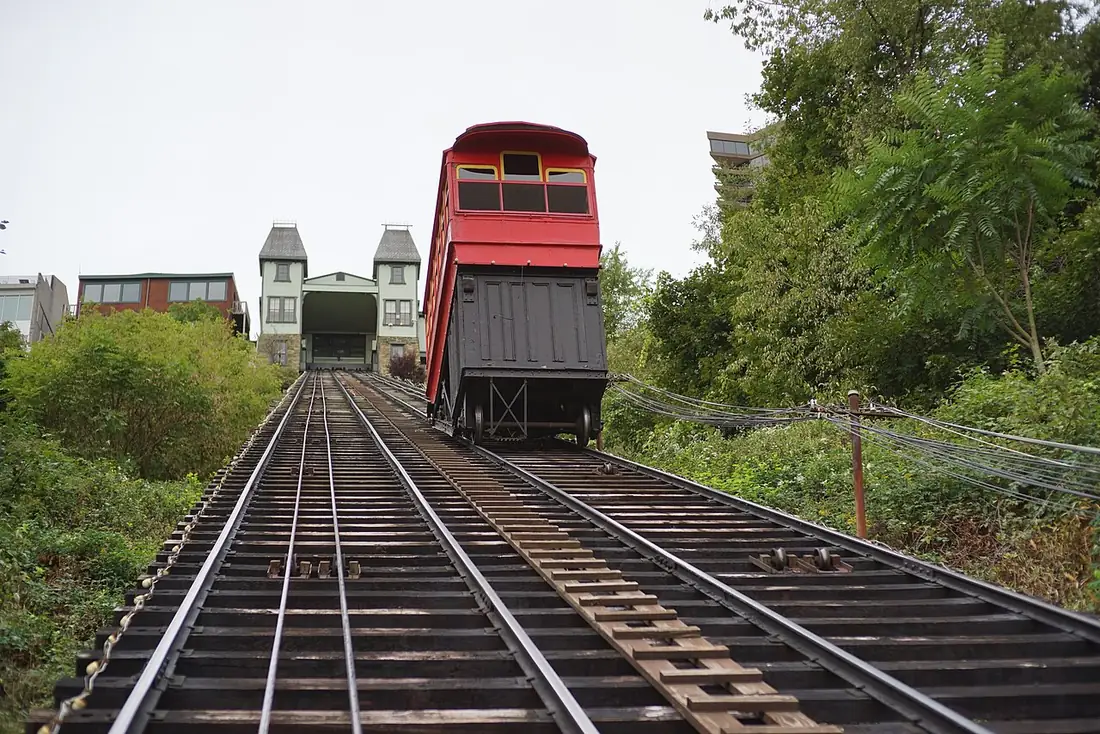
Drain cleaning in Pittsburgh, PA - Allegheny County - 75 ZIP codes covered
Drain Cleaning in Pittsburgh, PA
Pittsburgh drains work against the terrain before they work against anything else. Houses climb steep streets above the Allegheny, Monongahela and Ohio rivers, and the pipe leaving each house often drops sharply, bends, and drops again before it reaches the main. The housing stock makes the job older still. The median Pittsburgh home was built in 1942, and 68.8 percent of homes predate 1960, so a large share of laterals are clay or cast iron lines that have been in the ground for eighty years or more. Add a combined sewer system that can be strained by very small amounts of rain, and the pattern here is specific: slow drains that turn into backups during wet weather, on lines the homeowner fully owns. DrainFlowed connects Pittsburgh homeowners with independent local drain contractors. Standard drain cleaning runs $99-$450 depending on the line and access.
Laterals on a hillside behave differently
A flat lot gives a sewer lateral one steady slope to work with. Much of Pittsburgh gives it a staircase. Lines leave basements at one elevation, cross retaining walls and terraced yards, and connect to mains that sit well below or, on some streets, surprisingly close to the house level. Every change in slope is a place where flow slows, solids settle, and a partial blockage can sit quietly for months. That is one reason Pittsburgh stoppages so often present as intermittent. The line copes on ordinary days, then a laundry load plus a shower pushes enough water through the low spot to reveal it.
The age of the run compounds the geometry. With 68.8 percent of Pittsburgh homes built before 1960 and a median build year of 1942 across 161,908 housing units, many laterals are sectional clay pipe. Clay itself lasts, but the joints between sections are the weak point. Ground movement on slopes works those joints open a fraction at a time, tree roots find the moisture that escapes, and the root mass then catches grease and paper. A cable that only punches through the roots restores flow without removing the reason they entered, which is why recurring clogs in Pittsburgh so often trace back to one joint on the downhill run.
Access decides how thorough the fix can be. A proper outside cleanout near the house lets a contractor run a full size blade the length of the lateral and follow with a camera. Without one, work may have to start through a basement fixture or a pulled toilet, which limits blade size and camera quality. If you do not know where your cleanout is, ask the contractor to locate and mark it during the visit. On a hillside lot, knowing that access point before an emergency is worth real money, because it can be the difference between a cleaning in the $99-$450 range and excavation talk nobody wants to have in the rain.
Drain problems we handle in Pittsburgh
The problems Pittsburgh's own housing, ground and weather produce most. The full symptom list is on the problems hub; these are the ones that earn their place here.
Recurring Clogs in Pittsburgh
A clog that returns is not bad luck. It is an undiagnosed cause - roots, scale, a belly, or a cleaning that never removed the material..
Multiple Drains Backing Up in Pittsburgh
Several drains failing together is the main line or sewer until proven otherwise. Stop the water, protect the floor, make the call..
Slow Drain in Pittsburgh
One slow fixture is a narrowing pipe. Several slow fixtures are a main-line warning. How to tell the difference and what fixes each..
Gurgling Drains in Pittsburgh
Gurgling is air moving where it should not - displaced by a partial blockage or a vent problem. It is one of the earliest main-line warnings..
Rain, three rivers, and a combined system
Pittsburgh is served by a combined sewer system in much of the city, meaning one pipe carries both sanitary sewage and stormwater. The Allegheny County Sanitary Authority, ALCOSAN, treats the flow and is carrying out its Clean Water Plan under a federal consent decree to cut overflows of diluted, untreated wastewater into local rivers and streams. Reporting on the plan notes that as little as a tenth of an inch of rain can overload parts of the system today. For a homeowner, the practical translation is simple. During heavy rain, the public system has less room for your water, and a house line that is already narrowed has nowhere to send its flow.
The climate numbers in the data pack support that caution. Pittsburgh averaged 51.1 inches of precipitation a year over the 2014 to 2023 period, with about 6.4 heavy rain days a year and 25.3 inches of snow. Snowmelt matters here too, because a fast thaw sends a long, steady volume into the same combined pipes. A backup that only happens in wet weather is therefore a different diagnosis from a backup that happens on a dry Tuesday. Tell the contractor about the timing in detail. Backups that track storms point toward capacity, infiltration through cracked joints, or a main that is running full, while dry weather backups point back at the condition of your own lateral.
There is also a diagnostic step that costs nothing. If several houses on your street are backing up at the same time during a storm, the problem is more likely in the shared system than in any one lateral, and that is worth reporting to Pittsburgh Water and ALCOSAN channels as well as handling your own line. If yours is the only house affected, the restriction is almost certainly on your side of the connection. Either way, avoid running water during the event. Every gallon you add arrives at the lowest fixture in your basement, not at the street.
One Pittsburgh specific habit follows from all of this. Because the combined system reacts to small rain amounts, the city and ALCOSAN operate overflow alert awareness around wet weather, and homeowners on combined streets learn to treat a forecast of steady rain the way coastal owners treat a tide table. Run the laundry before the storm, not during it. Keep the basement floor drain area clear on wet weekends. None of that prevents a public surcharge, but it decides whether a surcharge meets a prepared basement or a furnished one, and that difference is measured in belongings, not in plumbing theory.
About Pittsburgh: the local snapshot
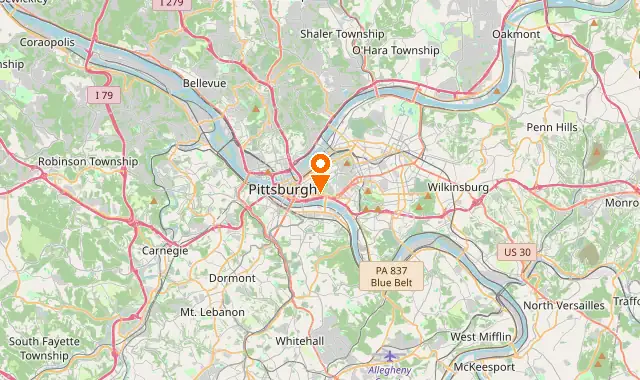
Local facts from Wikipedia and Wikidata, retrieved 2026-10-25. Population and area describe the city itself; the drain coverage counted on this page spans the wider area around it.
What 1942 housing means inside the pipes
A median build year of 1942 puts most Pittsburgh homes in the clay and cast iron era, with galvanized and lead era plumbing inside some walls as well. Cast iron drain lines corrode from the inside, developing a rough, scaled surface that grabs hair, grease and sediment. Plumbers call the advanced stage channeling, where the bottom of the pipe wears into a trough. A drain can look fine on a light day and still be badly narrowed, because the scale reduces diameter gradually and the household adapts without noticing, one slower sink at a time.
Only 9.6 percent of Pittsburgh homes were built after 2000, and 14.2 percent date from 1960 to 1979, so newer PVC laterals are the minority here. That mix is why blanket advice fails in this city. A 2015 suburban style line and a 1925 clay line need different blades, different camera expectations, and different conversations afterward. For an older line, the valuable product of a visit is often the camera record itself: where the joints are, which ones hold roots, whether there is a belly collecting water, and whether the line under the basement floor is channeling. That record turns the next decision, clean on an interval or repair a section, into an evidence based one.
Single family homes make up 57.7 percent of the stock, but Pittsburgh also has dense rows and multi unit conversions where one lateral may serve more than one household. In those buildings, a backup in the lowest unit can be caused by usage from every unit above it. If you own or manage such a property, say so when you book. The contractor needs to know the line serves multiple households, because the cleaning has to clear the shared run, not just the branch behind the complaining fixture.
The entire lateral is yours, and that changes the math
Pittsburgh Water states the rule plainly: a sewer lateral runs from the Pittsburgh Water sewer main to your internal plumbing, and the entire sewer lateral is the responsibility of residential and commercial property owners. There is no property line split to hide behind. The stretch under your yard, the stretch under the sidewalk, and the connection at the main all sit on your side of the ledger, while Pittsburgh Water maintains the public main itself. Many owners only learn this when a letter or a backup forces the question, which is the worst possible time to absorb it.
The rule makes two habits valuable. The first is documentation. Keep camera footage, invoices and any notices together, because a lateral history follows the house and answers questions at sale time and at the next backup. The second is timing. A root filled clay lateral found by a planned camera inspection, with sewer line work in the $250-$900 range for cleaning related services and repair scoped separately, is a manageable project. The same line discovered as a full backup with sewage in the basement is an emergency, and emergency service runs $150-$700 before any repair conversation even starts.
DrainFlowed is a connection service, not the contractor. When you call (866) 555-0134, you are connected with an independent local business that sets its own schedule and prices within the ranges shown on this page. Ask that contractor directly who pulls any permit the work needs and who is responsible for the section under the street if repair, rather than cleaning, turns out to be required. In Pittsburgh that answer will usually point back to you, and hearing it before digging starts is far better than hearing it after.
Winter freeze is a drain issue here, not just a pipe issue
Pittsburgh averaged 102 freeze days a year in the 2014 to 2023 data, the joint highest pattern in this part of the country, along with 25.3 inches of annual snow. Freeze affects drains in quieter ways than the classic burst supply pipe. A shallow section of lateral, a line under an unheated porch, or a belly holding standing water can ice at the edges and narrow further. Grease that stays liquid in September congeals faster in a cold January line, which is why kitchen stoppages cluster in winter even in houses that change nothing about how they cook.
Snow placement plays a part too. Roof drainage and sump discharge that are routed toward the sanitary system add meltwater exactly when the combined system is handling everyone else's meltwater as well. Keep discharge arrangements as they were designed, and never improvise a connection into a sanitary line to solve an icy puddle. If a floor drain or basement fixture only misbehaves during deep cold or thaw, write down the dates. That pattern, handed to a contractor, separates a freeze related restriction from a root problem that merely happened to announce itself in February.
Practical preparation is unglamorous. Know the cleanout location before the ground freezes. Keep the path to it clear of snow storage. If your home will sit empty during a cold stretch, arrange for someone to run water and check the basement, because a slow backup in an empty house does its damage unnoticed for days. None of this requires buying anything. It requires treating the lateral as the eighty year old piece of infrastructure it is.
What a Pittsburgh drain visit should include
A good visit starts with triage, not equipment. Which fixtures are affected, when did it start, does weather matter, and has this line been cleaned before. One slow bathroom sink is a branch problem. Several fixtures gurgling together, or the lowest basement fixture backing up first, points at the main lateral. Main line cleaning runs $200-$650, and a camera inspection runs $125-$500. In a housing stock this old, pairing the two is usually the sensible spend, because clearing a 1942 clay line without looking inside it leaves the most important questions unanswered.
Hydro jetting, at $300-$900, has a specific Pittsburgh use case. Grease heavy kitchen laterals and lines with soft buildup respond well to jetting, which scours the wall instead of boring through the middle. On fragile, cracked clay, the contractor may prefer a cable and blade first and jetting only after a camera confirms the pipe can take it. Ask which tool they plan to use and why. A clear answer naming your pipe material and what the camera showed is the sign of a contractor reading your line rather than selling a package.
Before the contractor leaves, you should know four things: where the restriction was, what it was made of, what the camera showed about the joints and slope, and what interval or repair they recommend, with the reasoning. If roots at one joint are the finding, a cleaning interval may be the honest plan for years. If the line is collapsed or channelled through, cleaning money is better redirected to repair. DrainFlowed connects you to independent local contractors who make that call on site. Your job is to make sure the call is explained in terms of your pipe, not in generalities.
Drain services available in Pittsburgh
The services that answer Pittsburgh's lead problems, from the independent contractors who cover the city. Ranges are the national typical ranges used across this site.
| Service | Typical range | What it is |
|---|---|---|
| Drain Cleaning | $99-$450 | The core service: mechanical cleaning that clears the clog and scrapes the pipe walls, not just a hole poked through the blockage.. |
| Main Line Cleaning | $200-$650 | When every drain in the house slows at once, the problem is the main line. |
| Sewer Line Cleaning | $250-$900 | The buried line from your house to the street: root cutting, scale removal and jetting, with camera proof of the pipe's condition.. |
| Hydro Jetting | $300-$900 | High-pressure water that scours pipe walls clean - the answer for grease, scale and lines that keep re-clogging after cabling.. |
| Drain Camera Inspection | $125-$500 | See inside the pipe before you spend on the fix: roots, cracks, bellies and blockages located precisely, with footage to decide on.. |
| Emergency Drain Cleaning | $150-$700 | Sewage backing up, water rising, guests arriving: what counts as a drain emergency, what to do in the first ten minutes, and how the visit works.. |
Full detail on every service, with signs and causes, is on the services hub, and every range on the site is collected in the cost guide.
Pittsburgh coverage snapshot
Nearby covered cities: Allentown, Harrisburg, Lancaster, Scranton.
Pittsburgh sewer and water resources
The city and utility pages this page's local facts rest on, worth bookmarking if you own a home in Pittsburgh:
Sources for this page
- sewer lateral responsibility: Entire sewer lateral from the Pittsburgh Water main to internal plumbing is the property owner's responsibility, per Pittsburgh Water wording quoted in source (source)
- combined sewer: Combined system with overflows to rivers and streams, ALCOSAN Clean Water Plan under consent decree aims to cut overflows by about 7 billion gallons a year (source)
- housing age: Median year built 1942, 68.8 percent pre 1960, 161,908 housing units, ACS 2024 5 year via Census Reporter (source)
- climate: 51.1 inches annual precipitation, 102 freeze days, 6.4 heavy rain days, Open-Meteo ERA5 2014 to 2023 (source)
- Housing age: median year built and build-era shares (US Census Bureau ACS)
- Weather averages: 2014-2023 daily record (Open-Meteo archive, ERA5)
Coverage around Pittsburgh
Nearby cities we cover in Pennsylvania
- Drain cleaning in Allentown, PA
- Drain cleaning in Harrisburg, PA
- Drain cleaning in Lancaster, PA
- Drain cleaning in Scranton, PA
- Drain cleaning in Reading, PA
- Drain cleaning in York, PA
- Drain cleaning in Philadelphia, PA
The full list for the state is on the Pennsylvania locations page.
Beyond Pittsburgh
Coverage at this depth continues nearby: see drain cleaning in Philadelphia, PA and drain cleaning in Allentown, PA, each written from its own city's data the same way this page is.
Questions, answered
Who pays when my Pittsburgh sewer lateral breaks under the sidewalk?
You do, in most cases. Pittsburgh Water states that the entire sewer lateral, from the public main to your internal plumbing, is the responsibility of the property owner. That includes the section under the sidewalk and street. Pittsburgh Water maintains the public main itself. A camera inspection, $125-$500, confirms exactly where the failure sits before you commit to repair.
Why do my drains back up mainly when it rains hard?
Much of Pittsburgh uses combined sewers that carry sewage and stormwater in one pipe, and ALCOSAN's Clean Water Plan exists because even small rain amounts can overload parts of that system. When the public side runs full, a house line that is already narrowed by roots or scale has nowhere to drain. If neighbours are affected at the same time, report it as a possible public system issue as well.
My Pittsburgh home was built in the 1920s. What pipe do I likely have?
Most likely a sectional clay lateral outside and cast iron drains inside, given that 68.8 percent of Pittsburgh homes predate 1960 and the median build year is 1942. Clay joints are where roots enter, and cast iron roughens with internal scale over decades. A camera inspection shows the actual material and condition of your line, which matters more than the build year alone.
What does drain cleaning cost in Pittsburgh?
Standard drain cleaning runs $99-$450. Main line cleaning runs $200-$650, hydro jetting $300-$900, sewer line services $250-$900, camera inspection $125-$500, and emergency service $150-$700. The independent contractor you are connected with confirms the price for your line and access before work begins. DrainFlowed is a connection service and does not set the contractor's final price.
How often should a clay lateral be cleaned in Pittsburgh?
There is no fixed city schedule. The right interval comes from your camera findings. A clay lateral with roots returning at one or two joints may stay clear for a year or more after a full blade cleaning, while a line with several open joints can need attention sooner. Ask the contractor to base the interval on footage of your line, and keep that footage with your house records.
Can I book an emergency visit at night in Pittsburgh?
Yes. Call (866) 555-0134 and DrainFlowed will connect you with an independent local contractor who handles emergency work. Emergency service runs $150-$700 depending on the line and timing. While you wait, stop running water and avoid flushing, because in a main line backup every extra gallon arrives at your lowest basement fixture.
Does Pittsburgh help pay for private lateral repairs?
There is no general city program in the sources reviewed for this page that pays to repair a private residential lateral, and Pittsburgh Water's own statement places the entire lateral on the owner. Public money in this region is concentrated on the public system through ALCOSAN's Clean Water Plan. If a contractor or neighbour mentions a specific assistance scheme, verify it directly with Pittsburgh Water before relying on it.
Drain problem in Pittsburgh? Make the call
A live person answers around the clock. Describe the problem, hear the likely range, and get an independent local contractor on the way.
(866) 555-0134 Tap to call nowA live person answers, day or night. Describe the problem, hear the likely range, then decide.