
Drain cleaning in Washington, DC - District of Columbia County - 86 ZIP codes covered
Drain Cleaning in Washington, DC
Washington's drain system carries a particular history. About a third of the District drains through combined sewers, the 19th century design that the Clean Rivers programme is now spending billions to tame with tunnels, and the homes above those sewers are old in the specific way that matters: the median build year is 1958, 52.2 percent of housing predates 1960, and only 32.7 percent is single family, much of it rowhouses sharing walls and street laterals with their neighbours. The District also does something generous and specific in response: for eligible owners with a documented backup, DC Water will reimburse a backwater valve up to 6,000 dollars. DrainFlowed connects you with an independent local contractor. Call (866) 555-0134.
First call the District, then the plumber: DC's backup sequence
Washington has the clearest official script in this set for the moment a sewer backs up, and following it in order saves money. DC Water instructs residents to report a backup immediately to its Water and Sewer Emergency Line on (202) 612-3400. The utility then checks its own main. If DC Water determines the main sewer is clear, the responsibility steps down to you: you are required to hire a registered master plumber to clear the sewer lateral, the line serving your property, at your own expense.
The same guidance assigns the standing duties. The property owner is required to maintain the sewer service line and remove any clogs in the lateral, and cleanup and damage from a backup are most often the owner's responsibility as well, which is why DC Water suggests considering a sewer backup rider on your homeowner's policy. There is a detail for the plumber's side of the job too: if the blockage sits in the public portion of the lateral and your plumber cannot clear it, the plumber must call DC Water for assistance and file a report. The system is designed so the boundary between private and public trouble gets documented, not guessed.
Why does the order matter? Because a backup that turns out to be a blocked city main is the city's problem to clear, and an owner who starts by paying a plumber to attack a main line blockage through their lateral has spent money in the wrong pipe. In Washington, the emergency line call is not bureaucracy. It is the first diagnostic step, and it is answered around the clock.
Drain problems we handle in Washington
The problems Washington's own housing, ground and weather produce most. The full symptom list is on the problems hub; these are the ones that earn their place here.
Multiple Drains Backing Up in Washington
Several drains failing together is the main line or sewer until proven otherwise. Stop the water, protect the floor, make the call..
Gurgling Drains in Washington
Gurgling is air moving where it should not - displaced by a partial blockage or a vent problem. It is one of the earliest main-line warnings..
Recurring Clogs in Washington
A clog that returns is not bad luck. It is an undiagnosed cause - roots, scale, a belly, or a cleaning that never removed the material..
The 6,000 dollars backwater valve: the District's answer to its own sewers
A backwater valve is a one way gate fitted on the sewer lateral. It lets your wastewater out and closes when the public sewer surcharges, preventing storm driven sewage from entering your building through its lowest fixtures. DC Water's description adds the operating warning every owner should hear before installation: while the valve is closed, you must not run water in the house, because your own discharge has nowhere to go either. The valve trades a flooded basement for a paused household during the worst hours of a storm, which is a trade most flooded owners would make eagerly.
The District puts serious money behind that trade. DC Water expanded its rebate programme beyond the original combined sewer areas to reimburse eligible residents with documented sewer backups up to 6,000 dollars for the purchase and installation of a backwater valve, at 100 percent of cost. One route covers owners in the combined sewer area who have not yet taken part and had a documented backup since 2012. Another covers owners whose documented backup relates to the September 10, 2020 storm. Eligibility is checked through DC Water's request process, and the installation itself requires a DC permit obtained by a licensed master plumber.
Read the eligibility language as a prompt to keep records. Documented is the word that decides claims, so a backup should be reported to the emergency line when it happens, photographed, and invoiced properly when it is cleared. Owners in the older combined sewer districts who have already lived through one backup are, in the District's own framework, exactly the people the programme was built for, and the time to establish eligibility is before the second backup, not after it.
About Washington: the local snapshot
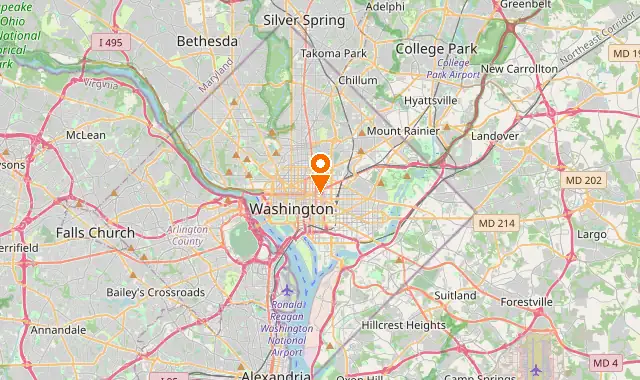
Local facts from Wikipedia and Wikidata, retrieved 2026-10-25. Population and area describe the city itself; the drain coverage counted on this page spans the wider area around it.
Combined sewers over the old third of the city, and Clean Rivers
About a third of Washington, roughly 33 percent, is served by a combined sewer system, concentrated in the older central parts of the District, while the rest drains through separate sanitary and storm systems. The combined third is where storm driven backups live. In heavy rain, and Washington averages 52.4 inches a year with about 10.4 heavy rain days, the shared pipe fills with stormwater faster than it can carry it away, pressure rises, and basement fixtures in that third of the city become the relief valves of a 19th century design decision.
DC Water's Clean Rivers programme is the generational answer, a system of deep tunnels and related work designed to capture combined sewer overflows before they reach the Anacostia and Potomac rivers and Rock Creek, and in doing so reduce the surcharging that drives backups. The tunnels change the odds materially in the areas they serve. They do not change the physics inside a single house, where a lateral below the level of a full street sewer remains a path water can travel, which is why the backwater valve programme runs alongside the tunnels rather than being replaced by them.
For an owner, the actionable fact is location. If your home sits in the combined sewer area, your backup risk has a weather component that owners in the separated districts largely escape, and backflow protection deserves a place in your planning that it does not need elsewhere. If you do not know which system serves your street, that is a question DC Water can answer, and it is worth asking before you finish a basement in the combined third of the District.
1958 median, rowhouses, and laterals that predate the tunnels by a century
The housing numbers give Washington an old core with a modern rim. Median year built 1958, 52.2 percent of the 361,014 housing units built before 1960, 16.8 percent from 1960 to 1979, and 23.9 percent after 2000. The pre 1960 majority is concentrated where the combined sewers are, which means the oldest laterals serve the highest risk drainage, clay and iron lines that have been jointed, rooted, and repaired in sections for generations. A Washington rowhouse lateral often carries a repair history as layered as the house itself.
Only 32.7 percent of homes are single family detached, and much of that count is itself attached in practice, rowhouses with party walls. Rowhouse drainage has neighbour physics: a shared street, similar elevations, and laterals laid in the same era to the same main. When one house on the row backs up in a storm, the information is relevant to every house on the row, because their exposure is built from the same materials in the same ground on the same slope. Owners on such rows who compare notes after a storm are not gossiping. They are pooling diagnostic data.
The post 2000 rim, nearly a quarter of the stock, drains through modern pipe into whichever system serves its street, and its problems are the usual contents problems. As in Atlanta and Dallas, the year built sorts Washington drain calls into two kinds before the first cable is loaded: pipe problems in the old core, content problems in the new rim, and a camera inspection, $125-$500, as the instrument that confirms which kind you actually have.
Moderately hard water and 73 freeze days: the supporting cast
Two environmental factors play supporting roles in Washington drainage. The first is water hardness. DC Water describes the District's water as moderately hard, typically around 70 to 120 parts per million, or 3 to 9 grains per gallon, with hardness peaking in the warmer months and easing in winter. At those levels, scale is a slow contributor rather than a leading cause: a gradual crust in water heaters, spotting on glassware in summer, and, inside an old iron drain, one more rough layer for grease to grip. It belongs in the diagnosis, below roots, grease and joint condition, but it is real enough that a contractor may note mixed buildup in an older line.
The second factor is winter. Washington averages 73 freeze days a year and 16.1 inches of snow, a genuine freeze season acting on pre 1960 pipes. The vent frost pattern appears here as it does further north: a cold snap narrows the roof vent, the system gurgles under load, and the symptom melts away with the thaw. Freeze and thaw also worry the shallowest joints over decades, though Washington's laterals, laid deep for a northern city, feel this less than the soil movement cities further south.
Neither factor should be allowed to explain away a persistent symptom. Hardness at 70 to 120 ppm does not block a drain in a season, and a vent does not stay frosted in April. A Washington drain that is slow in May has a pipe or contents problem, and the seasonal suspects, politely considered and set aside, are how a good diagnostic conversation starts rather than where it ends.
Finishing a basement in the combined area: questions in the right order
Washington's rowhouses invite a particular ambition: the finished basement, dug out or dressed up into the extra living space the upper floors cannot offer. In the combined sewer third of the District, that ambition should begin with drain questions rather than flooring samples, because the lowest room in the house is also the room the sewer visits when it visits. The order of questions matters. Which system serves this street, combined or separate? Has this house ever taken a backup, and is that event documented anywhere? What condition is the lateral in, on camera, this decade? And is a backwater valve present, planned, or eligible for the rebate?
Those questions are not pessimism. They are the difference between a basement designed around its risks and a basement surprised by them. A finished room planned with a backwater valve in the lateral, fixtures chosen with the surcharge level in mind, flooring and storage that assume water is possible even when it is unlikely, costs marginally more at renovation time than the naive version. It costs dramatically less than the naive version after its first storm, when the renovation is redone around lessons that were available, cheaply, in advance.
The District, to its credit, has priced its side of this conversation. Between the emergency line that establishes whether a backup is public or private, the rebate that can carry a backwater valve up to 6,000 dollars for an eligible owner, and a Clean Rivers programme reducing the surcharge itself, Washington gives a basement renovator more institutional support than any city in this set. The support only works in sequence, though. Ask the drain questions first, claim what the house qualifies for, and then finish the basement, in that order, and the room below a 1920s rowhouse becomes an asset with its risks managed rather than a wager against the next heavy rain day.
Washington pricing, with a rebate in the background
Standard ranges apply. A single line cleaning runs $99-$450, main line cleaning $200-$650, sewer line cleaning $250-$900, hydro jetting $300-$900, a camera inspection $125-$500, and an emergency visit $150-$700. Washington's older core pushes work toward the upper ends through longer diagnosis and root or repair findings, while the newer rim prices like the young suburbs it resembles. Any backwater valve installation is a separate scope, priced by the plumber, and it is the one job in this document where a public programme can erase most or all of an eligible owner's cost.
DrainFlowed is a connection service, not DC Water and not a contractor. For an active backup, your first call is the DC Water emergency line so the main gets checked. For the drain work itself, call (866) 555-0134, describe the pattern and any storm link, and you will be connected with an independent local contractor. Verify their licence, in the District the lateral work calls for a registered master plumber, and insurance, and agree the range before work begins.
The Washington sequence, assembled, is unusually well signposted for a homeowner willing to follow it. Report backups so they are documented. Keep the lateral maintained because the rules assign it to you. Camera the line when symptoms recur. And if you are in the combined area with a documented backup behind you, claim the protection the District has already budgeted for, before the next 10 heavy rain days arrive on schedule.
Drain services available in Washington
The services that answer Washington's lead problems, from the independent contractors who cover the city. Ranges are the national typical ranges used across this site.
| Service | Typical range | What it is |
|---|---|---|
| Main Drain Cleaning | $200-$650 | When every drain in the house slows at once, the problem is the main line. |
| Sewer Line Cleaning | $250-$900 | The buried line from your house to the street: root cutting, scale removal and jetting, with camera proof of the pipe's condition.. |
| Hydro Jetting | $300-$900 | High-pressure water that scours pipe walls clean - the answer for grease, scale and lines that keep re-clogging after cabling.. |
| Sewer Camera Inspection | $125-$500 | See inside the pipe before you spend on the fix: roots, cracks, bellies and blockages located precisely, with footage to decide on.. |
| Emergency Drain Cleaning Service | $150-$700 | Sewage backing up, water rising, guests arriving: what counts as a drain emergency, what to do in the first ten minutes, and how the visit works.. |
Full detail on every service, with signs and causes, is on the services hub, and every range on the site is collected in the cost guide.
Washington coverage snapshot
Nearby covered cities: see the state list below.
Washington sewer and water resources
The city and utility pages this page's local facts rest on, worth bookmarking if you own a home in Washington:
Sources for this page
- housing age and mix: Median year built 1958, 52.2 percent pre 1960, 23.9 percent post 2000, 32.7 percent single family, 361,014 units (source)
- climate: 52.4 in precipitation, 16.1 in snow, 73 freeze days, 10.4 heavy rain days per year (source)
- sewer lateral responsibility: If DC Water finds the main clear, the owner must hire a registered master plumber to clear the lateral at own expense; owner maintains the sewer service line (source)
- city programs and combined sewer: Backwater valve rebate of 100 percent up to 6,000 dollars for eligible owners in the combined sewer area with a documented backup since 2012, and for those affected by the September 10, 2020 storm (source)
- water hardness: Moderately hard, typically 70 to 120 ppm or 3 to 9 grains per gallon, peaking in warmer months, per DC Water (source)
- Housing age: median year built and build-era shares (US Census Bureau ACS)
- Weather averages: 2014-2023 daily record (Open-Meteo archive, ERA5)
Coverage around Washington
Areas and neighbourhoods in and around Washington
Calls also come in from Washington Navy Yard and the streets between them. Those areas sit inside the same coverage, on the same contractor rounds.
Washington Navy Yard
Nearby cities we cover in District of Columbia
The full list for the state is on the District of Columbia locations page.
Beyond Washington
Coverage at this depth continues nearby: see drain cleaning in Atlanta, GA and drain cleaning in Boston, MA, each written from its own city's data the same way this page is.
Questions, answered
Who pays when my sewer lateral clogs in Washington?
DC Water's own guidance: if DC Water determines the main sewer is clear, you hire a registered master plumber to clear the sewer lateral at your own expense, and the property owner is required to maintain the sewer service line and remove clogs in the lateral. Call the emergency line on (202) 612-3400 first so the main gets checked.
How does the DC Water backwater valve rebate work?
DC Water reimburses eligible residents with a documented sewer backup up to 6,000, dollars at 100 percent of cost, for purchase and installation of a backwater valve. Eligibility covers owners in the combined sewer area with a documented backup since 2012 and those affected by the September 10, 2020 storm. A DC permit and a licensed master plumber are required for the valve work.
Does Washington have combined sewers?
About a third of the District, roughly 33 percent, is served by combined sewers under DC Water's Clean Rivers programme, concentrated in the older parts of the city. In heavy rain the combined system can surcharge toward basement fixtures, which is why the backwater valve programme exists and why its eligibility is tied to combined sewer areas.
Is DC water hard?
Moderately. DC Water puts typical hardness at about 70 to 120 parts per million, or 3 to 9 grains per gallon, peaking in warmer months. Expect light scale in water heaters and on fixtures over time, enough to roughen an older drain line gradually, but grease, roots and pipe age remain the bigger local causes.
How much does drain cleaning cost in Washington?
A single line runs $99-$450, main line cleaning $200-$650, sewer line cleaning $250-$900, and a camera inspection $125-$500. A backwater valve installation is a separate job, and for eligible owners the DC Water rebate can cover it up to 6,000, dollars which changes the decision completely.
My drains gurgle in winter. Should I be worried?
With 73 freeze days a year, a vent terminal can frost and make drains gurgle in a cold snap, clearing with the thaw. Persistent slowness, or gurgling with slow fixtures in mild weather, is not the vent. It is the line, and in a stock where 52.2 percent of homes predate 1960, the line has earned a camera look.
Drain problem in Washington? Make the call
A live person answers around the clock. Describe the problem, hear the likely range, and get an independent local contractor on the way.
(866) 555-0134 Tap to call nowA live person answers, day or night. Describe the problem, hear the likely range, then decide.