
Drain cleaning in Houston, TX - Harris County - 247 ZIP codes covered
Drain Cleaning in Houston, TX
Houston receives more rain than any city in this set, 68.2 inches a year on average, with about 16.3 heavy rain days, and it spreads that water across flat ground and slab built homes. The stock is younger than the northern flagships, median year built 1982, but youth has its own catch: some 30.3 percent of homes date from 1960 to 1979, old enough for their buried lines to have been worked on by decades of soil movement, while almost half the city, 47.6 percent, lives in single family homes whose entire drain system sits under or beyond a concrete slab. There is no basement to inspect from and no frost to blame. There is water, soil, and time. DrainFlowed connects you with an independent local contractor. Call (866) 555-0134.
68.2 inches of rain, and a sewer system under a consent decree
Begin with the number that organises everything else on this page. Houston's ten year climate average is 68.2 inches of precipitation a year, the highest in this flagship set, delivered in part through about 16.3 heavy rain days. That volume of water does not just fall on roofs and streets. It saturates the soil around every buried lateral, finds the open joints in older lines, and enters the sanitary system as extra flow the system was never sized to carry on a dry day.
The city scale consequence has a legal name Houston homeowners have heard for years: sanitary sewer overflows. Houston's wastewater system operates under a federal consent decree, a court monitored programme of repairs and capacity work intended to reduce the spills and backups that heavy rain triggers across the network. Bayou City Waterkeeper, which tracks the decree, defines the everyday version plainly: a sewer backup is an overflow that comes home, sewage reversing through pipes to surface in toilets and drains.
For an individual house, the decree matters mostly as context. The city is fixing its mains on a schedule measured in years. Your lateral is fixed on your schedule, and a line that is already restricted is the weakest point in the chain on the day the neighbourhood system runs full. The consent decree is a reason to keep your own pipe in the best condition you can, not a reason to wait for the city's programme to reach your street.
Drain problems we handle in Houston
The problems Houston's own housing, ground and weather produce most. The full symptom list is on the problems hub; these are the ones that earn their place here.
Multiple Drains Backing Up in Houston
Several drains failing together is the main line or sewer until proven otherwise. Stop the water, protect the floor, make the call..
Standing Water in Houston
Water that will not go down has a blockage at a specific level. Which level decides whether it is a quick clean or a main-line job..
Recurring Clogs in Houston
A clog that returns is not bad luck. It is an undiagnosed cause - roots, scale, a belly, or a cleaning that never removed the material..
Slow Drain in Houston
One slow fixture is a narrowing pipe. Several slow fixtures are a main-line warning. How to tell the difference and what fixes each..
The split at the right of way, and the slab that hides everything
Houston's responsibility rule follows the pattern most Texas homeowners meet. The sewer lateral is the pipe carrying sewage from your building's plumbing to the city's sanitary system, and when the portion of that lateral on private property breaks, the property owner is responsible for the repairs, which Bayou City Waterkeeper notes can be costly. The city's maintenance responsibility covers its mains and the service within the public right of way. Where a blockage sits therefore decides whose bill it is, and a camera with a distance counter is how that location gets proven rather than argued about.
What makes Houston's version of this rule harder to live with is the slab. With 47.6 percent of homes single family and the great majority of those built on slab foundations, there is no basement or crawl space from which to see the main line, spot a leak, or reach a fitting. The first visible sign of a below slab drain problem is usually a symptom at a fixture: a shower that drains slowly, a toilet that gurgles when the washer empties, or, in the bad version, water arriving where no water should be.
That invisibility changes good practice. Houston slab owners benefit more than most from knowing where their cleanouts are, there are typically access points outside the home, and from treating a camera inspection, $125-$500, as the standard diagnostic step for any recurring problem rather than an optional extra. On a slab, guessing is expensive, because the repair options divide sharply between work done through a cleanout and work that involves the floor.
About Houston: the local snapshot
Houston is the most populous city in the U.S. state of Texas and the Southern United States.
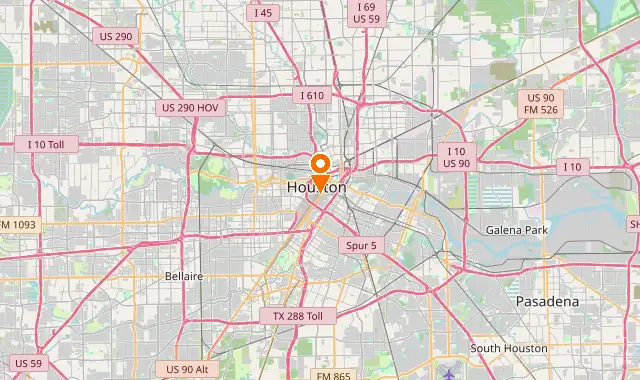
Local facts from Wikipedia and Wikidata, retrieved 2026-10-25. Population and area describe the city itself; the drain coverage counted on this page spans the wider area around it.
A 1982 median, a 1960 to 1979 bulge, and moving ground
Houston's housing stock is not old in the Boston sense, but it is old in the specific places that matter for drains. Only 16.7 percent of homes predate 1960, yet 30.3 percent were built between 1960 and 1979, which puts close to half the city past the forty year mark. The buried lines under that bulge were laid in an era of cast iron and clay, in soil that does not sit still. Houston's ground shifts with moisture cycles, swelling in wet periods and shrinking in dry ones, and rigid pipe joints are the part of the system least able to follow that movement.
The failure mode this produces is gradual and recognisable. A joint opens a fraction. Roots, drawn by the moisture escaping there, enter and thicken. The line still drains, but it catches paper at the root net and slows a little more each season. Homeowners describe it as a house that clogs more than it used to, and they are right, literally: the pipe they have now is narrower and rougher than the pipe the house was built with.
Newer Houston stock, the 30.4 percent built after 2000, mostly drains through plastic pipe that shrugs off joint movement and root entry far better. So Houston drain trouble, like Miami's, clusters by era. If your home sits in the 1960 to 1979 bulge and your clogs are recurring, the working assumption until a camera proves otherwise is that the line itself has changed, and the fix should be aimed at the line, not at another pass of the same cable.
The consent decree context deserves one household level translation. A city system being rebuilt under court supervision is a system whose weaknesses are documented and scheduled, not hidden, and Houston homeowners can use that honesty. Overflow records and the city's own reporting describe, in general terms, where the network struggles in heavy rain. A homeowner whose line is sound but whose street sits in a known surcharge area has a different risk profile from one whose backups trace to their own roots, and the responses differ too: backflow protection and wet weather discipline for the first, cleaning and joint repair for the second. The camera distinguishes them, because it shows whether your pipe contributed to the event or merely received it. That distinction, established once, is the foundation of every sensible Houston drain plan, and it cannot be established from the bathroom floor during the storm itself.
Six freeze days: the winter excuse does not work here
Houston averages six freeze days a year and 0.4 inches of snow. The famous exception, the February 2021 freeze, is remembered precisely because it was an exception, a supply pipe catastrophe rather than a drain event. For drains specifically, cold is a footnote in this city. Vents do not frost shut for weeks, traps do not freeze in unheated basements that mostly do not exist, and the soil does not heave on a northern cycle.
Removing winter from the suspect list clarifies Houston diagnosis. A slow drain here is buildup, roots, a sag, or a break, in some order, and all four are visible on a camera. Gurgling is air displaced by a restriction or, on septic fringe properties, a tank issue, not a frozen vent. Odors are a dry trap in a little used guest bath, a sludge layer, or a venting fault, not a seasonal effect that spring will cure.
The climate pressure in Houston is hydraulic instead. Sixteen heavy rain days a year test every marginal line repeatedly, which means Houston homeowners get more frequent, and therefore earlier, warnings than owners in drier cities. A line that backs up in a storm in March and again in June is not unlucky. It is measured. The interval between those warnings is the window in which a planned cleaning or repair, at daytime prices, is available.
Reading a Houston drain problem: fixture, house, or weather
Three patterns cover most Houston calls, and separating them before you pick up the phone sharpens everything that follows. Pattern one is a single slow fixture in an otherwise healthy house. That is a branch line problem, hair in a bathroom, grease in a kitchen, lint in a laundry line, and it is the cheapest job in the trade at $99-$450. Pattern two is several fixtures misbehaving together, with the lowest shower or tub showing water first. On a slab that is a main line restriction until proven otherwise, and it is urgent in the specific sense that the next load of laundry has nowhere to go.
Pattern three is the Houston signature: the system behaves until it rains hard, then backs up, gurgles, or drains slowly for a day, then recovers. That timing points away from anything inside the house and toward the buried line, groundwater entering at bad joints, a partial restriction with no storm margin, or a city side surcharge on a bad day. Pattern three is the one homeowners most often misread as bad luck, and it is the one a camera inspection answers most completely.
Whichever pattern you have, the contractor you reach through DrainFlowed will work it the same way: establish which lines are affected, clear through the proper cleanout, and, when the pattern suggests the pipe rather than its contents, run the camera and show you the finding. What you do with the finding, clean on an interval or repair the section, is then a decision made with the pipe's actual condition in front of you.
Finding the cleanouts on a slab home before you need them
On a slab foundation, the humble cleanout does the work a basement does in northern houses. It is the access point through which cables and cameras reach the main line, and Houston homes typically have them outside, near the foundation, sometimes in a flower bed, sometimes buried by years of landscaping or hidden under a deck. Owners who have never located theirs are in the majority, right up until the night a backup makes the location the most important fact in the world and the search happens by flashlight in the rain.
The dry weather version of that search takes ten minutes with a contractor on site for any reason, or a little longer alone with a probe and patience. Cleanouts are usually found along the line of the home's main bathroom wall, in line with where the sewer leaves the house toward the street. Once found, the cap should be checked: a cracked or missing cap admits soil, roots and storm runoff into the line and slowly buries the access it was meant to protect. Marking the spot, in a photo, a note in the house file, or a discreet marker in the bed, is a permanent gift to every future visit.
There is a second access question worth settling in calm weather, which is whether your home's line can be reached at full size at all. Older homes occasionally present only small or awkward access, and jobs that must be worked through a pulled toilet or a roof vent cost more and clean less completely than jobs run through a proper ground level cleanout. If a camera inspection is in your plans anyway, ask the contractor to report on access as part of the findings. In Houston's slab stock, improving access once is often the cheapest upgrade available to every drain job that follows it.
Houston pricing, and why planned beats flooded here
The ranges are the standard ones. Standard drain cleaning runs $99-$450, main line cleaning $200-$650, sewer line cleaning $250-$900, hydro jetting $300-$900, a camera inspection $125-$500, and an emergency visit $150-$700. Houston jobs on older lines with root work drift toward the upper ends, and any repair involving a slab is quoted separately after diagnosis, because the scope depends entirely on where the failure sits and what access exists.
DrainFlowed is a connection service, not the contractor who will do the work. Call (866) 555-0134, describe the pattern, single fixture, whole house, or rain linked, and the era of the home, and you will be connected with an independent local contractor. Verify their licence and insurance, agree the price range before work starts, and ask whether the camera is included when the problem is recurring, because in this city it usually should be.
The closing arithmetic is Houston specific. A sewage backup inside a basement home is miserable; inside a slab home it spreads across living floors with no lower level to sacrifice. Against that outcome, the planned versions of every service on this page, booked in dry weather at standard ranges, are inexpensive. Houston gives its homeowners frequent warnings and long wet seasons to act in. The expensive choice here is rarely the repair. It is the third warning ignored.
Drain services available in Houston
The services that answer Houston's lead problems, from the independent contractors who cover the city. Ranges are the national typical ranges used across this site.
| Service | Typical range | What it is |
|---|---|---|
| Drain Cleaning | $99-$450 | The core service: mechanical cleaning that clears the clog and scrapes the pipe walls, not just a hole poked through the blockage.. |
| Main Drain Cleaning | $200-$650 | When every drain in the house slows at once, the problem is the main line. |
| Sewer Line Cleaning | $250-$900 | The buried line from your house to the street: root cutting, scale removal and jetting, with camera proof of the pipe's condition.. |
| Sewer Camera Inspection | $125-$500 | See inside the pipe before you spend on the fix: roots, cracks, bellies and blockages located precisely, with footage to decide on.. |
| Floor Drain Cleaning | $110-$450 | Basement, laundry and garage floor drains: the house's safety valve, cleaned and trap-checked before it is needed in a flood.. |
| Emergency Drain Cleaning Service | $150-$700 | Sewage backing up, water rising, guests arriving: what counts as a drain emergency, what to do in the first ten minutes, and how the visit works.. |
Full detail on every service, with signs and causes, is on the services hub, and every range on the site is collected in the cost guide.
Houston coverage snapshot
Nearby covered cities: Channelview, Spring, Baytown, Pasadena.
Houston sewer and water resources
The city and utility pages this page's local facts rest on, worth bookmarking if you own a home in Houston:
Sources for this page
- housing age and mix: Median year built 1982, 16.7 percent pre 1960, 30.3 percent built 1960 to 1979, 47.6 percent single family, 1,040,576 units (source)
- climate: 68.2 in annual precipitation, 16.3 heavy rain days, 6 freeze days, 0.4 in snow per year (source)
- sewer lateral responsibility: Property owner is responsible for repairs when the portion of the sewer lateral on private property breaks; Houston system operates under a federal consent decree on sewer overflows (source)
- Housing age: median year built and build-era shares (US Census Bureau ACS)
- Weather averages: 2014-2023 daily record (Open-Meteo archive, ERA5)
Coverage around Houston
Areas and neighbourhoods in and around Houston
Calls also come in from Alief, Huffman, Kingwood, North Houston and the streets between them. Those areas sit inside the same coverage, on the same contractor rounds.
AliefHuffmanKingwoodNorth Houston
Nearby cities we cover in Texas
- Drain cleaning in Channelview, TX
- Drain cleaning in Spring, TX
- Drain cleaning in Baytown, TX
- Drain cleaning in Pasadena, TX
- Drain cleaning in Dallas, TX
- Drain cleaning in San Antonio, TX
- Drain cleaning in Austin, TX
- Drain cleaning in Fort Worth, TX
The full list for the state is on the Texas locations page.
Beyond Houston
Coverage at this depth continues nearby: see drain cleaning in Dallas, TX and drain cleaning in San Antonio, TX, each written from its own city's data the same way this page is.
Questions, answered
Who is responsible for my sewer lateral in Houston?
The portion on your private property is yours. Bayou City Waterkeeper's sewer guide, summarising Houston's system, puts it plainly: when the part of the lateral on private property breaks, the property owner pays for repairs. The portion in the city right of way is the city's side of the maintenance split.
Why does my drain back up mainly when it rains hard?
Usually restriction plus volume. Houston averages 68.2 inches of rain a year with about 16.3 heavy rain days. A line narrowed by roots or scale copes until a storm adds groundwater through bad joints and pushes it over the edge. A backup with a weather pattern is a camera diagnosis, at $125-$500, not just a cleaning.
Could roots be causing my recurring clogs in Houston?
It is the likeliest suspect in this stock. Some 30.3 percent of Houston homes date from 1960 to 1979 and ground movement stresses their joints, while mature trees over the line supply the roots. Recurring clogs on a shortening cycle mean the cause survived the last cleaning. Jetting at $300-$900 plus a camera look settles it.
Does a slab foundation change how drain work is done?
It can. Houston slab homes have no basement plumbing to inspect from below, so most drain access is through cleanouts and fixture traps, and a below slab problem is located with a camera and leak detection rather than by eye. Tell the contractor the house is on a slab when you call so the right equipment comes on the truck.
How much does drain cleaning cost in Houston?
A single line runs $99-$450. Main line cleaning is $200-$650, sewer line cleaning $250-$900, and emergency work $150-$700. In Houston the honest comparison is with the cost of a sewage backup inside a slab home, where there is no basement to contain it, which is why early cleaning here is cheap insurance.
Several drains are backing up at once. What should I do?
Stop adding water and call the same day. On a slab, wastewater that cannot leave has no low basement fixture to pool in, so it arrives in showers, tubs and across floors at living level. Limit flushing and laundry, keep children and pets clear of affected rooms, and describe the whole house pattern when you call (866) 555-0134.
Drain problem in Houston? Make the call
A live person answers around the clock. Describe the problem, hear the likely range, and get an independent local contractor on the way.
(866) 555-0134 Tap to call nowA live person answers, day or night. Describe the problem, hear the likely range, then decide.