Drain cleaning in San Antonio, TX - Bexar County - 166 ZIP codes covered
Drain Cleaning in San Antonio, TX
San Antonio drains run over limestone, under slabs, and through weather that arrives all at once. The San Antonio Water System draws its supply from groundwater, with the Edwards Aquifer at the center of its system, and the same limestone country that holds that aquifer shapes excavation, drainage and pipe bedding across the city. Housing here is younger than the old industrial cities: median build year 1985, about 30.6 percent of homes from after 2000, and a large 61.1 percent single family share across roughly 612,901 units. Rain averages about 38.7 inches a year but concentrates into roughly 7.8 heavy rain days, the Central Texas pattern of long dry spells broken by intense storms. The San Antonio drain story is therefore a story of hard ground, slab construction with few second chances, and private laterals that belong entirely to the homeowner once they leave the public right of way.
Your lateral, the right of way line and SAWS
San Antonio draws a clean boundary. The city side maintains the sanitary sewer service within the public right of way or sewer easement, and the property owner maintains the service from that right of way or easement boundary to the structure. Everything on the house side of the line, which on most lots is most of the pipe, is private infrastructure with a private repair bill attached. Sewer emergencies involving mains or breaks in the public system go to the San Antonio Water System around the clock, while plumbing problems on private property are the owner responsibility to arrange and fund.
That boundary is worth locating before an emergency locates it for you. The cleanout, usually near the front of the house or at the property line, is the access point every future job will use. In slab neighborhoods the cleanout may be the only practical entry to the main run, because indoor access can mean pulling fixtures. Knowing where yours sits, and keeping it uncovered by landscaping and hardscape, is the cheapest preparation a San Antonio owner can make.
When several drains misbehave at once, work the boundary logic in order. Stop using water, check whether neighbors share the problem, and report a suspected public main issue to SAWS. If the problem is yours alone, it almost certainly sits on your side of the line, and an independent contractor with a camera is the next call. The measurement habit saves the argument: footage plus distance tells everyone which side of the easement the defect calls home.
Military families and the steady churn of a large service economy give San Antonio a particular drain pattern: homes that change occupants often, with each household inheriting an undocumented lateral. Landlords here should treat a camera pass at turnover the way they treat a lock change, as routine preparation that prevents disputes. A tenant cannot be blamed fairly for a root mass that predates the lease, and an owner cannot budget for a line nobody has seen. The footage settles both questions before they become arguments, which is worth more than its cost in a high turnover market.
Drain problems we handle in San Antonio
The problems San Antonio's own housing, ground and weather produce most. The full symptom list is on the problems hub; these are the ones that earn their place here.
Slow Drain in San Antonio
One slow fixture is a narrowing pipe. Several slow fixtures are a main-line warning. How to tell the difference and what fixes each..
Multiple Drains Backing Up in San Antonio
Several drains failing together is the main line or sewer until proven otherwise. Stop the water, protect the floor, make the call..
Standing Water in San Antonio
Water that will not go down has a blockage at a specific level. Which level decides whether it is a quick clean or a main-line job..
Limestone country: hard digging and honest pricing
Much of San Antonio sits on or near limestone. For drain work that fact is not scenery, it is a line item. Excavating a failed lateral through rocky ground takes longer, wears equipment harder and produces fewer options for hand digging than the same job in soft soil. Contractors price that reality into excavation work, which is why a San Antonio owner should be suspicious of any underground quote given without a camera pass and a depth measurement first. The unseen variables here, depth, rock and route, are exactly the ones that move price.
The same geology rewards trenchless thinking. Where a line has sound structure with root intrusion or joint problems, jetting and mechanical cleaning restore it without touching the ground above. Where a section has failed, methods that minimize excavation deserve a serious hearing before open digging, especially when the route crosses driveways, patios or mature landscaping that cost real money to replace. Ask any bidding contractor to price the least invasive method that the footage supports, and to say plainly if the pipe condition rules it out.
Slab construction raises the stakes further. A large share of San Antonio homes sit on slabs, with drain lines cast beneath concrete that nobody wants to open. A problem located under the slab is a different project from the same problem located in the yard, in cost, in disruption and in the case for trenchless or rerouting options. This is the strongest argument in this city for filming a line at the first repeat symptom rather than the fifth: information is cheap while the pipe is still a pipe, and very expensive once the only remaining route runs through a floor.
Heat deserves its paragraph in a South Texas drain page. Months of high temperatures dry the ground, and drying ground in this region shrinks and settles away from pipes it supported in wetter months. Joints that were tight in spring can stand open by September, ready to admit roots hunting the moisture your line carries through a dry landscape. That seasonal cycle is why a San Antonio line can pass a spring inspection and clog by fall without any change in household behavior. The pipe environment changed around it, on a schedule the climate repeats every year.
About San Antonio: the local snapshot
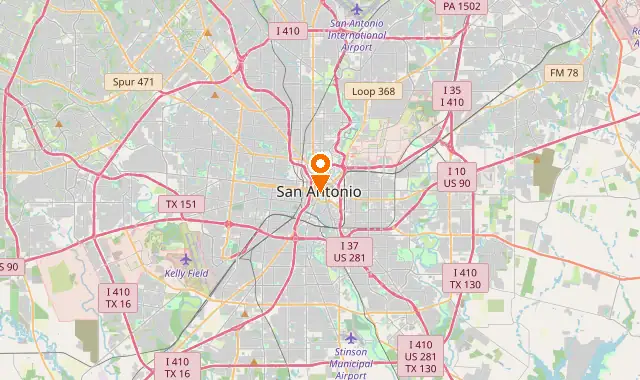
Local facts from Wikipedia and Wikidata, retrieved 2026-10-25. Population and area describe the city itself; the drain coverage counted on this page spans the wider area around it.
A younger housing stock entering its repair years
San Antonio median home was built in 1985, with about 19.4 percent of homes predating 1960, 23.2 percent from 1960 to 1979 and 30.6 percent built after 2000. Read as pipe ages, the city is a wave: the pre 1980 stock is now deep into the years when original materials reach their limits, the large 1980s and 1990s tracts are entering the window where joints, roots and ground movement start their work, and the post 2000 homes mostly face use related clogs rather than age related failure.
Across roughly 612,901 housing units and a population of 1,434,625 in the 2020 census count, that wave means San Antonio drain demand is rising on schedule rather than spiking at random. Owners of 1980s and 1990s homes in particular should retire the assumption that their underground lines are still new. They are middle aged infrastructure in hard ground, and a first camera inspection in the $125-$500 range at this stage buys a baseline while every option, cleaning, jetting, spot repair, is still on the table.
Growth adds one more wrinkle. Newer subdivisions at the city edge sometimes tie into the system with long private runs and shared elements in multi unit developments. If you buy in a newer community, learn exactly where your private responsibility ends and any association or public responsibility begins, in writing, before a backup turns that paperwork question into a midnight negotiation.
New construction is not exempt from local lessons. Fast building on the city edges sometimes leaves owners with long runs, multiple turns and cleanouts buried by final landscaping before the first occupant arrives. If your home is new and drains misbehave early, suspect installation and access questions before age questions, and use the builder warranty window while it exists. Filming a new line that performs badly is not confrontational. It is how a defect gets documented inside the period when someone else still owns the cost of fixing it.
Dry for weeks, then the sky empties: storm behaviour
San Antonio averages about 38.7 inches of rain a year, a moderate total delivered in an immoderate style: roughly 7.8 heavy rain days, long dry intervals and intense Central Texas storms. Freeze days are few, about 6 a year, and snow is a curiosity at 0.6 inches. Drains here are therefore not stressed by constant volume. They are stressed by sudden volume arriving at ground that sheds water quickly and at lines that may have spent months carrying only household flow.
The household translation is that capacity margin matters more than average capacity. A lateral narrowed by roots or buildup handles laundry day without complaint, then fails during the first big storm when infiltration through old joints adds groundwater to the flow and the whole neighborhood system is working hardest. The symptom pattern gives it away: fine in dry weather, backing up in storms. That pattern is diagnostic information, and it points at joints and capacity rather than at anything your household did that week.
Standing water complaints follow the same logic after storms, when saturated ground and overwhelmed drainage leave fixtures slow for hours. Before paying for a second emergency visit, get the line filmed in dry weather and compare. The dry weather footage is the truth about your pipe. The storm behaviour is the truth about how much margin that pipe has left, and in San Antonio margin is what the weather tests.
Water conservation, a genuine civic strength in San Antonio, carries one drain side effect worth knowing. Low flow fixtures move less water per use, and less water carries solids less forcefully through long or gently sloped runs. In an older line with any sag, that can mean more settling between uses. The answer is not to waste water. It is to keep marginal lines cleaner on a schedule, run full loads where appliances allow, and treat a slow drain in a water wise home as a slope or sag question for the camera, not a mystery.
Edwards Aquifer water and what it means indoors
The San Antonio Water System reports that its water originates as groundwater, with the Edwards Aquifer the cornerstone supply among a diversified portfolio it has built since 1999. Water drawn through limestone country carries the character of that rock. This page deliberately does not print a single hardness number for San Antonio, because the utility current published water quality report does not state one in a form verified for this page, and DrainFlowed does not fill gaps with borrowed figures. What can be said honestly is that owners here widely deal with mineral character in their water, and that any softening or treatment decision should start from a test of your own tap rather than a number on a website.
For drains specifically, the everyday drivers remain the unglamorous ones: cooking grease cooled in kitchen lines, hair and soap in bathroom runs, and products marketed as flushable that do not disperse the way toilet paper does. Those causes respond to mechanical cleaning in the $99-$450 standard range and to habit changes that cost nothing. Where a home has both recurring buildup and ageing pipe, hydro jetting in the $300-$900 range scours the line back to its wall and, paired with a camera, separates a dirty pipe from a dying one.
Treat any contractor who diagnoses your water or your pipes without testing or filming as a storyteller. The good ones in this market reach for instruments first, because limestone country punishes guesses underground and slab floors punish them indoors. Evidence first is not a slogan here. It is the local economics of rock and concrete.
Garages and additions create a San Antonio specific trap: converted spaces plumbed into existing runs that were sized for the original house. An added bathroom or laundry at the far end of the system loads the same lateral harder and complains first when capacity shrinks. If problems concentrate in the converted space, the diagnosis may be arithmetic rather than breakage: more fixtures than the old line happily serves. An honest contractor will say so, and will price relief options, from cleaning rhythm to rerouting, instead of selling a repair for a pipe that is intact.
San Antonio costs, ranges and getting connected
Published ranges for private work are standard drain cleaning $99-$450, main line cleaning $200-$650, sewer line cleaning $250-$900, hydro jetting $300-$900, camera inspection $125-$500 and emergency service $150-$700. Excavation through rock, work under slabs and long private runs can push a repair scope beyond cleaning ranges entirely, which is why repair pricing follows the camera and is agreed in writing before ground opens. Anyone offering a fixed underground price sight unseen is transferring the risk of the unknown to you, priced in their favor.
DrainFlowed is a connection service, not the contractor. It connects San Antonio homeowners with independent local businesses who perform, warrant and price their own work. Verify license and insurance, confirm where your private responsibility boundary sits for the job at hand, and keep the inspection footage. Call (866) 555-0134 to get connected, and mention slab construction, storm linked symptoms or a suspected under slab problem when you call, because each detail routes you to the right kind of crew and equipment the first time.
If raw sewage is surfacing outdoors or the problem clearly involves the street, report it to SAWS as a water and sewer emergency as well. Public main events are the utility problem to solve, and prompt reports help it map failures across a fast growing system. Private and public, the pattern that serves San Antonio owners best is constant: locate the problem, prove which side of the line it is on, then spend money once, in the right place.
Finally, keep perspective on emergencies. A single clogged kitchen line on a Tuesday is a scheduling problem, priced in the standard range. Sewage at a floor drain, multiple fixtures down or any surfacing outdoors is a stop using water problem, priced in the emergency range and timed in hours. Knowing which of those two situations you are in, before you call, keeps panic out of the transaction and money in your pocket. Describe symptoms plainly when you call (866) 555-0134, and let the description, not the fear, set the response.
Drain services available in San Antonio
The services that answer San Antonio's lead problems, from the independent contractors who cover the city. Ranges are the national typical ranges used across this site.
| Service | Typical range | What it is |
|---|---|---|
| Drain Cleaning | $99-$450 | The core service: mechanical cleaning that clears the clog and scrapes the pipe walls, not just a hole poked through the blockage.. |
| Clogged Drain Repair | $120-$550 | For the drain that is already blocked: diagnosis first, then the right fix, so the same clog does not come back next month.. |
| Main Line Cleaning | $200-$650 | When every drain in the house slows at once, the problem is the main line. |
| Sewer Line Cleaning | $250-$900 | The buried line from your house to the street: root cutting, scale removal and jetting, with camera proof of the pipe's condition.. |
| Floor Drain Cleaning | $110-$450 | Basement, laundry and garage floor drains: the house's safety valve, cleaned and trap-checked before it is needed in a flood.. |
| Emergency Drain Cleaning | $150-$700 | Sewage backing up, water rising, guests arriving: what counts as a drain emergency, what to do in the first ten minutes, and how the visit works.. |
Full detail on every service, with signs and causes, is on the services hub, and every range on the site is collected in the cost guide.
San Antonio coverage snapshot
Nearby covered cities: Schertz, Austin, Fort Worth, El Paso.
San Antonio sewer and water resources
The city and utility pages this page's local facts rest on, worth bookmarking if you own a home in San Antonio:
Sources for this page
- sewer lateral responsibility: Owner maintains sanitary sewer service from right of way or easement boundary to the structure; city maintains the service within the right of way or easement; private property plumbing problems are owner responsibility per SAWS guidance (source)
- local fact, water source: SAWS water originates as groundwater with the Edwards Aquifer as cornerstone supply in a diversified portfolio (SAWS water quality reporting) (source)
- water hardness: Omitted as a number. SAWS published report reviewed for this page does not state a hardness figure in verified form, so no figure is printed. (source)
- housing age: Median year built 1985, 19.4 percent pre 1960, 30.6 percent post 2000, 612901 housing units, 61.1 percent single family (ACS 2024 5-year) (source)
- climate: 38.7 in annual precipitation, 7.8 heavy rain days, 6 freeze days, 0.6 in snow (Open-Meteo ERA5 2014 to 2023) (source)
- Housing age: median year built and build-era shares (US Census Bureau ACS)
- Weather averages: 2014-2023 daily record (Open-Meteo archive, ERA5)
Coverage around San Antonio
Areas and neighbourhoods in and around San Antonio
Calls also come in from Jbsa Ft Sam Houston and the streets between them. Those areas sit inside the same coverage, on the same contractor rounds.
Jbsa Ft Sam Houston
Nearby cities we cover in Texas
- Drain cleaning in Schertz, TX
- Drain cleaning in Austin, TX
- Drain cleaning in Fort Worth, TX
- Drain cleaning in El Paso, TX
- Drain cleaning in Mcallen, TX
- Drain cleaning in Denton, TX
- Drain cleaning in Arlington, TX
- Drain cleaning in Houston, TX
The full list for the state is on the Texas locations page.
Beyond San Antonio
Coverage at this depth continues nearby: see drain cleaning in Austin, TX and drain cleaning in Dallas, TX, each written from its own city's data the same way this page is.
Questions, answered
Who is responsible for the sewer line at my San Antonio home?
The owner maintains the sanitary sewer service from the right of way or sewer easement boundary to the structure. The city side maintains the service within the right of way or easement. Plumbing problems on private property are the owner responsibility, while public main emergencies should be reported to SAWS.
How much does drain cleaning cost in San Antonio?
Standard cleaning typically runs $99-$450. Main line work runs $200-$650, sewer line work $250-$900, hydro jetting $300-$900, camera inspection $125-$500 and emergency service $150-$700. Rock excavation and under slab work are priced after inspection.
Why does my drain back up only during big storms?
San Antonio rain concentrates into about 7.8 heavy rain days a year. A narrowed or joint worn lateral copes in dry weather but not when storm infiltration adds load. Dry weather camera footage shows the narrowing or joint damage behind the pattern.
Does a slab foundation change drain repair in San Antonio?
Yes. Lines under a slab cost more to reach and disrupt more when opened, which strengthens the case for early camera diagnosis, cleaning or jetting while they still work, and trenchless options where footage supports them.
Is San Antonio water hard?
SAWS supply is groundwater centered on the Edwards Aquifer, drawn through limestone country. This page does not publish a hardness figure because the utility current report does not state one in a verified form here. Test your own tap before sizing any treatment equipment.
When should I call SAWS instead of a contractor?
When the problem looks public: sewage surfacing near the street, several neighbors affected at once, or a suspected main break. Private property plumbing problems are handled by an independent contractor, which DrainFlowed can connect you with at (866) 555-0134.
Drain problem in San Antonio? Make the call
A live person answers around the clock. Describe the problem, hear the likely range, and get an independent local contractor on the way.
(866) 555-0134 Tap to call nowA live person answers, day or night. Describe the problem, hear the likely range, then decide.