
Drain cleaning in Phoenix, AZ - Maricopa County - 118 ZIP codes covered
Drain Cleaning in Phoenix, AZ
Phoenix drains age under a particular combination: very hard water, slab foundations, and a housing stock that mostly went up after air conditioning made the desert buildable at scale. The median Phoenix home was built in 1985, and only 14.0 percent of homes predate 1960, so this is not an old clay pipe city. The enemy here is mineral scale. City of Phoenix water runs 172 to 302 mg/L of hardness, and that scale coats pipe walls year after year until a line that should carry a full tub drains like it is breathing through a straw. DrainFlowed connects you with an independent local contractor. Call (866) 555-0134 and describe which fixtures are slowing down.
Hard water is the main character in a Phoenix drain
Start with the water itself, because in Phoenix the water explains more drain trouble than the pipe does. The City of Phoenix 2025 Water Quality Report puts total hardness between 172 and 302 mg/L, roughly 10 to 17.6 grains per gallon. On the standard scale that range runs from hard to very hard. The supply is mostly surface water drawn from the Salt, Verde and Colorado river systems, and as it moves through desert geology it picks up the calcium and magnesium that later come out of solution inside your plumbing.
Scale does not block a drain in a season. It roughens the wall first, and a rough wall catches everything that a smooth wall would pass: grease film, soap residue, food particles, hair. Year by year the effective bore shrinks. Homeowners usually notice it at the shower, where water starts pooling around the ankles, or at a kitchen sink that burps and drains in a slow spiral. By the time a line is visibly slow, the coating behind it is usually well established, which is why a proper cleaning here focuses on scraping the wall back, not just punching a hole through the middle of the buildup.
Hardness also changes what a good maintenance conversation sounds like. A contractor who finds heavy scale should say so plainly, show you what came back on the cable, and talk about intervals rather than miracles. Water treatment at the house is a separate decision that belongs to you. What DrainFlowed handles is the connection: call (866) 555-0134, describe the fixture and the history, and you will be matched with an independent local contractor who can clean the line and tell you honestly what condition it is in.
Drain problems we handle in Phoenix
The problems Phoenix's own housing, ground and weather produce most. The full symptom list is on the problems hub; these are the ones that earn their place here.
Slow Drain in Phoenix
One slow fixture is a narrowing pipe. Several slow fixtures are a main-line warning. How to tell the difference and what fixes each..
Recurring Clogs in Phoenix
A clog that returns is not bad luck. It is an undiagnosed cause - roots, scale, a belly, or a cleaning that never removed the material..
Standing Water in Phoenix
Water that will not go down has a blockage at a specific level. Which level decides whether it is a quick clean or a main-line job..
A 1985 housing stock, mostly on slabs
Phoenix housing tells a growth story rather than a decay story. Of 653,065 housing units in the city, 27.6 percent were built between 1960 and 1979 and 27.8 percent after 2000, with a median year built of 1985. Single family homes make up 64.6 percent of the stock. Most of those homes sit on concrete slabs, which matters for drains in a specific way: the pipe runs under the slab are out of sight and out of easy reach, so a problem there announces itself through symptoms inside the house rather than through any visible sign in the yard.
The mixed ages create two different drain populations in one city. The post 2000 subdivisions mostly have plastic drain lines that resist scale adhesion better and rarely trouble anyone in their first decades. The 1960 to 1979 belt, now 45 to 65 years old, is where metal drain pipe, early plastics and decades of hard water meet. If your home falls in that band and a drain has slowed for the second time, treat the repeat as information. A camera inspection, in the $125-$500 range, shows whether you are looking at a cleanable coating or a pipe wall that is itself deteriorating.
Slab construction also raises the value of diagnosis before anyone talks about repair. Breaking into a slab is disruptive and expensive, and it should never be the first move for a slow drain. Cleaning through existing access, then a camera look if the symptoms justify it, resolves the large majority of Phoenix calls without anyone touching the floor. A contractor who proposes slab work before showing you footage is skipping the step that justifies it.
About Phoenix: the local snapshot
Phoenix is the capital and most populous city of the U.S. state of Arizona.
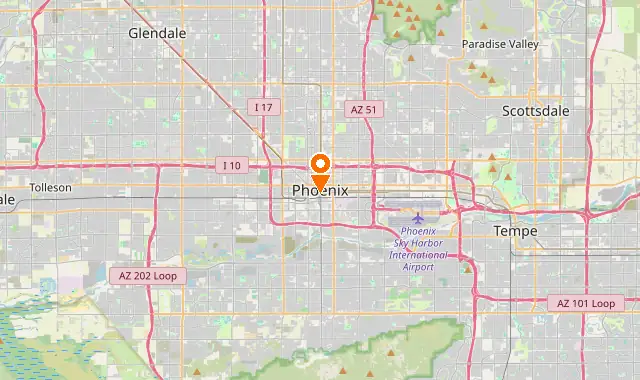
Local facts from Wikipedia and Wikidata, retrieved 2026-10-25. Population and area describe the city itself; the drain coverage counted on this page spans the wider area around it.
Who owns the pipe: Phoenix Code 28-5 and the right of way exception
Phoenix draws the responsibility line in its municipal code, and the line has a wrinkle worth knowing. Under Phoenix City Code Section 28-5(a), the property owner is responsible for cleaning, unstopping, maintenance and repair of the building connection piping from the home or building to the public sewer line. That is the default, and it covers the clogged, scaled and root troubled stretches that make up nearly every residential call.
The wrinkle is the exception written into the same section: repair or replacement of damaged or broken piping in the public right of way that serves a single family or duplex property is carved out of the owner obligation. Read carefully, that means a blockage anywhere is yours to clear, and a broken pipe on your own lot is yours to fix, but a physically broken section under the street or sidewalk serving a house or duplex may fall to the city. The distinction between a blockage and a break, and between your lot and the right of way, is exactly what a camera inspection establishes.
So the sequence in Phoenix is practical. Get the line cleaned and, if the problem recurs or the cable comes back with evidence of damage, get it televised. If that footage shows a break in the right of way serving a single family home, you have a code based conversation to have with the city before you pay to fix pipe that may not be yours. If it shows a break on your lot, the repair is yours, and you can plan it with evidence in hand instead of urgency doing the negotiating.
Eleven inches of rain, arriving in bursts
Phoenix averages only 11.5 inches of precipitation a year, with about 1.7 heavy rain days and just 2 freeze days on the ten year record. Drain trouble here is therefore rarely a storm sewer story. Roofs and streets are built to shed the occasional intense downpour, and the sanitary system is separate from storm drainage, so a summer cloudburst does not normally push sewage back toward houses the way it can in combined sewer cities.
What the dry climate does instead is concentrate household causes. With little rain to think about, the lines that fail in Phoenix fail from the inside: scale, grease, and the occasional root system that finds a joint because roots in a desert yard hunt for water wherever it runs, and a sewer line is the most reliable moisture in the ground. A tree planted for shade twenty years ago can be the reason a line slows every year at the same season, as roots thicken during the growing months.
The near absence of freezing weather removes one whole category of drain trouble that northern cities deal with, and replaces it with heat related neglect. Floor drains and little used guest bathrooms can go many months without a flush of water through their traps in an air conditioned house, and a dried trap lets sewer odor into the room. If a smell appears in a bathroom nobody uses, run water into every fixture in it and wait a day before assuming anything structural. That simple refill solves the most common odor call in this climate.
Reading the symptoms before you spend anything
Phoenix symptoms sort themselves cleanly once you know the local causes. One slow fixture, in a house where everything else runs fine, is a local restriction: a hair and soap mat in a bathroom branch, grease in a kitchen line, or scale narrowing that one run. Several fixtures slowing together, especially with gurgling when the washing machine drains, moves the suspicion downstream to the main line leaving the house, and that is a different job with different equipment.
Recurring clogs deserve special honesty in this city. Because scale regrows on a roughened wall at a predictable pace, a line that clogs again within months of a cleaning is telling you the cleaning did not restore the wall, or the wall can no longer be restored by cleaning. Hydro jetting, in the $300-$900 range, strips coating more completely than a cable alone and is often the right second step for a grease and scale line. If a jetted line still recurs quickly, the camera has the final word, and the conversation becomes about the pipe, not about another clearance.
Standing water in a single tub or sink is the end stage of the same narrowing, not a new disease. Bail what you can, skip chemical openers, which sit in the standing water as a corrosive puddle and do nothing to scale or a mature mat, and book the cleaning. The fixture is out of service until the material physically comes out of the pipe, and no product poured from a bottle changes that.
Access decides the invoice: cleanouts on a slab home
One unglamorous detail shapes a Phoenix drain bill more than homeowners expect: how the contractor gets into the line. On a slab home, the friendly route is a proper cleanout, an access cap at ground level outside or in a utility area that lets a cable or camera enter the main line in a straight run. The unfriendly routes are pulling a toilet to enter through its flange, or going onto the roof to work down a vent stack. All three can clear a line, but they differ in time, mess and what the contractor can actually see and reach once inside.
Phoenix housing makes this a real variable rather than a theoretical one. The post 2000 subdivisions, 27.8 percent of the stock, were generally built with accessible cleanouts placed for exactly this work. The 1960 to 1979 belt is mixed: some homes have them, some have them buried under landscaping or hardscape added decades later, and some never had a ground level cleanout at all. A contractor who asks about cleanouts on the booking call is not stalling. They are deciding what equipment to load and whether the visit starts with ten minutes of locating or none.
If your home lacks an accessible cleanout, a cleaning visit is the right moment to discuss adding one. It is a modest plumbing job compared with the work it serves, and it converts every future call, cleaning, camera or emergency, into a faster and cheaper event. It also protects the roof and the toilets from becoming plumbing access points, which neither was designed to be.
Whatever the access route, leave the visit with the cleanout location written down, and if a camera went in, with the footage or at least the findings noted. In a slab city, where the pipes themselves are entombed in concrete and memory fades faster than scale builds, those two scraps of information are the difference between a household that manages its drains and a household that rediscovers them, at emergency rates, once a decade.
What drain work costs in Phoenix, and how the call works
DrainFlowed publishes the same national ranges in every city, and Phoenix work sorts into them by scope. A standard drain cleaning typically runs $99-$450. Main line cleaning runs $200-$650, sewer line cleaning $250-$900, hydro jetting $300-$900, a camera inspection $125-$500, and an emergency visit $150-$700. A straightforward scale or hair job on one fixture sits low in its range. A main line that needs jetting and a camera sits higher, and you should hear the likely range on the first call once you describe the symptoms.
DrainFlowed is a connection service. It does not employ the contractor who comes to your door, and it does not set their final price. When you call (866) 555-0134, you describe the problem, you are connected with an independent local contractor, and you agree the price range with them before work starts. Verify their licence and insurance as you would with any contractor you hire, and ask the two questions that protect you in this city: what did you find in the line, and if it is scale, how long should this cleaning hold.
One Phoenix specific habit is worth adopting after the visit. Note the date and the finding somewhere you will keep. In a hard water city, drain history is a maintenance schedule in embryo: the interval between this cleaning and the first sign of the next slowdown tells you and any future contractor exactly how fast your lines coat, and planned cleanings at the low end of the range beat emergency calls at the high end every time.
Drain services available in Phoenix
The services that answer Phoenix's lead problems, from the independent contractors who cover the city. Ranges are the national typical ranges used across this site.
| Service | Typical range | What it is |
|---|---|---|
| Drain Cleaning | $99-$450 | The core service: mechanical cleaning that clears the clog and scrapes the pipe walls, not just a hole poked through the blockage.. |
| Clogged Drain Repair | $120-$550 | For the drain that is already blocked: diagnosis first, then the right fix, so the same clog does not come back next month.. |
| Hydro Jetting | $300-$900 | High-pressure water that scours pipe walls clean - the answer for grease, scale and lines that keep re-clogging after cabling.. |
| Drain Camera Inspection | $125-$500 | See inside the pipe before you spend on the fix: roots, cracks, bellies and blockages located precisely, with footage to decide on.. |
| Floor Drain Cleaning | $110-$450 | Basement, laundry and garage floor drains: the house's safety valve, cleaned and trap-checked before it is needed in a flood.. |
Full detail on every service, with signs and causes, is on the services hub, and every range on the site is collected in the cost guide.
Phoenix coverage snapshot
Nearby covered cities: Queen Creek, Avondale, Buckeye, Goodyear.
Phoenix sewer and water resources
The city and utility pages this page's local facts rest on, worth bookmarking if you own a home in Phoenix:
Sources for this page
- housing age and mix: Median year built 1985, 14.0 percent pre 1960, 27.6 percent built 1960 to 1979, 27.8 percent post 2000, 653,065 units, 64.6 percent single family (source)
- climate: 11.5 in annual precipitation, 0 in snow, 2 freeze days, 1.7 heavy rain days per year (2014 to 2023 average) (source)
- water hardness: Total hardness 172 to 302 mg/L (10 to 17.6 grains per gallon), hard to very hard, City of Phoenix Water Services 2025 Water Quality Report (source)
- sewer lateral responsibility: Phoenix City Code 28-5(a): owner maintains the building connection to the public sewer, except repair or replacement of damaged or broken piping in the public right of way serving a single family or duplex property (source)
- Housing age: median year built and build-era shares (US Census Bureau ACS)
- Weather averages: 2014-2023 daily record (Open-Meteo archive, ERA5)
Coverage around Phoenix
Nearby cities we cover in Arizona
- Drain cleaning in Queen Creek, AZ
- Drain cleaning in Avondale, AZ
- Drain cleaning in Buckeye, AZ
- Drain cleaning in Goodyear, AZ
- Drain cleaning in Surprise, AZ
- Drain cleaning in Tempe, AZ
- Drain cleaning in Peoria, AZ
- Drain cleaning in Tucson, AZ
The full list for the state is on the Arizona locations page.
Beyond Phoenix
Coverage at this depth continues nearby: see drain cleaning in Tucson, AZ and drain cleaning in Mesa, AZ, each written from its own city's data the same way this page is.
Questions, answered
Does Phoenix hard water really clog drains, or is that a sales line?
It is documented water chemistry, not a pitch. The City of Phoenix 2025 Water Quality Report measures total hardness at 172 to 302 mg/L, which is hard to very hard. Scale roughens pipe walls and catches grease and debris until the bore narrows. A contractor should be able to show you scale on the cable or camera rather than asking you to take it on faith.
Who pays if my sewer pipe breaks under the sidewalk in Phoenix?
Possibly not you. Phoenix City Code 28-5(a) makes owners responsible for the building connection to the public sewer, but it excepts repair or replacement of damaged or broken piping in the public right of way serving a single family or duplex property. A camera inspection establishes whether the break is physical damage and where it sits, which decides which side of that exception you are on.
Why does the same drain keep slowing down every year or so?
In Phoenix the usual answer is scale rebuilding on a wall that cleaning left rough, or roots regrowing through the same joint. If a line recurs, the next spend should be a camera inspection at $125-$500 rather than a third blind cleaning, because the fix for coating, roots and a failing pipe wall are three different jobs.
My home was built in the 1970s on a slab. Should I be worried about the drains under it?
Not worried, but attentive. Homes from 1960 to 1979 are 27.6 percent of Phoenix housing and their drain materials are now 45 to 65 years old, with decades of hard water through them. A camera inspection when a drain first recurs gives you the condition of the under slab runs while every option is still calm and comparatively cheap.
How much does drain cleaning cost in Phoenix?
A standard cleaning runs $99-$450, main line work $200-$650, and hydro jetting $300-$900. A single fixture with scale or hair sits toward the low end. You agree the range with the independent contractor before work begins when you book through DrainFlowed at (866) 555-0134.
There is a sewer smell in a guest bathroom nobody uses. What is it?
Most often a dried trap. Phoenix homes are closed and air conditioned for much of the year, and the water seal in an unused sink, tub or floor drain evaporates over time, opening a path for sewer gas. Run water into every fixture in that room, wait a day, and only investigate further if the smell survives a full trap.
Can heavy desert rain back sewage into my Phoenix home?
It is not the typical pattern here. Phoenix averages 11.5 inches of rain a year with about 1.7 heavy rain days, and the sanitary system is separate from storm drainage. Whole house backups in Phoenix usually trace to the house line itself, roots, scale or a main line restriction, which a contractor can confirm at the cleanout.
Drain problem in Phoenix? Make the call
A live person answers around the clock. Describe the problem, hear the likely range, and get an independent local contractor on the way.
(866) 555-0134 Tap to call nowA live person answers, day or night. Describe the problem, hear the likely range, then decide.