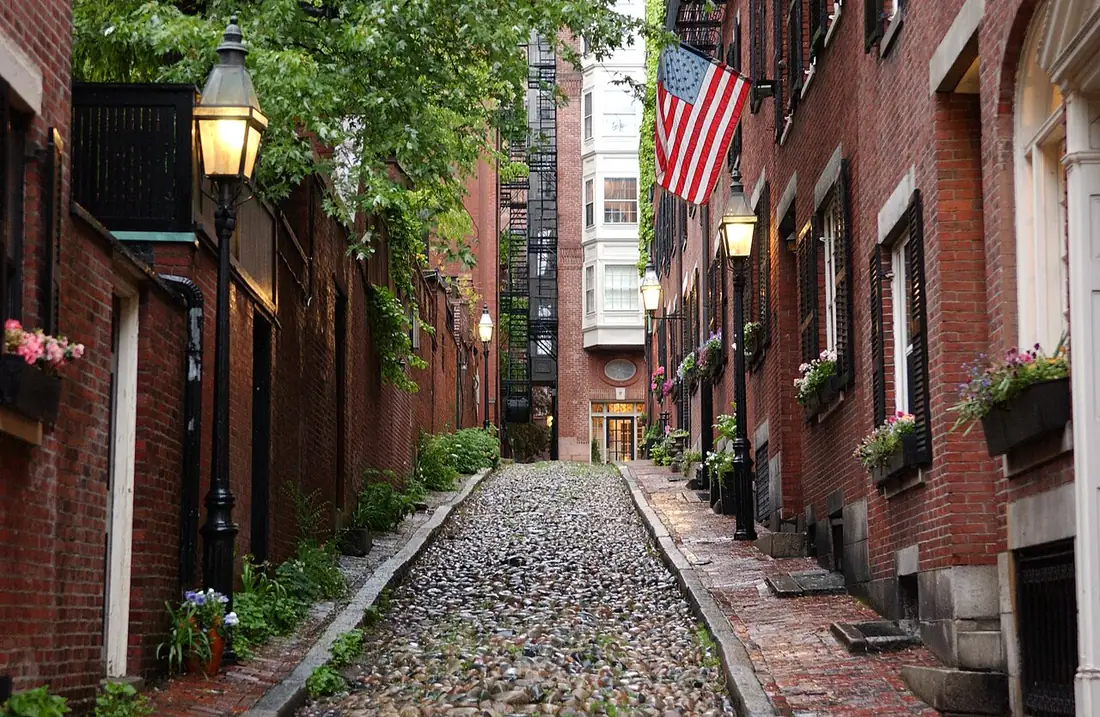
Drain cleaning in Boston, MA - Suffolk County - 57 ZIP codes covered
Drain Cleaning in Boston, MA
Boston gives its homeowners the hardest lateral rule in this set and then, to its credit, one of the most concrete offers of help with it. The owner here is responsible for the entire sewer lateral, from inside the basement all the way to the Boston Water and Sewer Commission main in the street, including the cost of finding out why it blocked. The stock that rule lands on is old and cold: median year built 1947, 58.3 percent of homes before 1960, 108 freeze days a year and 40.3 inches of snow. Only 18.3 percent of homes are single family detached, so triple deckers and shared systems fill the rest of the picture. DrainFlowed connects you with an independent local contractor. Call (866) 555-0134.
From inside your basement to the main in the street: BWSC's line
Boston Water and Sewer Commission states the ownership rule with a completeness other cities should copy. While BWSC maintains its sewer main in the public way, property owners are responsible for all expenses of maintaining and repairing their entire lateral from inside the basement to BWSC's sewer main in the street. The commission then defines the work so there is no shelter in vagueness: maintenance includes cleaning out debris, removing grease, and cutting roots, and the owner also pays for determining or relieving the cause of any blockage anywhere along that whole length.
Notice what that does to the usual arguments. The blockage under the sidewalk is yours. The root mass at the connection is yours. Even the diagnostic visit that establishes where the problem sits is yours. A Boston owner who internalises this early stops waiting for a city crew that is not coming and starts treating the lateral as what the commission says it is: a privately owned pipe that happens to end in a public street.
The rule's severity is also what makes the commission's assistance programme, covered next, structurally important rather than decorative. Boston pairs the strictest assignment of responsibility in this set with a grant that can reimburse a major share of the worst case scenario. Owners who know both halves of that bargain, the duty and the grant, are in a fundamentally different position from owners who only learn the first half on the worst day of their pipe's life.
Drain problems we handle in Boston
The problems Boston's own housing, ground and weather produce most. The full symptom list is on the problems hub; these are the ones that earn their place here.
Recurring Clogs in Boston
A clog that returns is not bad luck. It is an undiagnosed cause - roots, scale, a belly, or a cleaning that never removed the material..
Slow Drain in Boston
One slow fixture is a narrowing pipe. Several slow fixtures are a main-line warning. How to tell the difference and what fixes each..
Multiple Drains Backing Up in Boston
Several drains failing together is the main line or sewer until proven otherwise. Stop the water, protect the floor, make the call..
Drain Odors in Boston
Sewer smell, rotten-egg smell, sour buildup smell.
The grant: up to 8,000, dollars once a decade, with conditions that reward order
The Sewer Lateral Financial Assistance Program works like this. If a plumber or drain cleaner cannot clear your blockage, or the pipe is found collapsed or leaking, you may be eligible for a one time grant of up to 8,000 dollars toward an 8 foot relay, or up to 6,000 dollars toward a full lateral line. Eligibility is verified, not assumed: the blocked, collapsed or leaking condition must be confirmed by BWSC, your BWSC account must be current, the building must not have used the programme in the last ten years, and you must collect three estimates from contractors licensed and bonded by BWSC before authorisation to proceed.
The sequence matters as much as the amounts. When a contractor cannot clear the line, the owner arranges a meeting between the contractor and BWSC, by calling Operations, so the commission can verify the condition itself. If the contractor does clear the line by rodding or snaking, the clearing cost is simply the owner's, and the programme is not engaged. After authorised work is complete, BWSC inspects, the owner pays the contractor in full, and the grant cheque follows within a few weeks. Work must be finished within 30 days of the eligibility determination unless an extension is approved.
BWSC adds one piece of advice that reveals long experience. A partial repair restores flow but does nothing for leaks or weakness elsewhere along the same old pipe, and since the grant is one time assistance, owners approved for excavation are encouraged to put it toward replacing or relining the entire lateral from foundation to main. In a city of 1947 laterals, that is the voice of an agency that has watched a thousand spot repairs meet the next failure two seasons later. The grant is a decade scale resource. Spend it on the whole pipe.
About Boston: the local snapshot
Boston is the capital and most populous city of the U.S. state of Massachusetts.
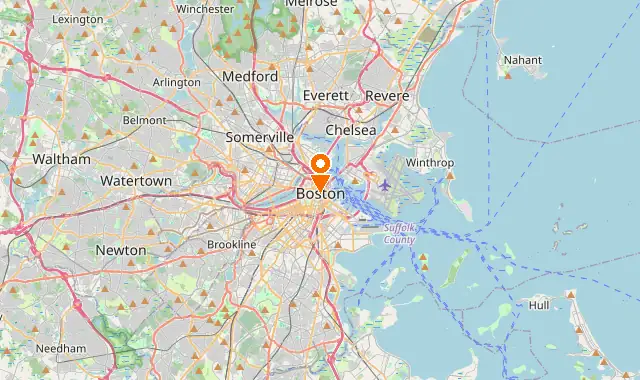
Local facts from Wikipedia and Wikidata, retrieved 2026-10-25. Population and area describe the city itself; the drain coverage counted on this page spans the wider area around it.
1947 stock, triple deckers, and the shared system problem
Boston's housing figures describe age compounded by density. Some 310,625 housing units with a median build year of 1947, 58.3 percent pre 1960 and only 18.1 percent built after 2000, and a single family share of just 18.3 percent, the second lowest in this set. Most Boston homes are therefore units in multi family buildings, the triple deckers and apartment blocks where one lateral and one stack system serve several households stacked vertically, and where a drain problem is a building event before it is a unit event.
The multi family pattern changes diagnosis. When the ground floor unit of a triple decker backs up, the suspect list starts with the shared main and the building lateral, not with anything that unit's occupants did. When one upper unit runs slow, the branch serving that unit is the suspect. Counting which units are affected, and on which floors, is the fastest sorting tool a Boston caller has, and it costs nothing to do before the phone call. In the neighbourhoods BWSC's alias data rolls into Boston, Allston, Brighton, Dorchester, Jamaica Plain, Roxbury, South Boston and their neighbours, the buildings differ but the shared system logic is the same.
Age does the rest. A lateral laid for a 1910 triple decker has carried a century of grease, roots and freeze cycles, often with repairs layered over repairs. Camera footage in this stock frequently shows a pipe of several materials and vintages end to end. That patchwork is not a scandal; it is Boston. But it means the honest question is rarely whether the lateral has a weak section. It is where, how many, and whether the grant assisted full renewal now beats another decade of sectional surprises.
The neighbourhood roll up in the city's coverage data makes the same point geographically. Boston as DrainFlowed covers it includes Allston, Brighton, Charlestown, Dorchester, East Boston, Hyde Park, Jamaica Plain, Mattapan, Roslindale, Roxbury, South Boston and West Roxbury among its areas, and the housing across them shares the profile the census describes: old, attached or multi unit, and drained by laterals whose condition is a building level fact. A buyer in any of these areas is not really purchasing a unit's plumbing. They are purchasing a share of a building's buried infrastructure, and the inspection that prices that share is the lateral camera, not the faucet test.
108 freeze days and 40 inches of snow against old clay
Boston's climate record is the coldest in this set after Chicago: 46.9 inches of precipitation, 40.3 inches of snow, and 108 days a year below freezing. For buried infrastructure, that means deep seasonal frost working on shallow sections and cleanouts, and a long annual cycle of contraction and thaw acting on clay joints that were rigid when they were laid and are brittle now. The freeze does not usually break a sound deep lateral outright. It worries the same joints, winter after winter, until a root or an offset finishes in July what January started.
Inside the house, winter writes its usual false signature: the roof vent terminal frosted narrow, the whole building gurgling under load, the symptom gone by the first thaw. In a triple decker that pattern can trigger an expensive main line callout for a vent problem, which is why the timing question, did this arrive with the cold snap, belongs at the start of every winter call in this city. BWSC itself publishes winter guidance on protecting pipes and meters from freezing, a reminder that the commission regards cold as a first order plumbing force here.
Snowmelt adds a spring chapter. Forty inches of snow leaves the ground in a few weeks, saturating soil around laterals just as the frost releases its grip, and groundwater finds every joint the winter loosened. A Boston lateral that weeps infiltration on camera in April is telling a seasonal story with a mechanical ending: the joint is open, the water is evidence, and the repair decision does not improve by waiting for next winter to work the same joint again.
The 18 percent: Boston's remaining combined sewers, named by BWSC
Boston is mostly a separated sewer city, and the commission is precise about the remainder. BWSC states that its earliest sewers were combined, carrying wastewater and stormwater in a single pipe, that separate systems were installed as the city expanded in the early 1900s, and that about 18 percent of the stormwater system is still combined with sewers, including parts of Back Bay, Beacon Hill, Roxbury, North Dorchester, and East, South and Downtown Boston. The commission is actively upgrading that combined remainder toward separation, under a consent decree framework with the EPA aimed at protecting Boston Harbor and its rivers.
That 18 percent figure disciplines the advice on this page. In the named combined areas, a storm driven basement backup has the same mechanics as in New York or Philadelphia, and backflow protection and wet weather discipline belong in the conversation. In the separated majority, a backup is far more likely to be your own lateral, blocked, collapsed or root bound, which routes the response back to cleaning, camera work, and the grant programme rather than to storm management. One city, two different backup logics, decided by which side of a line on BWSC's map your street sits.
The separation work itself occasionally becomes a household event, since separating combined systems eventually reaches individual building connections in the work areas. Owners in active separation zones may hear from the commission about their connections. That letter, when it comes, is not a sales pitch. It is the leading edge of the programme BWSC describes, and it is worth answering promptly, because work coordinated with a city project is almost always cheaper than the same work commissioned alone.
Soft water, hard problems: why scale is innocent in Boston
Boston's water arrives from MWRA reservoirs in central and western Massachusetts, and the Massachusetts Water Resources Authority describes it plainly: MWRA water is considered soft, with a hardness of about 15 to 20 mg/L, roughly 1 grain per gallon, where hard water would exceed 75 mg/L. Boston sits at the far soft end of the American range, softer even than New York, and that fact acquits an entire suspect. Mineral scale does not meaningfully narrow Boston drains, does not crust Boston water heaters the way it does in Miami or Los Angeles, and should not be sold to a Boston homeowner as the explanation for a slow drain.
Removing scale from the suspect list concentrates the mind usefully. What narrows Boston drains is the old stock itself: grease layered on corroded iron, hair and soap in triple decker branches, corrosion roughness that grabs everything passing, and roots at clay joints. The cleaning methods follow the material, mechanical cutting and jetting for grease and roots, in the $300-$900 hydro jetting range where the line needs scouring, and never a treatment aimed at minerals that were never in the water.
There is a quiet advantage buried here. Soft water is gentle on everything it touches, so Boston fixtures, heaters and laundry age more kindly than hard water cities allow. The drain system's enemies in Boston are time, roots, grease and cold, all of which are manageable with diagnosis and maintenance. A homeowner who understands that list, and the grant that stands behind its worst item, owns an old Boston house with its eyes open.
One more soft water consequence deserves a sentence, because it affects how Boston owners should hear sales pitches. Treatments and devices marketed nationally for hard water damage answer a problem MWRA water does not create. A Boston homeowner being sold scale protection for their drains is being sold a remedy for another city's water. The money that pitch asks for is better held for the expenses this city's water and weather actually produce: the camera inspection, the root cutting cycle, and, when the decade's turn comes, the lateral renewal that the BWSC grant helps carry.
Boston pricing, and spending a once a decade grant well
The standard ranges close the page. A single line cleaning runs $99-$450, main line cleaning $200-$650, sewer line cleaning $250-$900, hydro jetting $300-$900, a camera inspection $125-$500, and an emergency visit $150-$700. Boston's age profile means more jobs here end in a camera conversation than in younger cities, and more camera conversations end in a lateral condition than a cleaning schedule, which is exactly the fork where BWSC's programme enters the arithmetic.
DrainFlowed is a connection service, not BWSC and not a contractor. Call (866) 555-0134 with the pattern, which units and floors are affected, whether it follows storms or cold, and whether it has happened before, and you will be connected with an independent local contractor. Verify licence and insurance, and note that the grant programme requires BWSC licensed and bonded contractors and three estimates, so if a collapse is suspected, say so on the first call and choose accordingly.
The Boston rule of thumb writes itself from the commission's own documents. Clean what is cleanable, camera what recurs, and when the footage shows the lateral itself failing, do not spend the decade's one grant on the smallest repair that restores flow. Renew the line, claim the assistance once, and give a 1947 house a drain with a future as long as its past.
Drain services available in Boston
The services that answer Boston's lead problems, from the independent contractors who cover the city. Ranges are the national typical ranges used across this site.
| Service | Typical range | What it is |
|---|---|---|
| Drain Cleaning | $99-$450 | The core service: mechanical cleaning that clears the clog and scrapes the pipe walls, not just a hole poked through the blockage.. |
| Clogged Drain Repair | $120-$550 | For the drain that is already blocked: diagnosis first, then the right fix, so the same clog does not come back next month.. |
| Main Line Cleaning | $200-$650 | When every drain in the house slows at once, the problem is the main line. |
| Sewer Line Cleaning | $250-$900 | The buried line from your house to the street: root cutting, scale removal and jetting, with camera proof of the pipe's condition.. |
| Hydro Jetting | $300-$900 | High-pressure water that scours pipe walls clean - the answer for grease, scale and lines that keep re-clogging after cabling.. |
| Drain Camera Inspection | $125-$500 | See inside the pipe before you spend on the fix: roots, cracks, bellies and blockages located precisely, with footage to decide on.. |
Full detail on every service, with signs and causes, is on the services hub, and every range on the site is collected in the cost guide.
Boston coverage snapshot
Nearby covered cities: Revere, Worcester, Springfield, New Bedford.
Boston sewer and water resources
The city and utility pages this page's local facts rest on, worth bookmarking if you own a home in Boston:
Sources for this page
- housing age and mix: Median year built 1947, 58.3 percent pre 1960, 18.3 percent single family, 310,625 units (source)
- climate: 46.9 in precipitation, 40.3 in snow, 108 freeze days, 9.5 heavy rain days per year (source)
- sewer lateral responsibility: Owner is responsible for all expenses of maintenance and repair of the entire lateral from inside the basement to BWSC main in the street, including determining or relieving any blockage (source)
- city programs: Sewer Lateral Financial Assistance Program: one time grant up to 8,000 dollars for an 8 foot relay or 6,000 dollars for a full lateral, once every 10 years, BWSC verified, three estimates required (source)
- combined sewer: About 18 percent of the system still combined, including parts of Back Bay, Beacon Hill, Roxbury, North Dorchester, and East, South and Downtown Boston; BWSC is separating it (source)
- water hardness: MWRA water is soft, hardness about 15 to 20 mg/L, about 1 grain per gallon (source)
- Housing age: median year built and build-era shares (US Census Bureau ACS)
- Weather averages: 2014-2023 daily record (Open-Meteo archive, ERA5)
Coverage around Boston
Areas and neighbourhoods in and around Boston
Calls also come in from Allston, Brighton, Charlestown, Chestnut Hill, Dorchester, Dorchester Center and the streets between them. Those areas sit inside the same coverage, on the same contractor rounds.
AllstonBrightonCharlestownChestnut HillDorchesterDorchester CenterEast BostonHyde ParkJamaica PlainMattapanReadvilleRoslindaleRoxburyRoxbury CrossingSouth BostonWest Roxbury
Nearby cities we cover in Massachusetts
- Drain cleaning in Revere, MA
- Drain cleaning in Worcester, MA
- Drain cleaning in Springfield, MA
- Drain cleaning in New Bedford, MA
- Drain cleaning in Cambridge, MA
- Drain cleaning in Lowell, MA
- Drain cleaning in Leominster, MA
The full list for the state is on the Massachusetts locations page.
Beyond Boston
Coverage at this depth continues nearby: see drain cleaning in Worcester, MA and drain cleaning in Springfield, MA, each written from its own city's data the same way this page is.
Questions, answered
Who is responsible for the sewer lateral in Boston?
All of it, and BWSC says so in terms: the owner is responsible for the entire lateral from inside the basement to the BWSC sewer main in the street, including paying to find and clear any blockage anywhere along it. Cleaning, grease removal and root cutting on that whole length are maintenance the owner pays for.
Does Boston help pay for a collapsed sewer lateral?
Potentially, yes. BWSC's Sewer Lateral Financial Assistance Program offers a one time grant, up to 8,000 dollars for an 8 foot relay or 6,000 dollars for a full lateral line, when a blocked, collapsed or leaking lateral is verified by BWSC, your account is current, you gather three estimates from BWSC licensed and bonded contractors, and the property has not used the programme in ten years.
Is Boston a combined sewer city?
Mostly, no. About 18 percent of the system is still combined, in areas BWSC lists including parts of Back Bay, Beacon Hill, Roxbury, North Dorchester, and East, South and Downtown Boston, and BWSC is actively separating those pipes. Outside those areas, storm backups are far less likely to be a combined sewer event.
Is Boston water hard?
About as soft as American city water gets. MWRA puts hardness at roughly 15 to 20 mg/L, about 1 grain per gallon, against more than 75 mg/L for hard water. Mineral scale is a minor actor in Boston drain problems; age, roots, grease and corrosion do the damage here.
How much does drain cleaning cost in Boston?
A single line runs $99-$450, main line cleaning $200-$650, sewer line cleaning $250-$900, and a camera inspection $125-$500. In a stock with a 1947 median build year, the camera earns its fee by establishing whether you have a cleaning job or a lateral condition that the BWSC grant programme should hear about.
My drain clears and then clogs again months later. Why?
That is the textbook Boston pattern for an aging lateral: a partial restriction, roots at a joint, or a coating that regrows. With 108 freeze days a year also working on shallow joints, recurrence here should be read as the pipe asking for a diagnosis. Ask for the camera footage and a named cause before paying for a third clearing.
Drain problem in Boston? Make the call
A live person answers around the clock. Describe the problem, hear the likely range, and get an independent local contractor on the way.
(866) 555-0134 Tap to call nowA live person answers, day or night. Describe the problem, hear the likely range, then decide.