
Drain cleaning in Chicago, IL - Cook County - 165 ZIP codes covered
Drain Cleaning in Chicago, IL
Chicago puts two big facts in the path of every drain call. The first is age: the median home was built in 1953, and 58.1 percent of the housing stock predates 1960, much of it drained by clay tile laterals that have survived more than a century of winters. The second is the system underneath: most older neighbourhoods drain through combined sewers, one pipe for sewage and stormwater alike, backed up by the enormous Tunnel and Reservoir Plan. When a Chicago basement floods in a storm, it is usually those two facts meeting. There is also a piece of genuinely good news buried in the rules, a city program that can repair part of your drain at no cost. DrainFlowed connects you with an independent local contractor. Call (866) 555-0134 to start.
The Private Drain Program: the break Chicago will pay for
Chicago splits sewer responsibility in a way worth memorising. The private drain from your house is yours to maintain and repair, with one large exception administered by the Department of Water Management. Under the Private Drain Program, the city may repair sewer drain tiles coming from private residences, in buildings of up to four units, that are proven broken under the public way. The public way here means the stretch from the city sidewalk to the center of the street, ground the homeowner could never reasonably be expected to excavate.
The conditions are procedural and they matter. A licensed sewer contractor must first rod the line, or make a video inspection of it, and the contractor must schedule a review by a city sewer inspector. Tiles proven broken under the public way are then repaired by the city at no cost to the property owner. Tiles broken on your side of the sidewalk, however dramatic the footage, remain your expense, as does all routine rodding and maintenance of the private drain.
Read that programme as a reason to insist on a camera. In most cities a camera inspection at $125-$500 buys you knowledge. In Chicago it also buys you the evidence on which a five figure public way repair decision turns. If your line keeps failing and the break might sit past the sidewalk, the sequence is fixed: hire the licensed contractor, get the video, book the inspector review, and let the city confirm or deny its share before you agree to pay for the whole run yourself.
There is a timing detail in the programme worth planning around. The city's review depends on the contractor's evidence, which means the video has to show the break clearly enough for an inspector to agree on where it sits. A line so choked with roots or debris that the camera cannot travel it may need rodding first, at the owner's cost, just to make the qualifying footage possible. Owners sometimes hear that sequence as an obstacle. It is better read as the programme protecting itself against paying for the wrong repairs, and it leaves the owner, even in the worst case, with a cleared and filmed line whose condition is no longer a matter of opinion. Budget for the evidence step, treat anything the city then repairs under the public way as the return on it, and the arithmetic of the Chicago system becomes clear: proof first, then the split, then the shovel.
Drain problems we handle in Chicago
The problems Chicago's own housing, ground and weather produce most. The full symptom list is on the problems hub; these are the ones that earn their place here.
Multiple Drains Backing Up in Chicago
Several drains failing together is the main line or sewer until proven otherwise. Stop the water, protect the floor, make the call..
Recurring Clogs in Chicago
A clog that returns is not bad luck. It is an undiagnosed cause - roots, scale, a belly, or a cleaning that never removed the material..
Gurgling Drains in Chicago
Gurgling is air moving where it should not - displaced by a partial blockage or a vent problem. It is one of the earliest main-line warnings..
Slow Drain in Chicago
One slow fixture is a narrowing pipe. Several slow fixtures are a main-line warning. How to tell the difference and what fixes each..
Combined sewers and the Deep Tunnel beneath the problem
Chicago operates one of the largest combined sewer systems in North America. In most older neighbourhoods, a single network carries sanitary waste and storm runoff together, so a hard rain does not just add water to the system, it competes directly with your household discharge for the same pipe capacity. When the system surcharges, wastewater pushes back through the lowest openings it can find, which in a Chicago house usually means the basement floor drain or a below grade fixture.
Above that local picture sits the Metropolitan Water Reclamation District and its Tunnel and Reservoir Plan, the Deep Tunnel, roughly 109 miles of tunnels and vast reservoirs designed to capture excess combined flow before it reaches waterways or basements. TARP has cut overflow frequency dramatically, and the district issues overflow action alerts urging residents to conserve water during major storms. But TARP operates downstream of your street. It cannot relieve a private lateral that is half closed by roots, and it cannot stop a surcharge arriving through a cracked drain tile.
The homeowner's share of combined sewer defence is therefore local. Keep the private drain fully open, because a restricted line fails first. Take overflow alerts seriously and delay laundry and long showers during the worst of a storm. And if backups arrive only with rain, say so when you call, because a rain linked backup is a different diagnosis from a blockage, pointing at backflow protection and the condition of the drain under the public way rather than at anything in your kitchen.
About Chicago: the local snapshot
Chicago is the most populous city in the U.S. state of Illinois and in the Midwestern United States.
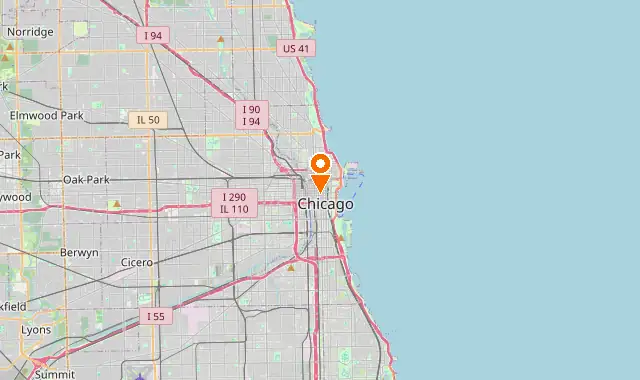
Local facts from Wikipedia and Wikidata, retrieved 2026-10-25. Population and area describe the city itself; the drain coverage counted on this page spans the wider area around it.
112 freeze days against a 1953 housing stock
Chicago's climate record in the data pack is the harshest combination in this set after the far north: 46.3 inches of precipitation, 28.9 inches of snow, and 112 days a year below freezing, acting on a housing stock with a median build year of 1953. Freeze and thaw is not a single event for a clay lateral. It is a yearly cycle of soil heaving and settling that works each joint a fraction, and Chicago laterals have had seventy to a hundred and twenty of those cycles to work through.
The visible consequences fill the camera footage of this city: joints offset by seasons of movement, tiles cracked along their length, and roots that found the gaps winter opened. Inside the house, the same cold produces the classic false alarm, a roof vent terminal narrowed by frost so the whole system gurgles under load until the thaw. Distinguishing vent frost from a main line restriction is a pattern question: symptoms that arrive with a cold snap and vanish with a warm day belong to the vent, while slowness that persists through a mild week belongs to the pipe.
Basements raise the stakes on diagnosis. Chicago homes put living space, laundry, and often a bathroom below grade, close to the elevation where a surcharging combined sewer arrives. A drain problem here is rarely confined to inconvenience. It threatens finished rooms, which is why this page keeps returning to the same advice: in Chicago, a recurring symptom in an old house earns a camera, early, while the line still drains.
Lake Michigan water at 140 mg/L: scale joins grease
Chicago draws its drinking water from Lake Michigan, and city water analyses put its hardness at about 140 mg/L, which the US Geological Survey classifies as hard. That number changes the chemistry of buildup inside Chicago drains. Mineral scale precipitates onto pipe walls and fixture outlets year after year, and in an older iron or clay line the scale does double damage: it narrows the bore directly, and it roughens the surface so grease and soap catch and hold instead of washing through.
The result, in a kitchen line of any age in this city, is often a laminated clog, grease bound into a mineral crust, which is why a quick cable pass that pokes a hole through it tends to fail early. The coating is still there, waiting to catch the next load. Proper cleaning scrapes the wall, and for grease and scale heavy lines, hydro jetting at $300-$900 scours the deposit off and washes it out of the line entirely, resetting the clock in a way a piercing never does.
Scale also writes itself into the rest of the house: cloudy glassware, slow ice makers, crust at faucet aerators. None of that is dangerous, but it is a useful tell. A home fighting visible scale at its fixtures has the same process running quietly inside its drains, and a contractor who finds heavy scale in the line will say so, because it changes the cleaning interval that makes sense for that house.
Rainblockers, street ponding, and reading a storm backup
One Chicago institution explains a sight that puzzles newcomers. During heavy rain, some Chicago streets hold water deliberately. Since 1998 the city has fitted catch basins with inlet restrictor valves, the Rainblocker program, which narrow the opening into the sewer so stormwater ponds on the street temporarily instead of overwhelming the combined system all at once. The street becomes short term storage, buying the sewers time and reducing the pressure that would otherwise drive wastewater into basements.
Knowing this reframes two experiences. Standing water on your street in a storm is not necessarily a blocked inlet; it may be the system working as designed. And a basement backup during the same storm, despite the rainblockers, is information: your private drain or its connection may be compromised enough that even a managed storm defeats it. That is precisely the profile the Private Drain Program exists to investigate, starting with a contractor's video and an inspector's review.
There is a household habit that pairs with the rainblockers. The program works best when roof downspouts are disconnected from the sewer and directed to yards, alleys, or streets where the restrictors can meter the flow. A downspout still plumbed straight into your house drain pours roof water into the very pipe you are trying to protect. If you do not know where your downspouts discharge, ask during the drain visit. It is a five minute check with an outsized effect on storm day risk.
Overhead sewers and backflow valves: Chicago's flood control conversation
Owners whose basements have taken storm water more than once eventually hear two terms that define Chicago flood control work. The first is the backwater, or backflow prevention, valve: a gate in the drain line that lets wastewater out and closes when the city sewer surcharges, keeping the combined system's worst hour out of your basement. The second is the overhead sewer conversion, in which basement plumbing is rerouted to eject wastewater up and out above the level of the street sewer, so a surcharge has no gravity path into the house at all. Both approaches appear in the flood control installations Chicago sewer contractors describe, alongside sump and ejector systems sized to the property.
Neither device is a substitute for a sound drain, and Chicago's own programme logic says so in reverse: the Private Drain Program repairs a proven break, while flood control equipment manages the water that arrives when the pipe is intact but the system beyond it is full. The two conversations are often confused at kitchen tables. A valve will not fix a collapsed tile, and a repaired tile will not stop a surcharge entering through a floor drain in a street flooding storm. A good contractor separates them explicitly, tells you which risk your house actually carries, and prices only the work that addresses it.
The decision inputs are local and knowable. How often has the basement taken water, and was the drain itself found broken or clear each time? Where do your basement fixtures sit relative to the street sewer's level? Has the Private Drain review already established the condition of the section under the public way? With those answers, flood control stops being a frightening upsell and becomes what it is in this city: a standard second layer of defence for below grade rooms living on top of a combined sewer, chosen by owners who have read their own basement's history correctly.
What Chicago drain work costs, and the order to do it in
The ranges are the national ones used across this site. A standard drain cleaning runs $99-$450. Main line cleaning runs $200-$650, sewer line cleaning $250-$900, hydro jetting $300-$900, a camera inspection $125-$500, and an emergency visit $150-$700. Chicago's older stock pushes jobs toward the upper ends more often than a newer city would, through longer runs, heavier scale, and root work, which is all the more reason to agree the range before work starts and to know which parts might not be yours to pay for.
DrainFlowed is a connection service, not a contractor. Calling (866) 555-0134 connects you with an independent local contractor; verify their licence, they must be a licensed sewer contractor for Private Drain Program evidence to count, and their insurance, and confirm the price range on the call. Mention storm linked symptoms, repeat clogs, and the age of the house, because each one steers the visit toward the right equipment.
The order of operations this city rewards is consistent. Clear the line, camera the line, and if the footage shows a break, establish where it sits relative to the sidewalk before pricing the repair. Owners who follow that sequence sometimes discover the most expensive section of their drain belongs, by the city's own program, to the city.
Drain services available in Chicago
The services that answer Chicago's lead problems, from the independent contractors who cover the city. Ranges are the national typical ranges used across this site.
| Service | Typical range | What it is |
|---|---|---|
| Drain Cleaning | $99-$450 | The core service: mechanical cleaning that clears the clog and scrapes the pipe walls, not just a hole poked through the blockage.. |
| Main Line Cleaning | $200-$650 | When every drain in the house slows at once, the problem is the main line. |
| Sewer Line Cleaning | $250-$900 | The buried line from your house to the street: root cutting, scale removal and jetting, with camera proof of the pipe's condition.. |
| Hydro Jetting | $300-$900 | High-pressure water that scours pipe walls clean - the answer for grease, scale and lines that keep re-clogging after cabling.. |
| Drain Camera Inspection | $125-$500 | See inside the pipe before you spend on the fix: roots, cracks, bellies and blockages located precisely, with footage to decide on.. |
| Emergency Drain Cleaning | $150-$700 | Sewage backing up, water rising, guests arriving: what counts as a drain emergency, what to do in the first ten minutes, and how the visit works.. |
Full detail on every service, with signs and causes, is on the services hub, and every range on the site is collected in the cost guide.
Chicago coverage snapshot
Nearby covered cities: Glenview, Hoffman Estates, Oak Park, Tinley Park.
Chicago sewer and water resources
The city and utility pages this page's local facts rest on, worth bookmarking if you own a home in Chicago:
Sources for this page
- housing age and mix: Median year built 1953, 58.1 percent pre 1960, 29.2 percent single family, 1,277,054 units (source)
- climate: 46.3 in precipitation, 28.9 in snow, 112 freeze days, 7.1 heavy rain days per year (source)
- sewer lateral responsibility and city programs: Private Drain Program: city repairs drain tiles proven broken under the public way (sidewalk to center of street) for buildings up to four units at no cost, after a licensed contractor rods or videos the line and schedules an inspector review; maintenance stays with the owner (source)
- combined sewer: Combined sewer system served by MWRD Tunnel and Reservoir Plan (TARP), which captures excess combined flow; overflow action alerts issued in storms (source)
- water hardness: About 140 mg/L as CaCO3, hard, Lake Michigan supply, per city water analysis figures (source)
- Housing age: median year built and build-era shares (US Census Bureau ACS)
- Weather averages: 2014-2023 daily record (Open-Meteo archive, ERA5)
Coverage around Chicago
Nearby cities we cover in Illinois
- Drain cleaning in Glenview, IL
- Drain cleaning in Hoffman Estates, IL
- Drain cleaning in Oak Park, IL
- Drain cleaning in Tinley Park, IL
- Drain cleaning in Mount Prospect, IL
- Drain cleaning in Berwyn, IL
- Drain cleaning in Oak Lawn, IL
- Drain cleaning in Orland Park, IL
The full list for the state is on the Illinois locations page.
Beyond Chicago
Coverage at this depth continues nearby: see drain cleaning in Rockford, IL and drain cleaning in Peoria, IL, each written from its own city's data the same way this page is.
Questions, answered
Will Chicago pay for any part of my sewer repair?
Partly. The city repairs a drain proven broken under the public way, from the sidewalk to the center of the street, at no cost to the owner for homes up to four units. First a licensed sewer contractor must rod or video inspect the line and schedule a review by a city sewer inspector. Breaks on your own property remain your cost.
Why does my basement back up when it rains hard in Chicago?
Yes. Most older areas drain through combined sewers carrying sewage and stormwater together. In heavy rain the system can surcharge and push wastewater back through basement fixtures. The Tunnel and Reservoir Plan stores much of that excess, but it does not protect a private drain that is already cracked or restricted.
Do Chicago winters actually damage drain lines?
With 112 freeze days a year, frost can narrow the vent terminal on the roof, and heaving soil works on old clay joints a little each winter. Gurgling that tracks the cold is often vent frost. Offsets and root entry found on camera are the freeze and thaw story told over decades.
Is Chicago water hard enough to coat my pipes?
Yes. Chicago water from Lake Michigan runs about 140 mg/L hardness, classed as hard. Scale roughens older pipe and gives grease more to cling to, so kitchen lines here often carry a mixed coating of mineral and grease that needs mechanical cleaning, sometimes hydro jetting at $300-$900, to strip properly.
How much does drain cleaning cost in Chicago?
A single line is $99-$450. Main line cleaning is $200-$650, sewer line cleaning $250-$900 and a camera inspection $125-$500. The camera matters doubly here because its footage is also the evidence the Private Drain Program review is built on.
My drain clogs again every few months. Should I keep rodding it?
That rhythm usually means roots regrowing through a joint, or a coating that was pierced rather than removed. In a stock where 58.1 percent of homes predate 1960, the pipe itself is a prime suspect. Ask for a camera inspection and a finding you can see, rather than a fourth identical rodding.
Drain problem in Chicago? Make the call
A live person answers around the clock. Describe the problem, hear the likely range, and get an independent local contractor on the way.
(866) 555-0134 Tap to call nowA live person answers, day or night. Describe the problem, hear the likely range, then decide.