
Drain cleaning in Fort Worth, TX - Tarrant County - 108 ZIP codes covered
Drain Cleaning in Fort Worth, TX
Fort Worth is the anti Richmond in this series, and the contrast is the point. The city sewer system is separate by design, stormwater flows to creeks and the Trinity River rather than through the treatment plant, and the housing is young: median build year 1994, with 43.4 percent of homes built after 2000 and only 18.9 percent before 1960. The city FAQ defines the sewer lateral as the privately owned and maintained pipe connecting your building to the public main, full stop. What tests Fort Worth drains is not combined flow. It is infiltration and inflow, clean water sneaking into a sanitary system through cracks and bad connections, across 42.0 inches of rain a year delivered in Texas sized events, plus the grease and root habits of 373,948 households. This page is built on the city own FAQ language, because Fort Worth explains itself unusually well.
Separate by design: the Fort Worth system in the city own words
The City of Fort Worth sewer FAQ opens its rain answer with a design statement: by design, the city wastewater collection system is separate from the storm drainage system. Stormwater does not flow through the wastewater treatment plant. It flows directly into creeks, streams, lakes, and the Trinity River itself. Raw wastewater, meanwhile, arrives by gravity from homes and businesses across Fort Worth and its 23 customer cities, is treated, and is discharged as high quality effluent into the Trinity River. Two systems, two destinations, and a river that receives both stories at different points.
Then the FAQ does something honest: it explains how the separation leaks. Infiltration and inflow, shortened to I and I, is the process by which clean water that was never supposed to be in the sanitary system gets in anyway and steals its capacity. Infiltration is groundwater entering through cracks, holes, and faulty connections. Inflow is surface water entering through roof downspout connections, holes in manhole covers, and illegal plumbing connections. The consequences the city lists are the homeowner consequences too: sewer overflows into streets and waterways, sewer backups into homes, and treatment costs for water that needed no treatment, passed on to consumers.
Fort Worth fights back with named programs, a Wet Weather program and a Capacity, Management, Operations and Maintenance program, CMOM, both aimed at finding and eliminating I and I sources, plus a high rate clarifier built in 2004 so that high storm associated volumes can be safely treated and discharged. The household translation is that your private line is part of the city I and I map whether you think of it that way or not. Every cracked lateral in Fort Worth is a small, unmetered storm inlet, and the city programs exist because thousands of small inlets add up to a system problem with your basement potentially at the receiving end.
The 23 customer cities detail deserves its household translation. Fort Worth treats wastewater for a ring of surrounding communities whose flow arrives through the same mains and the same plant, which means the capacity conversation, the I and I arithmetic, is regional whether or not your street feels suburban. A homeowner in Fort Worth proper and a homeowner in a customer city share one system behavior: wet weather capacity is a commons, and every private line that admits storm water spends from it. That is the civic frame the FAQ assumes, and it is why the city publishes homeowner facing sewer education at all. Your lateral is private property with public consequences, and Fort Worth is unusually straightforward about saying so.
Drain problems we handle in Fort Worth
The problems Fort Worth's own housing, ground and weather produce most. The full symptom list is on the problems hub; these are the ones that earn their place here.
Slow Drain in Fort Worth
One slow fixture is a narrowing pipe. Several slow fixtures are a main-line warning. How to tell the difference and what fixes each..
Multiple Drains Backing Up in Fort Worth
Several drains failing together is the main line or sewer until proven otherwise. Stop the water, protect the floor, make the call..
Drain Odors in Fort Worth
Sewer smell, rotten-egg smell, sour buildup smell.
The lateral is privately owned and maintained. The FAQ says so.
Fort Worth answers the ownership question in its FAQ with a definitions clarity most cities never achieve. What is a sewer lateral? A sewer lateral is the privately owned and maintained sewer pipe connecting a building or dwelling to the public sewer main. And where does city responsibility begin and end? The city is responsible for all sewer collectors, mains, and outfalls located within right of ways and easements. Maintenance of customer service lines that are extended to the mains is the responsibility of the owners and customers. Private pipe, owner maintained, all the way to the main. Public mains in the right of way, city maintained. That is the entire Fort Worth split, in the city own published words.
The FAQ even scripts the diagnostic dance that follows from the split. Sewage backing up while you are not using water outlets suggests a problem in the city main, and the instruction is to call the city number, 817-392-4477, which is staffed 24 hours. If you are using water and the overflow stops when you turn your outlets off, you likely have a problem in your private sewer lateral and will probably need a plumber. Slow drainage gets the same fork: check whether neighbors share it, call the city to check the mains, and if the mains are clear, the plumber cleans your private lines. Location first, money second, exactly the order this page recommends everywhere and Fort Worth publishes as procedure.
Price the private side with the national ranges: standard cleaning $99-$450, main line and lateral cleaning $200-$650, hydro jetting $300-$900, camera inspection $125-$500, sewer line work $250-$900, emergency $150-$700. Fort Worth young housing stock means many of these jobs are maintenance events rather than archaeology. But the ownership does not soften with the age of the pipe. A 2010 lateral with a root problem at a bad joint is as privately owned as a 1955 one, and the city FAQ will read the same to both owners.
About Fort Worth: the local snapshot
Fort Worth is a city in the U.S. state of Texas.
Fort Worth is the county seat of Tarrant County, and the snapshot below keeps the city itself separate from the wider coverage area around it.
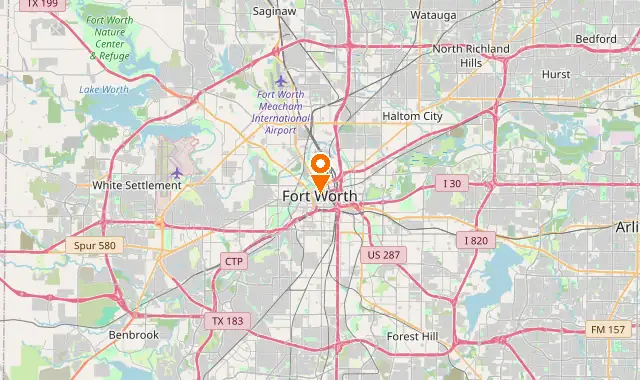
Local facts from Wikipedia and Wikidata, retrieved 2026-10-25. Population and area describe the city itself; the drain coverage counted on this page spans the wider area around it.
A 1994 median city, and what still clogs a young system
Fort Worth housing is the second youngest in this series. Of 373,948 units, 43.4 percent were built after 2000, 14.8 percent between 1960 and 1979, and 18.9 percent before 1960, with a median build year of 1994 and 67.9 percent single family homes. The population counted in the 2020 census is 918,915, and the city is the county seat of Tarrant County. Young, single family, and growing is a specific drain profile: modern plastic laterals with long expected lives, whose failures concentrate in a short list of causes that have nothing to do with pipe senescence.
Cause one is inputs. Grease, wipes, and the general cargo of a busy household narrow young pipes exactly as they narrow old ones, and a kitchen line in a 2012 Fort Worth home can be as filmed as one in a 1962 home if the cooking habits match. Cause two is ground and grade. A settled section in a newer lateral, where soil consolidation or a poor bedding job left a low spot, holds water and solids from its first year, and the symptom is a line that has always been a little slow and periodically stops pretending. Cause three is roots, which do not check build dates: a vigorous tree over a young lateral with one imperfect joint is a root problem on a modern pipe.
The diagnostic gift of a young stock is that the camera answer is usually decisive and reassuring. A $125-$500 inspection of a post 2000 lateral most often shows a clean, round, intact pipe with a specific, fixable insult in it: a grease dam, a root tuft at one joint, an object, a belly. Compare the older districts, the 18.9 percent pre 1960 and the 1960 to 1979 band, where the same camera may show a pipe whose whole length is a negotiation. Fort Worth contractors calibrate to the build year almost instinctively. State yours on the call and you will hear the calibration happen.
Growth speed writes one more Fort Worth pattern: the young line under new landscaping. Post 2000 homes often receive their first mature tree canopy a decade or two after construction, as builder plantings reach size, and root pressure on a lateral arrives on the landscaping schedule, not the plumbing one. A Fort Worth home that drained perfectly for fifteen years and begins a slow, seasonal decline in year sixteen is frequently meeting its own trees for the first time underground. The camera distinguishes that meeting, one joint, one tuft, from anything structural, and the fix is sized to a joint, not a system. Landscaping maturity is a drain milestone in this city, and it is entirely predictable.
42 inches of Texas rain and the I and I exam
Fort Worth averages 42.0 inches of precipitation a year, with 10.1 heavy rain days, only 21 freeze days, and 1.5 inches of snow. The rain total is unremarkable. Its delivery is not. North Texas rain concentrates into events that saturate soil fast, raise shallow groundwater, and push inflow through every opening the system offers, all in the same hours when households are home using water. That is the I and I exam, and a private lateral with cracked joints or a bad cleanout cap fails it publicly, at the lowest fixture in the house.
The city FAQ describes the system level stakes: I and I takes up treatment capacity, can result in overflows and backups, and can even force unnecessary expansion of treatment plants to handle episodic clean water flows, with costs passed to consumers. Scale that down to one address. Your lateral admitting storm water is competing with your own wastewater for the same pipe, and during the peak of a storm the rain usually wins on volume. A backup that happens only in major rain, in a house whose line is otherwise proven clean, is frequently an inflow story about your own property connections, and the fix lives at those connections, not in another cleaning.
What a homeowner can actually do is refreshingly concrete. Keep the cleanout cap intact and seated. Do not tie downspouts or area drains into the sanitary line, and if a previous owner did, untie them. If storm linked symptoms persist after a cleaning, ask for the camera to hunt specifically for entry points, cracks, and faulty connections, the FAQ own list of infiltration routes. Fort Worth has published its diagnosis. The most efficient visit is the one that simply executes it on your property.
Slow drainage in Fort Worth: the neighbor test and the city check
Fort Worth publishes a slow drainage protocol that deserves to be quoted in spirit because it is better than most improvisation. If your toilets and drains run slow, first check whether your neighbors are having a similar problem. Then call the city at 817-392-4477 and the city will check the mains. City crews will tell you whether the problem is in the city main or not. If the city system is clear, you call a plumber to clean your private sewer lines. Three steps: neighborhood pattern, public check, private work. Each step eliminates a universe of guessing, and the public check costs a phone call.
The neighbor test deserves respect as instrumentation. One house slowing is a house problem. A street slowing in the same week is a system datum, and in a gravity system where everything flows downhill through shared mains, synchrony is information about the shared segment. It is also, practically, how the city triages: a cluster of reports from one street is a crew dispatch pattern, while a single address is a private line pattern. When you call DrainFlowed or the city, report the neighborhood state accurately, including if you did not check. An unchecked assumption smuggled in as a fact is the only wrong answer available.
Odors get the same crisp treatment in the FAQ. Sewage has a natural tendency to produce odors, all sewers have odors, and the plumbing in your home is designed to keep them out with a vapor trap. Indoor odor therefore points at the trap: a dried out floor drain or little used fixture, a trap fault a plumber can correct. In Fort Worth slab homes, the floor drain population is smaller than in basement country, so the usual suspects are the guest bath and the laundry sink. Refill the traps monthly in little used rooms and you will retire most Fort Worth odor calls before they are made, at a total cost of one bucket of water.
Fort Worth heat plays the role other cities assign to cold. Long hot seasons keep grease liquid further into the line before it sets, bake vent terminals under attic heat, and drive the water use peaks, laundry, showers, irrigation mistakes, that load a marginal system in the evening hours. A Fort Worth slowdown that peaks on summer evenings and clears by morning is describing thermal and usage load on a partially restricted line. It will not improve as the summer does. Book the cleaning in the cool of a weekday morning, describe the evening pattern, and let the contractor meet the line at its honest worst rather than its rested best.
Booking in Fort Worth: use the city script, then the connection
DrainFlowed is a connection service, and Fort Worth is a city where the connection model fits the municipal script neatly. The city handles its mains and its checks. Your independent contractor, reached at (866) 555-0134, handles your lateral and your interior drains, quotes the work, performs it, and is responsible for it. Verify license and insurance with the contractor directly. Between the city published protocol and a contractor who follows it, a Fort Worth drain problem has very little room left to become a mystery or a dispute.
Sequence a Fort Worth call like the FAQ does. If water is backing up while your household is using nothing, call the city first at its 24 hour number and let the main be checked. If the problem is plainly private, a single slow fixture, a known grease history, a gurgling main line pattern in dry weather, call the connection and describe it in Fort Worth vocabulary: which fixtures, whether neighbors share it, whether it tracks rain, and the build year of the home. Contractors price clarity. Vague calls get vague ranges, and the ranges are wide enough, $99-$450 at the standard end and $250-$900 for sewer line work, that clarity is worth real money.
Keep the record the young city way. A 1994 median housing stock means most Fort Worth owners will sell or refinance with the original lateral still in service, and a dated file, cleanings, one camera survey, any I and I corrections at your own connections, documents the most invisible asset on the lot. Fort Worth is growing too fast for buyers to assume the underground is fine. The owner who can show it, is the owner whose showing goes smoothly.
Drain services available in Fort Worth
The services that answer Fort Worth's lead problems, from the independent contractors who cover the city. Ranges are the national typical ranges used across this site.
| Service | Typical range | What it is |
|---|---|---|
| Drain Cleaning | $99-$450 | The core service: mechanical cleaning that clears the clog and scrapes the pipe walls, not just a hole poked through the blockage.. |
| Clogged Drain Repair | $120-$550 | For the drain that is already blocked: diagnosis first, then the right fix, so the same clog does not come back next month.. |
| Main Line Cleaning | $200-$650 | When every drain in the house slows at once, the problem is the main line. |
| Sewer Line Cleaning | $250-$900 | The buried line from your house to the street: root cutting, scale removal and jetting, with camera proof of the pipe's condition.. |
| Bathroom Drain Cleaning | $99-$400 | Hair, soap scum and toothpaste: tubs, showers and bathroom sinks cleared at the trap and the branch, not just at the surface.. |
| Emergency Drain Cleaning | $150-$700 | Sewage backing up, water rising, guests arriving: what counts as a drain emergency, what to do in the first ten minutes, and how the visit works.. |
Full detail on every service, with signs and causes, is on the services hub, and every range on the site is collected in the cost guide.
Fort Worth coverage snapshot
Nearby covered cities: Haltom City, Keller, Bedford, Grapevine.
Fort Worth sewer and water resources
The city and utility pages this page's local facts rest on, worth bookmarking if you own a home in Fort Worth:
Sources for this page
- housing age and mix: Median year built 1994, 18.9 percent pre 1960, 14.8 percent built 1960 to 1979, 43.4 percent post 2000, 373,948 units, 67.9 percent single family (source)
- climate: 42.0 in annual precipitation, 1.5 in snow, 21 freeze days, 10.1 heavy rain days per year, 2014 to 2023 average (source)
- sewer lateral responsibility: Lateral is the privately owned and maintained pipe connecting a building to the public main; city is responsible for collectors, mains and outfalls in right of ways and easements; customer service lines are the owners responsibility (source)
- combined sewer status: No combined system. By design the wastewater system is separate from storm drainage; stormwater flows directly to creeks, streams, lakes and the Trinity River (source)
- city programs: Wet Weather program and CMOM program to identify and eliminate infiltration and inflow; high rate clarifier constructed in 2004 for storm associated volumes (source)
- water hardness: Utility reported average hardness about 108 mg/L (6.3 gpg), moderately hard, for the City of Fort Worth system via compiled utility data (source)
- Housing age: median year built and build-era shares (US Census Bureau ACS)
- Weather averages: 2014-2023 daily record (Open-Meteo archive, ERA5)
Coverage around Fort Worth
Areas and neighbourhoods in and around Fort Worth
Calls also come in from Naval Air Station Jrb and the streets between them. Those areas sit inside the same coverage, on the same contractor rounds.
Naval Air Station Jrb
Nearby cities we cover in Texas
- Drain cleaning in Haltom City, TX
- Drain cleaning in Keller, TX
- Drain cleaning in Bedford, TX
- Drain cleaning in Grapevine, TX
- Drain cleaning in Euless, TX
- Drain cleaning in North Richland Hills, TX
- Drain cleaning in Mansfield, TX
- Drain cleaning in El Paso, TX
The full list for the state is on the Texas locations page.
Beyond Fort Worth
Coverage at this depth continues nearby: see drain cleaning in El Paso, TX and drain cleaning in Mcallen, TX, each written from its own city's data the same way this page is.
Questions, answered
Who is responsible for the sewer lateral in Fort Worth?
The owner. The city FAQ defines a sewer lateral as the privately owned and maintained sewer pipe connecting a building to the public sewer main, and states that maintenance of customer service lines extended to the mains is the responsibility of the owners and customers. The city is responsible for collectors, mains, and outfalls within right of ways and easements.
Does Fort Worth have combined sewers?
No. The city states that by design its wastewater collection system is separate from the storm drainage system. Stormwater flows directly to creeks, streams, lakes, and the Trinity River, while treated wastewater effluent is discharged to the Trinity River after treatment. The wet weather problem here is not combined flow. It is infiltration and inflow of clean water into the sanitary system.
What is infiltration and inflow, and why does the city care about my lateral?
Infiltration is groundwater entering sewers through cracks, holes, and faulty connections. Inflow is surface water entering through roof downspout connections, manhole cover holes, and illegal plumbing connections. The city says this clean water steals treatment capacity, can cause overflows and backups into homes, and raises costs passed to consumers, which is why it runs Wet Weather and CMOM programs to find and eliminate sources, including on private lines.
Sewage is backing up but nobody is using water. What does Fort Worth advise?
Call the city at 817-392-4477, the 24 hour number. The FAQ says a backup occurring while you are not using water outlets may indicate a problem in the city main. If you are using water and the overflow stops when you turn outlets off, the problem is likely in your private lateral and you will probably need a plumber. For slow drainage, the city advises checking whether neighbors share the problem, then calling so crews can check the mains.
Why does my house smell like sewer sometimes?
The city FAQ explains that all sewers have odors and your plumbing keeps them out with a vapor trap, so indoor odor usually means a trap problem, most often a dried out trap in a little used bathroom, laundry sink, or drain. Refill traps with water regularly. If odor persists with slow drainage or gurgling, have the line checked, since a restriction can push gas past traps.
How much does drain cleaning cost in Fort Worth?
National ranges: standard cleaning $99-$450, main line $200-$650, hydro jetting $300-$900, camera inspection $125-$500, emergency $150-$700. Fort Worth young stock, median build year 1994, means many jobs are straightforward maintenance. The independent contractor connected at (866) 555-0134 sets your actual price.
My Fort Worth home was built in 2018. Can its sewer line really clog?
Yes, and the causes are a short list: grease and wipes from household habits, roots at a single imperfect joint, or a settled low section from installation. With 43.4 percent of Fort Worth homes built after 2000, young line clogs are routine work here. A camera inspection at $125-$500 usually identifies the single insult quickly, because the pipe around it is typically sound.
Drain problem in Fort Worth? Make the call
A live person answers around the clock. Describe the problem, hear the likely range, and get an independent local contractor on the way.
(866) 555-0134 Tap to call nowA live person answers, day or night. Describe the problem, hear the likely range, then decide.