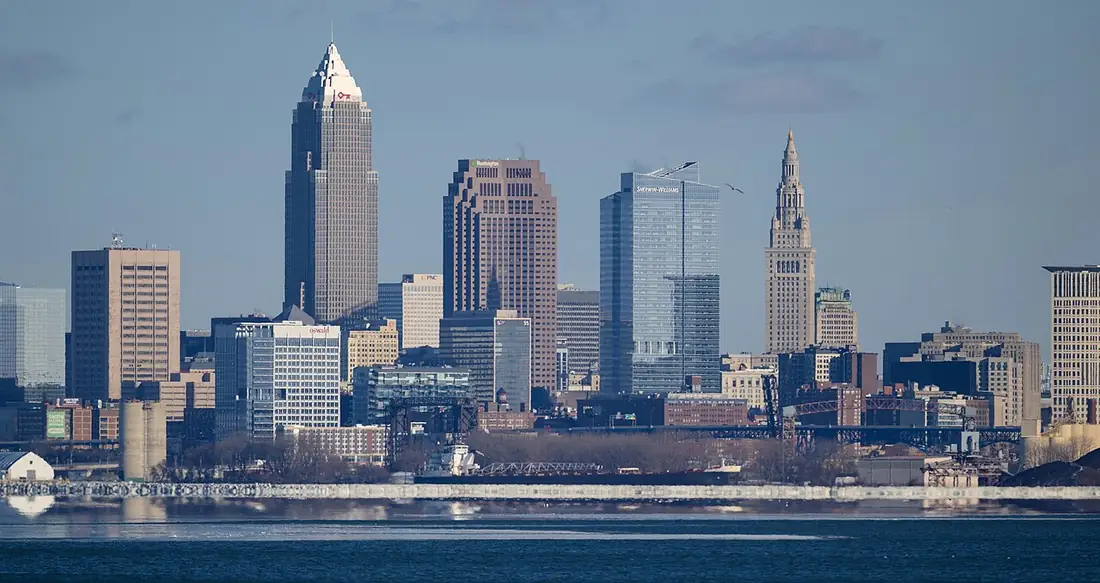
Drain cleaning in Cleveland, OH - Cuyahoga County - 40 ZIP codes covered
Drain Cleaning in Cleveland, OH
Cleveland has the oldest housing stock in this flagship group and the heaviest snow to go with it. The median home was built in 1941, and 71.2 percent of homes predate 1960, the highest prewar share of the ten cities covered here. Those homes drain through clay laterals and cast iron stacks that have survived eighty plus winters of lake effect weather, including an average 38.8 inches of snow a year. Over it all sits a combined sewer legacy managed regionally by the Northeast Ohio Regional Sewer District, NEORSD, where one pipe carries sewage and stormwater toward treatment plants on Lake Erie. When Cleveland drains fail, age, roots and wet weather are usually in the room together. DrainFlowed connects Cleveland homeowners with independent local contractors, and standard drain cleaning runs $99-$450.
Snow country plumbing: what 38.8 inches does underground
Cleveland's climate numbers set it apart from the other Ohio cities on this list. Annual precipitation averages 44.4 inches, similar to Cincinnati and Columbus, but snowfall averages 38.8 inches, more than double Cincinnati's figure, with 95 freeze days a year and only 3.8 heavy rain days. Lake effect snow changes the drain calendar. Instead of a few dramatic storms, Cleveland lines face repeated freeze and thaw cycles, long periods of saturated soil around shallow laterals, and melt events that send steady volume into the system for days at a time.
A lateral with a low section, a belly, feels that regime directly. Standing water sits in the sag, fine sediment settles into it all winter, and each thaw pushes more debris into the same trap. By late winter the effective diameter can be far smaller than it was in October, with no single event to blame. Homeowners describe this as a drain that gets worse every year around the same month. That seasonal fingerprint is worth reporting precisely when you book, because it points the camera operator at slope and standing water rather than only at the first root mass they meet.
Freeze also punishes marginal venting and shallow traps in older homes, which connects to the odor complaints Cleveland generates. A drain odor in a 1940s house in February can come from a trap affected by cold and disuse in a little used basement fixture, from organic buildup in a narrowed line, or from a genuine sewer gas path through a cracked fitting. Do not accept a scented cover up as a diagnosis. The contractor should identify which mechanism is at work, because the fixes are entirely different and only one of them involves cleaning at all.
Landlord owned doubles deserve one extra practice in this climate. Put the lateral on the property's own calendar, with a camera check at purchase and a cleaning interval set by what the footage shows, rather than waiting for the lower unit to report the emergency version. Cleveland's winter makes the emergency version worse than in milder cities, because a crew working around snow, frozen ground and a flooded basement in January faces conditions a planned autumn visit never meets. The cheapest Cleveland sewer work is almost always the work scheduled before the lake effect season, by an owner who treated an eighty year old clay line as the building system it is.
Drain problems we handle in Cleveland
The problems Cleveland's own housing, ground and weather produce most. The full symptom list is on the problems hub; these are the ones that earn their place here.
Recurring Clogs in Cleveland
A clog that returns is not bad luck. It is an undiagnosed cause - roots, scale, a belly, or a cleaning that never removed the material..
Multiple Drains Backing Up in Cleveland
Several drains failing together is the main line or sewer until proven otherwise. Stop the water, protect the floor, make the call..
Drain Odors in Cleveland
Sewer smell, rotten-egg smell, sour buildup smell.
Slow Drain in Cleveland
One slow fixture is a narrowing pipe. Several slow fixtures are a main-line warning. How to tell the difference and what fixes each..
1941 housing, read as a pipe inventory
Read the census figures as a materials list. A median build year of 1941 and 71.2 percent pre 1960 construction, with only 13.9 percent built from 1960 to 1979 and 8.9 percent after 2000, across 201,141 housing units, means Cleveland's default lateral is sectional clay and its default interior drain is cast iron, unless a renovation replaced them. Clay sections meet at joints that roots probe for moisture. Cast iron corrodes internally, and the rough scale it develops catches the hair, grease and sediment that a smooth modern pipe would pass. The failure style of this stock is gradual narrowing punctuated by sudden closure, not sudden breakage out of nowhere.
The single family share is 53.6 percent, so almost half the stock is doubles, multi unit buildings and conversions, where a shared lateral carries the load of several households. In a Cleveland double, the lower unit's backup is frequently the upper unit's usage arriving at a restriction neither tenant caused alone. Landlords in this market should treat camera records as part of the property file. Knowing that a lateral has roots at three joints and a belly at forty feet converts every future call about slow drains from an open ended argument into a lookup.
Because repairs and partial replacements are common in stock this old, many Cleveland lines are hybrids: clay from the house, a repaired section mid yard, a different material again near the main. Hybrid lines fail at the transitions. A camera inspection, at $125-$500, that narrates material changes, joint counts and offsets is therefore not a luxury in Cleveland. It is the basic map without which cleaning is guesswork and repair quotes are fiction. Ask for the footage and keep it.
About Cleveland: the local snapshot
Cleveland is a city in the U.S. state of Ohio, located along the southern shore of Lake Erie.
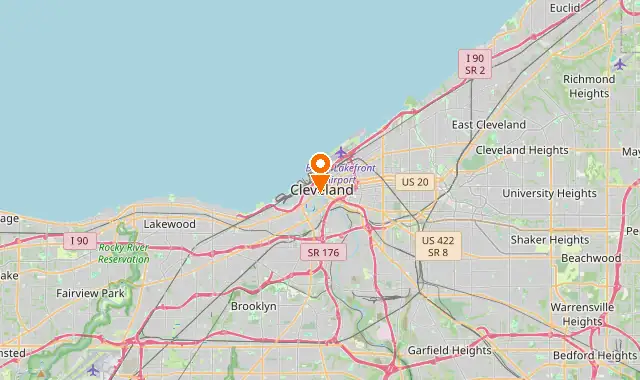
Local facts from Wikipedia and Wikidata, retrieved 2026-10-25. Population and area describe the city itself; the drain coverage counted on this page spans the wider area around it.
Combined sewers and the regional district above your street
Cleveland and its older inner ring suburbs run combined sewers, in which a single pipe conveys both stormwater and sanitary sewage. NEORSD explains that when those large sewers fill beyond capacity, typically during storms, relief points called outfalls discharge flow to the environment, such as Lake Erie or a nearby stream, and that the district works to minimise discharges and maximise treatment at its three plants, Easterly and Westerly in Cleveland and Southerly in Cuyahoga Heights. The regional system of interceptors and tunnels is NEORSD's responsibility. Local sewers remain the responsibility of each municipality, and private laterals remain yours. Three layers, three owners, one wet basement when they interact badly.
For diagnosis, use the neighbourhood test. A combined system under storm load tends to affect several properties on a street at once, and problems ease as flows subside. A private lateral restriction affects one house in all weather, getting steadily worse. Cleveland Water Pollution Control, the city division for local sewers, states the private side of this plainly in its guidance: tree roots enter through cracks and damage, the remedy is repairing the faulty pipe and removing roots, and maintenance of private sewers is the responsibility of private property owners, while the city repairs and cleans public lines.
Practical conduct during a storm backup is the same regardless of layer. Stop adding water, keep people and belongings away from the affected floor drain area, and note the timing and whether neighbours are affected. Then get your own line assessed once the event passes. A post storm camera run on a dry day, with main line cleaning at $200-$650 if buildup is found, gives you the private half of the picture in a form you can act on, and gives the city and district clean information if the public half needs attention.
Grease, wipes and roots: the WPC warnings are local data
Cleveland Water Pollution Control uses its public guidance to name the blockage ingredients it actually sees, and the list is worth treating as local evidence rather than generic advice. The division warns that disposable disinfectant wipes, baby wipes and so called flushable wipes cause serious problems because they do not break down once flushed, that paper products other than toilet paper behave the same way, and that when wipes meet food grease or invasive roots in the sewer they bind together into blockages with overflow potential. That binding mechanism is the detail to remember. A wipe alone may pass. A wipe arriving at a root fringe in a narrowed clay line becomes the net that catches everything behind it.
The same guidance asks residents to keep catch basins and storm drains clear of debris and to keep grass clippings, leaves, oil, paint and similar material out of them, because clogs in that system produce street flooding. In a combined sewer city, street level behaviour and basement level outcomes are connected by shared pipe capacity. Grease disposal gets the same treatment: container it and bin it, never pour it into a sink. Kitchen grease that cools inside a cold February lateral is the single most preventable ingredient in Cleveland winter stoppages.
None of this replaces cleaning an already narrowed line. It decides how long the cleaning lasts. A household that stops flushing wipes and stops pouring grease after a full diameter cleaning has removed the two ingredients that rebuild blockages fastest. A household that changes nothing should expect the calendar, not the contractor, to explain the next recurrence. When you book through DrainFlowed at (866) 555-0134, tell the contractor honestly what goes down your drains. The advice you get back will be more specific, and more useful, for it.
Hard water from Lake Erie, in proportion
Cleveland Water states its hardness openly: 7 grains per gallon, or 120 mg/L as calcium carbonate, which the utility places in the middle of the standard scale as moderate hardness, based on the naturally occurring mineral level in Lake Erie. The utility adds that hard water is not a health concern, and cautions that adding a whole house softener is not necessary for most residential customers, noting that salt based softening increases sodium intake and can make water more corrosive to home plumbing. That last point deserves attention in a city full of aging metal pipe. Aggressive softening and old galvanised or cast iron systems are not natural partners.
Where hardness does show up in drain work is at the margins. Scale contributes to the rough interior surface of older lines and to buildup inside water heating equipment, and fixture level flow problems in Cleveland are often aerator and showerhead scale rather than drain restrictions at all. A single slow bathroom faucet with normal drainage elsewhere is a supply fitting asking for attention, not a drain asking for a cable. Separating those two complaints at booking saves everyone time, and can save you the cost of the wrong visit entirely.
For the sewer lateral itself, roots, joints, slope and grease remain the main story, with hardness as background texture. Hydro jetting, at $300-$900, is the method that scours adhered buildup from pipe walls where the camera shows the pipe is sound enough for it. On fragile clay, a cable and cutter may be the first pass, with jetting judged after the footage is in. The sequence should be explained to you in terms of your pipe's condition, never as a house special.
Seasonal timing refines the point further. Scale and sediment present differently across the year in Cleveland because the water moving through the system changes temperature and the ground around shallow pipe changes state. A flow problem that appears only in deep winter at one fixture is a poor candidate for a sewer explanation and a good candidate for a local fitting, trap or exposed run explanation. Saying when a symptom happens, not only where, is the fastest way to keep a Cleveland contractor aimed at the right system, and it costs the homeowner nothing but attention.
Hiring in Cleveland: questions that fit this housing stock
Ask first about the map. Will the visit produce located camera footage showing material changes, joint condition, any belly holding water, and the distance to the main. In a city where most laterals are clay era originals or hybrids, that map is the product everything else depends on. Second, ask how the contractor separates a public system event from a private restriction, and what they found the last time they worked your street. Local pattern knowledge is real value in a combined sewer city, provided it is offered as experience rather than as a substitute for inspecting your line.
Confirm the responsibility paperwork in plain terms. The contractor is an independent local business. DrainFlowed connects you and does not perform or warrant the work. Verify license and insurance directly with the contractor, confirm who handles any permit for repair work, and get the scope in writing: standard cleaning at $99-$450, main line at $200-$650, emergency at $150-$700, each as ranges that the on site findings finalise. If a quote for major repair arrives without camera evidence behind it, the correct response in Cleveland is to pause and get the evidence first.
Last, plan the interval conversation like a Clevelander. If roots are the finding, ask how many joints are involved and how fast they regrew since any previous cleaning, because that regrowth rate, in this climate, sets a realistic maintenance rhythm. If the finding is a belly or a collapsed section, cleaning money is better redirected. Either answer is useful. What is not useful is another year of emergency calls on an eighty year old line nobody has actually looked at.
Drain services available in Cleveland
The services that answer Cleveland's lead problems, from the independent contractors who cover the city. Ranges are the national typical ranges used across this site.
| Service | Typical range | What it is |
|---|---|---|
| Drain Cleaning | $99-$450 | The core service: mechanical cleaning that clears the clog and scrapes the pipe walls, not just a hole poked through the blockage.. |
| Main Line Cleaning | $200-$650 | When every drain in the house slows at once, the problem is the main line. |
| Sewer Line Cleaning | $250-$900 | The buried line from your house to the street: root cutting, scale removal and jetting, with camera proof of the pipe's condition.. |
| Hydro Jetting | $300-$900 | High-pressure water that scours pipe walls clean - the answer for grease, scale and lines that keep re-clogging after cabling.. |
| Drain Camera Inspection | $125-$500 | See inside the pipe before you spend on the fix: roots, cracks, bellies and blockages located precisely, with footage to decide on.. |
| Emergency Drain Cleaning | $150-$700 | Sewage backing up, water rising, guests arriving: what counts as a drain emergency, what to do in the first ten minutes, and how the visit works.. |
Full detail on every service, with signs and causes, is on the services hub, and every range on the site is collected in the cost guide.
Cleveland coverage snapshot
Nearby covered cities: Strongsville, Euclid, Lakewood, Columbus.
Cleveland sewer and water resources
The city and utility pages this page's local facts rest on, worth bookmarking if you own a home in Cleveland:
Sources for this page
- sewer lateral responsibility: Cleveland Water Pollution Control: maintenance of private sewers is the responsibility of private property owners, owners are responsible for maintaining and repairing sewer laterals, city repairs and cleans public lines (source)
- combined sewer: City of Cleveland and older inner ring suburbs have combined sewers, NEORSD runs CSO control and three treatment plants (source)
- water hardness: Cleveland Water hardness 7 grains per gallon or 120 mg/L as calcium carbonate, moderate hardness from Lake Erie minerals (source)
- housing age: Median year built 1941, 71.2 percent pre 1960, highest pre 1960 share in this group, ACS 2024 5 year (source)
- climate: 38.8 inches annual snow, 95 freeze days, 3.8 heavy rain days, Open-Meteo ERA5 2014 to 2023 (source)
- Housing age: median year built and build-era shares (US Census Bureau ACS)
- Weather averages: 2014-2023 daily record (Open-Meteo archive, ERA5)
Coverage around Cleveland
Nearby cities we cover in Ohio
- Drain cleaning in Strongsville, OH
- Drain cleaning in Euclid, OH
- Drain cleaning in Lakewood, OH
- Drain cleaning in Columbus, OH
- Drain cleaning in Dayton, OH
- Drain cleaning in Akron, OH
- Drain cleaning in Toledo, OH
- Drain cleaning in Youngstown, OH
The full list for the state is on the Ohio locations page.
Beyond Cleveland
Coverage at this depth continues nearby: see drain cleaning in Columbus, OH and drain cleaning in Cincinnati, OH, each written from its own city's data the same way this page is.
Questions, answered
Who is responsible for my sewer lateral in Cleveland?
Cleveland Water Pollution Control states that maintenance of private sewers is the responsibility of private property owners, and that property owners are responsible for maintaining and repairing sewer laterals. The city repairs and cleans public sewer lines. A camera inspection, $125-$500, with locating, establishes where your problem sits before repair money is discussed.
What does a combined sewer mean for my basement?
Cleveland and its older inner ring suburbs use combined sewers, where one pipe carries stormwater and sanitary sewage, and NEORSD works to minimise combined sewer overflow discharges to Lake Erie and nearby streams. During major storms the system runs at capacity, and a house line already narrowed by roots or scale will back up first. Report storm linked, multi house events as public system information too.
How hard is Cleveland water?
Cleveland Water reports hardness of 7 grains per gallon, or 120 mg/L as calcium carbonate, based on minerals naturally present in Lake Erie, and describes it as moderate hardness. The utility notes hard water is not a health concern and that a whole house softener is not necessary for most homes. Expect gradual scale in hot water equipment rather than dramatic drain effects.
My Cleveland house was built in the 1930s. Is my lateral clay?
Very likely, in original form. With 71.2 percent of homes built before 1960 and a median year of 1941, most Cleveland laterals began as sectional clay, with cast iron drains inside. Many have been partially repaired since, which is why camera footage of your actual line matters more than the build year. The camera shows material changes, joints and root entry points along the run.
What does drain cleaning cost in Cleveland?
Standard drain cleaning runs $99-$450, main line cleaning $200-$650, hydro jetting $300-$900, sewer line services $250-$900, camera inspection $125-$500, and emergency service $150-$700. Your independent contractor confirms the amount for your line and access before work starts. DrainFlowed is a connection service and does not set that final price.
Can snowmelt cause a backup even without rain?
It can, through two routes. A sagging or joint damaged section can hold meltwater and debris as flow patterns change in a thaw, and freeze related narrowing in shallow sections reduces capacity just as snowmelt volume arrives. Note whether stoppages cluster in late winter. That timing, plus camera footage, helps a contractor separate a freeze and thaw pattern from simple root growth.
Drain problem in Cleveland? Make the call
A live person answers around the clock. Describe the problem, hear the likely range, and get an independent local contractor on the way.
(866) 555-0134 Tap to call nowA live person answers, day or night. Describe the problem, hear the likely range, then decide.