Drain cleaning in Cincinnati, OH - Hamilton County - 71 ZIP codes covered
Drain Cleaning in Cincinnati, OH
Cincinnati is one of the few cities in this group where a sewer backup can be a public system event, a private pipe event, or both at once, and the city has a formal program built around that distinction. The Metropolitan Sewer District of Greater Cincinnati, MSD, runs combined sewers across much of the older city, where one pipe carries sewage and stormwater together. When a storm fills that pipe, flow can reverse into basements through private building sewers. At the same time, 58.8 percent of Cincinnati homes predate 1960 and the median home was built in 1951, so the private side is often an aging clay lateral running down a hillside. Knowing which side failed is the whole game here. DrainFlowed connects you with independent local contractors, and standard drain cleaning runs $99-$450.
First question in Cincinnati: public backup or private backup
Start every Cincinnati backup with a fork in the road. MSD describes public sewer backups as what happens when a combined sewer fills with stormwater and flow stops moving toward treatment and pushes backward through private building sewers into buildings. Private backups are the more common case. MSD notes that about 85 percent of the time, sewer backups are not caused by the MSD public sewer, and the usual private causes are roots, grease and other material clogging the building sewer, or a broken and collapsed section. Both kinds can fill the same basement. They lead to completely different responsibilities, paperwork and next steps.
That is why the first call after a serious backup here should do two jobs. Report the event so MSD can judge whether the public system was involved, and get your own line assessed rather than assuming either answer. If neighbours on the same street backed up during the same storm, capacity in the public system moves up the list. If your house alone is affected on a dry day, the restriction is almost certainly in your building sewer. Write down the date, the weather, which fixtures were involved, and whether the problem cleared as the storm passed. Those details are evidence, and in Cincinnati they can determine whether a city program applies to you.
DrainFlowed's role in that moment is narrow and practical. Call (866) 555-0134 to be connected with an independent local contractor who can clear and camera your private line. A camera inspection, at $125-$500, is what turns an argument about causes into footage: a root mass at a joint, a collapsed section, or a clean private line that points attention back at the public side.
A short note on language helps Cincinnati owners read their own invoices and MSD letters accurately. The district calls your pipe a building sewer; plumbers often call it a lateral; older paperwork may call it a house tap. They are the same pipe. When a document assigns a duty or a cost, check which pipe name it uses and confirm it means the run from your building to the public main, because in this city's paperwork the difference between the building sewer and the public sewer is the difference between your ledger and MSD's.
Drain problems we handle in Cincinnati
The problems Cincinnati's own housing, ground and weather produce most. The full symptom list is on the problems hub; these are the ones that earn their place here.
Multiple Drains Backing Up in Cincinnati
Several drains failing together is the main line or sewer until proven otherwise. Stop the water, protect the floor, make the call..
Recurring Clogs in Cincinnati
A clog that returns is not bad luck. It is an undiagnosed cause - roots, scale, a belly, or a cleaning that never removed the material..
Gurgling Drains in Cincinnati
Gurgling is air moving where it should not - displaced by a partial blockage or a vent problem. It is one of the earliest main-line warnings..
Standing Water in Cincinnati
Water that will not go down has a blockage at a specific level. Which level decides whether it is a quick clean or a main-line job..
The MSD Sewer Backup Program, and its limits
MSD operates a Sewer Backup Program, often shortened to SBU, for property owners and tenants whose buildings take wastewater because of inadequate capacity or certain maintenance related issues in the public sewer. Within it, a Prevention Program assesses qualifying properties and can install protective systems. MSD lists possible solutions that include a backflow prevention device and a wastewater pump system, designed property by property after investigation steps that can include camera examination of the building sewer, dye testing, and a survey of elevations and drainage. MSD says the process takes on average six months to a year, which tells you it is a prevention track for repeat public backups, not an emergency response.
The limits matter as much as the offer. If a backup was caused solely by a private plumbing issue, the owner is responsible for cleanup and repairs and is not eligible for that assistance. Prevention Program participation also comes with conditions, including an approved design, a signed covenant recorded with the property, and restrictions on finishing the affected basement area while the process runs. None of that makes the program a bad deal for a house with repeated storm backups from a surcharging combined sewer. It makes it a specific deal, for a specific cause, and your private line still has to be kept clear either way.
Even if you never qualify, MSD's own prevention guidance is worth following. The district advises having the building sewer inspected and cleaned by a professional, considering a backflow valve discussion with a plumber, and keeping stormwater out of trouble by maintaining gutters and grading. In a combined system city, reducing what enters the pipes during a storm is not just environmental virtue. It is basement protection.
About Cincinnati: the local snapshot
Cincinnati is the most populous city in Hamilton County, Ohio, United States, and its county seat.
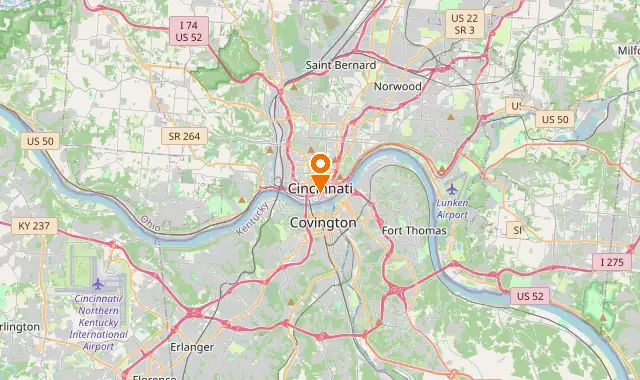
Local facts from Wikipedia and Wikidata, retrieved 2026-10-25. Population and area describe the city itself; the drain coverage counted on this page spans the wider area around it.
Your building sewer duties, stated precisely
MSD's wording is unusually clear, and Cincinnati owners should know it before they need it. A private building sewer, also called a house tap, lateral, or building sewer lateral, is the underground pipe connecting your plumbing to the MSD public sewer. Property owners are responsible for keeping the entire length of that line clear of clogs, even the portions lying under publicly owned sidewalks and streets. Owners are also responsible for repairing broken or collapsed portions located on private property. In some instances, MSD may undertake repair of the portion of a broken or collapsed building sewer located within a public easement or public right of way.
Read that split carefully, because it separates cleaning from structural repair. A root clog under the street is still your cleaning bill. A structural break under the street may be a case MSD handles. A structural break in your yard is yours. The only reliable way to place a problem on that map is a camera with a locator, so the contractor can state the distance from the house and the depth, not just the symptom. Main line cleaning runs $200-$650, and that locating work is what makes the conversation with MSD, if you need one, factual instead of hopeful.
Permits follow the same practical logic. Repair work needs the proper plumbing permit, and work in the street or sidewalk needs right of way authorisation and inspection. Confirm with your independent contractor who pulls which permit before excavation is discussed. DrainFlowed connects you with the contractor; the contractor carries the permit responsibility for the work they perform.
Hills, clay joints, and why Cincinnati clogs repeat
Cincinnati housing gives its laterals two handicaps at once. The median home was built in 1951, 58.8 percent predate 1960, and another 21.1 percent date from 1960 to 1979, across 160,409 housing units. That is a clay lateral city, with cast iron inside many homes. Sectional clay pipe fails at its joints first. Roots enter where moisture escapes, grow into nets, and catch everything solid that passes. Cleaning that only opens a channel through the root mass buys weeks. A full diameter cleaning that cuts roots back to the joint buys a season or more, and the camera afterward tells you how many joints are involved.
Then there is the topography. Cincinnati laterals frequently run down slopes, under steps, retaining walls and terraced yards, to mains in narrow streets below. Where a line crosses from loose fill into undisturbed ground, differential settling can offset a joint or create a belly that holds water permanently. A belly announces itself as a clog that returns to the same spot on camera, with standing water visible in the pipe between visits. Hydro jetting, at $300-$900, clears soft buildup thoroughly, but no cleaning tool corrects a sag. If the footage shows a belly or a sheared joint, the honest discussion shifts from cleaning intervals to repair options for that section.
Only 43.3 percent of Cincinnati housing is single family, so shared and multi unit buildings are a large part of the picture. In those properties, grease loading from several kitchens into one building sewer is a predictable pattern, and the lowest unit reports the problem that the whole building created. Owners of multi unit property should treat scheduled main line cleaning as routine maintenance here, not as an emergency purchase, and keep the camera records with the building file.
Roof drainage deserves a specific mention in Cincinnati because MSD investigations can include dye testing of gutters, downspouts and drains. In a combined sewer district, where roof water ends up matters. A downspout arrangement that sends storm volume toward the sanitary system adds your roof to the public load during exactly the storms when capacity decides whose basement floods. If an MSD investigation or a private plumber flags your roof drainage, treat the finding as part of the sewer work, not as landscaping. Redirecting roof water correctly is one of the few changes a homeowner can make that helps their own line and the street's system at the same time.
Hard water is a Cincinnati fact, within limits
Greater Cincinnati Water Works publishes its hardness by plant, which is more precision than most cities offer. Water from the Richard Miller Plant averages 126 mg per liter, or about 7 grains per gallon. Water from the Charles M. Bolton Plant averages 140 mg per liter, or about 8 grains per gallon. GCWW notes hardness does not affect the safety of the water. In practical household terms, that level of mineral content can contribute to scale inside water heaters and on fixtures over years of use, and it is worth checking aerators and showerheads for buildup when flow seems weak at a single fixture.
Keep the claim in proportion, though. Hardness acts on the supply side, in hot water equipment and at fixture outlets. It does not explain a main sewer backup, and it is not a substitute for the root and joint story that dominates Cincinnati drain work. Mention white crusting at fixtures to your contractor, by all means, because it helps separate a fixture restriction from a drain restriction. Just do not let a water treatment sales pitch talk you out of the camera inspection that actually diagnoses a building sewer. The two systems in your house share walls, not causes.
Cincinnati averages 45.4 inches of precipitation a year, with about 6.5 heavy rain days and 89 freeze days, on 2014 to 2023 data. That combination, wet storms on a combined system plus a real winter, is the backdrop for everything above. The drains that fail here usually fail for reasons you can see on a camera screen, in a specific joint, on a specific hillside run. Insist on that level of specificity.
Booking a Cincinnati visit that answers the right questions
Book with the public versus private question in mind. Tell the contractor whether the problem tracks rainfall, whether neighbours are affected, whether MSD has been notified, and what the camera has shown on any earlier visit. A single slow drain is a $99-$450 standard cleaning conversation. Multiple drains backing up together moves it into main line territory at $200-$650, with a camera inspection at $125-$500 strongly worth pairing in a city where responsibility depends on location. Emergency service runs $150-$700.
Ask two Cincinnati specific questions before work starts. First, will the cleaning cover the full diameter and full length of the building sewer, including the section under the sidewalk, since keeping that length clear is your duty under MSD's rule. Second, if the camera finds a structural defect, where exactly is it relative to your property line and the right of way, because that location decides whether it is your repair or a case to raise with MSD. A contractor who locates and documents defects as a routine habit is the right fit for this city.
DrainFlowed is a connection service. The independent contractor you are connected with sets the final price, pulls permits, and stands behind the work. Your protection is a clear scope before the cable goes in, camera evidence during it, and a written note of what was found and what is recommended next. In a city with a formal backup program, that documentation habit is worth more than any promise.
There is also a records habit Cincinnati owners should steal from the program itself. MSD documents investigations, camera findings and eligibility decisions as a matter of process, because capacity disputes are settled with files, not memories. Keep the same standard at home. Save the date and rainfall of every backup, the contractor's footage, and any MSD correspondence in one folder. If a second storm backup ever makes you a Prevention Program candidate, that folder is your application already half written, and if it never does, it is still the document set that makes your next contractor visit faster and cheaper.
Drain services available in Cincinnati
The services that answer Cincinnati's lead problems, from the independent contractors who cover the city. Ranges are the national typical ranges used across this site.
| Service | Typical range | What it is |
|---|---|---|
| Drain Cleaning | $99-$450 | The core service: mechanical cleaning that clears the clog and scrapes the pipe walls, not just a hole poked through the blockage.. |
| Main Line Cleaning | $200-$650 | When every drain in the house slows at once, the problem is the main line. |
| Sewer Line Cleaning | $250-$900 | The buried line from your house to the street: root cutting, scale removal and jetting, with camera proof of the pipe's condition.. |
| Hydro Jetting | $300-$900 | High-pressure water that scours pipe walls clean - the answer for grease, scale and lines that keep re-clogging after cabling.. |
| Drain Camera Inspection | $125-$500 | See inside the pipe before you spend on the fix: roots, cracks, bellies and blockages located precisely, with footage to decide on.. |
| Emergency Drain Cleaning | $150-$700 | Sewage backing up, water rising, guests arriving: what counts as a drain emergency, what to do in the first ten minutes, and how the visit works.. |
Full detail on every service, with signs and causes, is on the services hub, and every range on the site is collected in the cost guide.
Cincinnati coverage snapshot
Nearby covered cities: Cleveland, Columbus, Dayton, Akron.
Cincinnati sewer and water resources
The city and utility pages this page's local facts rest on, worth bookmarking if you own a home in Cincinnati:
Sources for this page
- sewer lateral responsibility: Owner keeps entire private building sewer clear of clogs including under sidewalks and streets, repairs structural defects on private property, MSD may repair structural defects in right of way or easement (source)
- city programs: MSD Sewer Backup Program with Prevention Program installing backflow prevention or pump systems for qualifying public sewer backups (source)
- combined sewer: Much of Cincinnati area has combined sewers, storm surcharge can push flow back through private building sewers into buildings (source)
- water hardness: GCWW Miller Plant average hardness 126 mg/L about 7 grains per gallon, Bolton Plant 140 mg/L about 8 grains per gallon (source)
- housing age: Median year built 1951, 58.8 percent pre 1960, ACS 2024 5 year via Census Reporter (source)
- Housing age: median year built and build-era shares (US Census Bureau ACS)
- Weather averages: 2014-2023 daily record (Open-Meteo archive, ERA5)
Coverage around Cincinnati
Nearby cities we cover in Ohio
- Drain cleaning in Cleveland, OH
- Drain cleaning in Columbus, OH
- Drain cleaning in Dayton, OH
- Drain cleaning in Akron, OH
- Drain cleaning in Toledo, OH
- Drain cleaning in Youngstown, OH
The full list for the state is on the Ohio locations page.
Beyond Cincinnati
Coverage at this depth continues nearby: see drain cleaning in Cleveland, OH and drain cleaning in Columbus, OH, each written from its own city's data the same way this page is.
Questions, answered
Who is responsible for my building sewer in Cincinnati?
You are responsible for keeping the entire length clear of clogs, even under sidewalks and streets, and for repairing structural defects on your own property. MSD states it may repair structural defects in the portion within a public right of way or easement. That split is why a camera inspection, $125-$500, matters before repair decisions.
Am I eligible for help from the MSD Sewer Backup Program?
Possibly. MSD runs a Sewer Backup Program for backups caused by inadequate capacity or certain maintenance issues in the public sewer, including a Prevention Program that can install devices such as a backflow prevention system or pump. Backups caused solely by a private plumbing problem are not eligible, and MSD notes most backups are private. Report the backup to MSD promptly so eligibility can be assessed.
Why does my basement back up during thunderstorms?
That timing points at capacity. Much of the Cincinnati area uses combined sewers carrying sewage and stormwater together, and MSD explains that during storms a full combined sewer can push flow backward through private building sewers into buildings. If your line is also narrowed, the effect is worse. Document the timing and report storm linked backups to MSD as well as having your own line checked.
How hard is Cincinnati water, and does it affect my drains?
Greater Cincinnati Water Works reports average hardness of 126 mg/L, about 7 grains per gallon, at the Richard Miller Plant, and 140 mg/L, about 8 grains, at the Charles M. Bolton Plant. That level of mineral content can leave scale in water using appliances and on fixtures. Scale is a supply side issue, but heavy buildup at fixtures is worth mentioning to your contractor during any drain visit.
What does drain cleaning cost in Cincinnati?
Standard drain cleaning runs $99-$450, main line cleaning $200-$650, hydro jetting $300-$900, sewer line services $250-$900, camera inspection $125-$500, and emergency service $150-$700. The independent contractor confirms the figure for your line, access and timing before starting. DrainFlowed connects you with that contractor and does not set the final price.
My lateral runs down a steep yard. Does slope cause repeat clogs?
Hillside movement is a common suspect where a line crosses from disturbed fill into stable ground. A camera inspection shows offsets, bellies and joint condition along the full run. Cleaning restores flow, at $99-$450 for a standard line, but a shifted joint that keeps catching debris may need a repair conversation based on what the footage shows.
Drain problem in Cincinnati? Make the call
A live person answers around the clock. Describe the problem, hear the likely range, and get an independent local contractor on the way.
(866) 555-0134 Tap to call nowA live person answers, day or night. Describe the problem, hear the likely range, then decide.