Drain cleaning in San Francisco, CA - San Francisco County - 31 ZIP codes covered
Drain Cleaning in San Francisco, CA
San Francisco asks its homeowners a question no other city in this set asks in quite the same way: which half of your sewer lateral is broken? The lateral here is split into an upper and a lower section with different owners of the repair bill, and that split sits inside the only combined sewer system on the California coast, beneath a housing stock with a median build year of 1946. Getting the geography of your own pipe right can be the difference between a cleaning bill and a repair the city carries. DrainFlowed matches you with an independent local contractor. Call (866) 555-0134 and describe the symptoms and the age of the house.
Upper lateral, lower lateral: the split that runs this city
SFPUC divides the residential sewer lateral into two sections. The upper lateral runs from the building to the property line area, and the lower lateral continues from there to the main in the street. As the property owner, you are fully responsible for the upper lateral: its maintenance, cleaning, jetting, and structural repair or replacement, all to the standards of the San Francisco Plumbing Codes. That part behaves like every other city on this site.
The lower lateral is where San Francisco becomes its own case. You are still responsible for maintaining it day to day, keeping it clear by jetting or other means and having it inspected by camera when trouble appears. But if that inspection shows the lower lateral needs structural repair or replacement, the process changes hands: you notify SFPUC through 311 or sf311.org, Sewer Operations inspects the line, and under most circumstances SFPUC completes the repair or replacement at no extra cost to you.
Everything in a San Francisco drain call should be organized around knowing which section a problem lives in. A blockage is a cleaning, and it is yours in both sections. A collapsed pipe is a structural job, and its address along the run decides whether the bill is yours or the city's. That is why the camera inspection, at $125-$500, is not an optional extra here. It is the survey that assigns the repair. Never let a contractor quote excavation on a lower lateral before SFPUC has seen the footage.
Drain problems we handle in San Francisco
The problems San Francisco's own housing, ground and weather produce most. The full symptom list is on the problems hub; these are the ones that earn their place here.
Recurring Clogs in San Francisco
A clog that returns is not bad luck. It is an undiagnosed cause - roots, scale, a belly, or a cleaning that never removed the material..
Multiple Drains Backing Up in San Francisco
Several drains failing together is the main line or sewer until proven otherwise. Stop the water, protect the floor, make the call..
Drain Odors in San Francisco
Sewer smell, rotten-egg smell, sour buildup smell.
Slow Drain in San Francisco
One slow fixture is a narrowing pipe. Several slow fixtures are a main-line warning. How to tell the difference and what fixes each..
The only combined sewer system on the California coast
San Francisco is the only coastal city in California that collects and treats wastewater and stormwater in the same pipes, a design inherited from the era when the city was first sewered. The numbers behind that design are dramatic. In dry weather the combined system carries over 80 million gallons a day to treatment. In wet weather it can carry over 500 million gallons a day, with treatment plants and storage structures built to capture and treat that surge. A network of underground transport and storage structures, much of it built in the 1980s and 1990s, holds storm flow back so it can be treated rather than discharged.
For a homeowner, combined sewers change the meaning of a storm backup. When the system runs at capacity, pressure can push back through laterals, and a house line already narrowed by grease feels it first. SFPUC's public guidance returns again and again to the same household behavior for this reason: fats, oils and grease must never go down the drain. Grease that leaves your kitchen liquid arrives at the cold pipe wall as a coating, and in a system that must also swallow a storm, every coated lateral is capacity the city does not have.
The city averages 21.6 inches of rain a year with about 4.0 heavy rain days, so the stress arrives in concentrated doses rather than steadily. The practical defences are the grease rule, strainers in sinks, and only the three Ps in the toilet, pee, poo and toilet paper, all of which SFPUC states plainly. A lateral kept genuinely clear in October is the cheapest storm preparation a San Francisco home can buy.
The household end of that system deserves the same respect as the engineering end. Everything a San Francisco kitchen sends down its drain enters a pipe that may, on the same day, be asked to carry storm flow measured in hundreds of millions of gallons. SFPUC's grease guidance is written for the system as a whole, but it is executed one pan at a time, in individual kitchens, on ordinary Tuesdays. A lateral that enters storm season already coated is a small pipe making a large system's problem measurably worse, starting with its own building. The cheapest capacity upgrade available to this combined network is not a bond measure. It is a strainer, a wiped pan, and a lateral cleaned before the rains rather than during them.
About San Francisco: the local snapshot
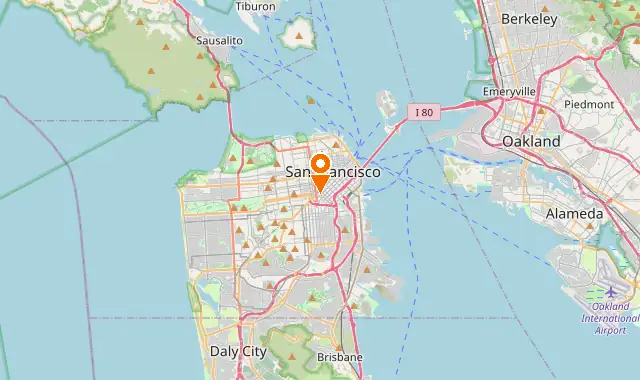
Local facts from Wikipedia and Wikidata, retrieved 2026-10-25. Population and area describe the city itself; the drain coverage counted on this page spans the wider area around it.
1946 above ground, older still below it
The Census profile is the oldest on the West Coast in this set. San Francisco's 414,602 housing units have a median year built of 1946, with 61.3 percent predating 1960, 15.1 percent from 1960 to 1979, and just 14.4 percent built after 2000. Only 30.4 percent of homes are single family, which means most drainage runs through multifamily buildings, shared stacks, and laterals that serve many households at once.
Under those buildings sits pipe of the same vintage: clay laterals in short jointed sections, cast iron inside, all of it cycled through a century of small earthquakes, soil movement on filled ground and ordinary corrosion. The failure modes follow the materials. Clay joints open and admit roots. Iron corrodes from inside until its wall weeps. Sections laid on bay fill settle against sections on firmer ground, creating the offsets a camera finds where two pipe ends no longer quite meet.
In shared buildings, the symptom map matters. A backup that appears in the lowest unit only is usually announcing a lateral or building drain problem, not that unit's fixtures. Grease from a dozen kitchens travels the same stack, so a building's drain history is a collective record, and condo associations and landlords here do well to keep lateral camera footage on file the way they keep roof records. In this housing stock, documentation is maintenance.
Soft Hetch Hetchy water changes the diagnosis
San Francisco's water comes largely from the Hetch Hetchy system, and it is soft: SFPUC figures report hardness ranging from 9.1 to 49 ppm with an average around 41 ppm. That is a fraction of the hardness in Phoenix or San Diego water. Mineral scale, the slow white narrowing that dominates drain talk in hard water cities, is a minor actor here, and any pitch built on dissolving scale in a San Francisco drain should be treated with suspicion.
What narrows these drains instead is the pairing of grease with old pipe texture. Corroded iron gives grease a rough wall to key into, and the city's dense restaurant and home cooking culture supplies the grease generously. SFPUC names fats, oils and grease as a primary enemy across its guidance, and the three Ps rule for toilets exists because everything else, wipes included, catches on exactly those rough, greased surfaces and builds the mat that stops the line.
The cleaning implications are concrete. Grease and mat respond to mechanical cleaning and, on main lines, hydro jetting in the $300-$900 range, which strips the wall rather than boring a hole through the blockage. Roots at a clay joint need cutting and a record of which joint, for the upper versus lower question. And a line that re-greases within a year is usually a habits problem arriving faster than the pipe is failing, which is the cheapest diagnosis a homeowner can get, because habits are free to change.
Odors, gurgles and the older building's quiet signals
Not every San Francisco drain problem announces itself with standing water. In older buildings, drain odors and gurgling are often the first language a lateral speaks. An odor that comes and goes with the weather can track system pressure in the combined network pushing against a weak trap seal. A gurgle when a neighbour's tub drains points at venting shared across a stack. With no freeze days in the climate record, the frozen vent explanation that applies in northern cities does not apply here, which narrows the local differential in a useful way.
The discipline is to record the pattern before spending. Which fixtures, which times of day, which weather, and whether the lowest unit is affected first. In a city of shared stacks and split laterals, that pattern is often enough for a contractor to arrive with the right equipment and a camera on the first visit rather than the third. Vague symptoms get exploratory invoices. Documented symptoms get diagnoses.
A sewer odor that persists after traps are confirmed full and vents are checked deserves the camera as well, because a cracked section in an upper lateral can vent gas into soil and wall cavities for a long time before it ever slows a drain. Old pipe fails quietly before it fails completely. The homeowners who come out ahead in this housing stock are the ones who treat the quiet signals as worth one inspection, priced at $125-$500, rather than as background noise to live with until the loud failure chooses its own timing.
What a useful camera inspection looks like in this city
A camera inspection can be thirty seconds of murky video that proves nothing, or it can be the document that assigns a five figure repair to the right owner. In San Francisco, where the upper and lower lateral split turns location into money, the difference between those two inspections is worth understanding before you book one. A useful San Francisco inspection produces three things: footage, distances, and a written finding that names which section of lateral each fault sits in.
The footage should carry a running distance counter, so that a root entry or a crack is recorded at a measured number of feet from the access point rather than described as out there somewhere. The operator should identify the transition between the upper and lower lateral on the recording and narrate it, because that junction is the border between your repair obligation and SFPUC's process. If the problem section is the lower lateral, the footage becomes the supporting evidence for the 311 notification that starts Sewer Operations' own inspection, so clarity is not a courtesy. It is the mechanism.
Ask for the finding in writing before the contractor leaves: the material of the line, the faults found, their distances, and the recommended next step separated into cleaning matters and structural matters. Contractors who work this city's laterals routinely produce exactly that, because the SFPUC process demands it. A quote for excavation that arrives without footage and distances behind it is asking you to fund the most expensive possible interpretation of a symptom, in the one city where a public process might carry the structural part.
Finally, keep the recording itself. Buildings here change owners, managers and tenants while the lateral stays the same, and a dated camera record is the closest thing the pipe has to a medical chart. The next problem, whenever it comes, will be diagnosed in half the time by anyone who can compare the line as it is with the line as it was.
What drain work costs in San Francisco, and how the call works
San Francisco work uses the same published national ranges. Itemized for this city: standard cleaning $99-$450; main line cleaning $200-$650; sewer line cleaning $250-$900; hydro jetting $300-$900; camera inspection $125-$500; emergency visit $150-$700. In San Francisco the highest value line item is often the camera, because its footage decides the upper versus lower question and can move a five figure structural question onto SFPUC's side of the ledger through the 311 process.
DrainFlowed operates as a connection service rather than a plumbing company. Call (866) 555-0134, describe the fixtures and the pattern, and you are connected with an independent local contractor who sets their own price within the range you discuss. Verify their licence and insurance before work begins, and ask them to mark distances on any camera footage, because a measurement in feet from the cleanout is what SFPUC will want if the fault sits in the lower lateral.
Keep the footage and the invoice. Between the split lateral rule, the combined system overhead, and a housing stock with a 1946 median, a San Francisco drain file is a genuinely financial document. The next problem, the next owner, and the city itself may all ask what your lateral looked like, and the household that can answer in pictures rather than memory starts every negotiation ahead.
Drain services available in San Francisco
The services that answer San Francisco's lead problems, from the independent contractors who cover the city. Ranges are the national typical ranges used across this site.
| Service | Typical range | What it is |
|---|---|---|
| Drain Cleaning | $99-$450 | The core service: mechanical cleaning that clears the clog and scrapes the pipe walls, not just a hole poked through the blockage.. |
| Main Line Cleaning | $200-$650 | When every drain in the house slows at once, the problem is the main line. |
| Sewer Line Cleaning | $250-$900 | The buried line from your house to the street: root cutting, scale removal and jetting, with camera proof of the pipe's condition.. |
| Hydro Jetting | $300-$900 | High-pressure water that scours pipe walls clean - the answer for grease, scale and lines that keep re-clogging after cabling.. |
| Drain Camera Inspection | $125-$500 | See inside the pipe before you spend on the fix: roots, cracks, bellies and blockages located precisely, with footage to decide on.. |
| Emergency Drain Cleaning | $150-$700 | Sewage backing up, water rising, guests arriving: what counts as a drain emergency, what to do in the first ten minutes, and how the visit works.. |
Full detail on every service, with signs and causes, is on the services hub, and every range on the site is collected in the cost guide.
San Francisco coverage snapshot
Nearby covered cities: San Diego, Riverside, Sacramento, San Jose.
San Francisco sewer and water resources
The city and utility pages this page's local facts rest on, worth bookmarking if you own a home in San Francisco:
Sources for this page
- housing age and mix: Median year built 1946, 61.3 percent pre 1960, 15.1 percent built 1960 to 1979, 14.4 percent post 2000, 414,602 units, 30.4 percent single family (source)
- climate: 21.6 in annual precipitation, 0 in snow, 0 freeze days, 4.0 heavy rain days per year (2014 to 2023 average) (source)
- sewer lateral responsibility: Owner fully responsible for the upper lateral; owner maintains and camera inspects the lower lateral, but structural repair or replacement of the lower lateral is performed by SFPUC at no extra cost in most circumstances after notification via 311 (source)
- combined sewer: Only coastal city in California with a combined sewer system; dry weather flow over 80 million gallons per day, wet weather over 500 million gallons per day treated (source)
- water hardness: SFPUC hardness range 9.1 to 49 ppm, average 41 ppm, soft water from the Hetch Hetchy supply (source)
- Housing age: median year built and build-era shares (US Census Bureau ACS)
- Weather averages: 2014-2023 daily record (Open-Meteo archive, ERA5)
Coverage around San Francisco
Nearby cities we cover in California
- Drain cleaning in San Diego, CA
- Drain cleaning in Riverside, CA
- Drain cleaning in Sacramento, CA
- Drain cleaning in San Jose, CA
- Drain cleaning in Fresno, CA
- Drain cleaning in Mission Viejo, CA
- Drain cleaning in Los Angeles, CA
The full list for the state is on the California locations page.
Beyond San Francisco
Coverage at this depth continues nearby: see drain cleaning in San Diego, CA and drain cleaning in Riverside, CA, each written from its own city's data the same way this page is.
Questions, answered
My plumber says the sewer lateral under the sidewalk is broken. Who pays in San Francisco?
The split is the point. You maintain, clear and inspect the whole lateral, upper and lower. If a camera shows the lower lateral needs structural repair or replacement, notify SFPUC through 311 before paying anyone. SFPUC Sewer Operations inspects, and in most circumstances completes that lower lateral work itself at no extra cost to you. An upper lateral structural problem remains yours.
How do I notify SFPUC about a lower lateral problem?
Through 311 or sf311.org, once a plumber has identified a structural problem in the lower lateral. SFPUC Sewer Operations then inspects the line itself. Do not authorise a private repair of the lower section before that inspection, because the city's own process may cover the work, and private excavation can complicate it.
Why do drains misbehave during big San Francisco storms?
Start with the scale of the system. San Francisco's combined sewers carry over 80 million gallons a day in dry weather and over 500 million gallons a day in wet weather to treatment. In an intense storm the pipes can run at capacity, and a lateral already narrowed by grease has no margin. SFPUC identifies fats, oils and grease down drains as a core behavior to change for exactly this reason.
Is San Francisco water hard?
No. SFPUC water is soft, averaging about 41 ppm hardness from the Hetch Hetchy supply. Narrowed drains here are grease, hair, and corrosion or root damage in old pipe, not mineral scale, so treatment aimed at scale is money spent on a problem this city's water does not create.
How much does drain cleaning cost in San Francisco?
A standard cleaning runs $99-$450, main line work $200-$650, and the camera inspection that maps upper versus lower runs $125-$500. Because the lower lateral split can move a structural repair to SFPUC, that camera footage has unusual financial value in this city. The range is yours to agree with the independent contractor before work begins.
What should I do with cooking grease in San Francisco?
Do not pour it anywhere near a drain. SFPUC's rule is blunt: fats, oils and grease never go down the drain, because they are a leading cause of sewer trouble in a combined system. Wipe pans into the trash, and use sink strainers. Toilets take only the three Ps, pee, poo and toilet paper.
My drains work, but the house is from the 1920s. Should I get a camera inspection anyway?
The housing stock argues for it. With a median build year of 1946 and 61.3 percent of homes predating 1960, most laterals have joints that have been cycling for 70 plus years. A camera while the line still drains gives you the upper and lower condition on record, which is the document every later decision in this city depends on.
Drain problem in San Francisco? Make the call
A live person answers around the clock. Describe the problem, hear the likely range, and get an independent local contractor on the way.
(866) 555-0134 Tap to call nowA live person answers, day or night. Describe the problem, hear the likely range, then decide.