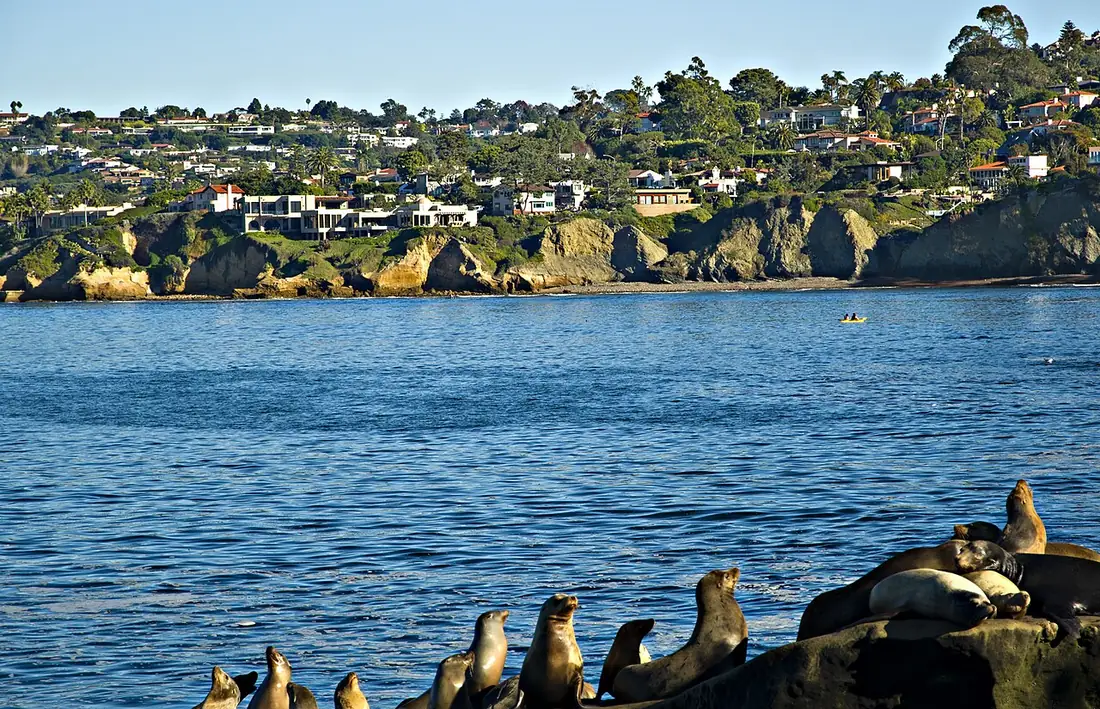
Drain cleaning in San Diego, CA - San Diego County - 76 ZIP codes covered
Drain Cleaning in San Diego, CA
San Diego runs two numbers that explain most of its drain trouble. The first is 16 grains per gallon, the average hardness of the city's drinking water, roughly 276 ppm, which coats the inside of drain lines year after year. The second is the full length of your lateral, because in San Diego the homeowner's responsibility runs from the house all the way to the connection with the sewer main, and that connection might sit out in the street, on an easement, or down in a canyon. Hard water above ground and a long owned pipe below it shape every call. DrainFlowed puts you in touch with an independent local contractor. Call (866) 555-0134 and describe the fixtures and the age of the home.
Your lateral runs to the main, wherever the main happens to be
The City of San Diego states the ownership rule in one unforgiving sentence: the property owner is responsible for maintenance of the lateral from the property all the way to the connection with the sewer main. The same guidance explains why that sentence bites harder here than in other cities. Depending on the neighbourhood and the era of construction, the connection may be located in the street well past the property line, across an easement, or in a canyon, and the owner's pipe runs to meet it in all of those places.
Within that long run, the city splits the remedy. A break or crack between the house and the property line is the homeowner's repair, full stop. If a licensed plumber determines that a break or collapse lies beyond the property line, the route changes: the plumber submits a Plumber's Report through the City Sewer Emergency Line at 619-515-3525, and the city investigates within 24 hours. That process is the reason a camera inspection with a locator matters so much in San Diego. The footage and the measured location are what move a street side failure into the city's hands.
For ordinary blockages there is no such handoff; cleaning the line is the owner's job along its whole length. The practical advice is to know your own geometry before you need it. Ask any contractor who televises your line to mark the cleanout, the route, and the connection point. In a city where your pipe may end in a canyon, that map is a household document on par with the survey.
Drain problems we handle in San Diego
The problems San Diego's own housing, ground and weather produce most. The full symptom list is on the problems hub; these are the ones that earn their place here.
Slow Drain in San Diego
One slow fixture is a narrowing pipe. Several slow fixtures are a main-line warning. How to tell the difference and what fixes each..
Recurring Clogs in San Diego
A clog that returns is not bad luck. It is an undiagnosed cause - roots, scale, a belly, or a cleaning that never removed the material..
Multiple Drains Backing Up in San Diego
Several drains failing together is the main line or sewer until proven otherwise. Stop the water, protect the floor, make the call..
Sixteen grains: the hardest working number in San Diego plumbing
San Diego's water is imported and mineral rich, and the city publishes the consequence plainly: drinking water averages about 16 grains per gallon of hardness, about 276 ppm, ranging between 16 and 18 grains. The city's annual reporting breaks the same story down by treatment plant, with treated water hardness measured in the 216 to 230 mg/L range at its plants. However you read it, this is hard water by national standards, several times harder than Seattle or San Francisco water, and it touches every drain in the city every day.
Scale from that water narrows pipes by accumulation rather than event. A wall that starts smooth develops a mineral roughness, the roughness catches grease film and soap, and the working bore shrinks across years. Homeowners meet it first at the shower and the kitchen sink. Because the process is gradual, it is also deniable, right up until the day a line that was slow becomes a line that stands full of water. The cleaning that answers it is mechanical and thorough: cabling that scrapes the wall, or hydro jetting in the $300-$900 range for lines where coating is established.
Hard water also reframes the maintenance interval question. In a soft water city, a cleaned line can stay clean for many years if habits are good. In San Diego, the water itself is a continuous input, so even perfect habits slow rather than stop the recoating. Owners of older homes do well to ask the contractor what the cable brought back and how fast the line is likely to coat again, then plan the next cleaning as maintenance instead of meeting it later as an emergency.
About San Diego: the local snapshot
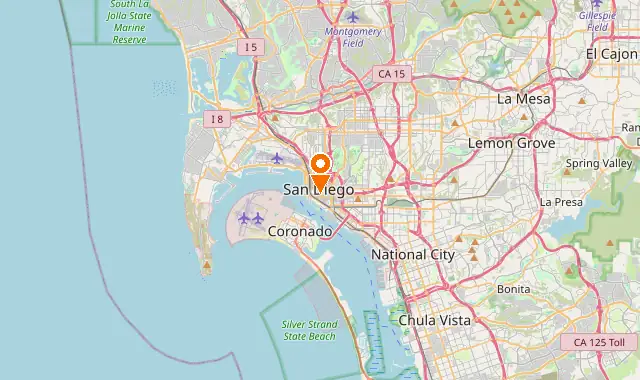
Local facts from Wikipedia and Wikidata, retrieved 2026-10-25. Population and area describe the city itself; the drain coverage counted on this page spans the wider area around it.
A 1979 stock, coastal and canyon cut
San Diego's housing profile sits between the old eastern cities and the desert new builds. Of 568,668 housing units, 20.5 percent predate 1960, 31.9 percent date from 1960 to 1979, and 19.5 percent were built after 2000, with a median year built of 1979 and single family homes at 53.0 percent. The 1960 to 1979 band is the city's drain centre of gravity: old enough for its metal and early plastic lines to have lived a full life in hard water, young enough that owners often assume the plumbing is still middle aged.
Topography writes the second half of the story. San Diego is cut by canyons, and sewer laterals follow the land. The city's own guidance warns owners that connections may sit in a canyon, which produces laterals that run long and downhill, crossing slope soil that shifts a little with the seasons. A shifted joint on a canyon run admits roots exactly the way a city joint does, but it is harder to reach, harder to excavate, and more expensive to get wrong, which again rewards diagnosis by camera before any digging is discussed.
For the post 2000 stock the picture is simpler: plastic lines, shorter runs in flatter subdivisions, and problems that trace to habits and objects rather than materials. The symptom language is the same, a slow drain is a slow drain, but the contractor's first hypothesis should follow the build year and the lot. Tell them both when you call. It takes ten seconds and it steers the whole visit.
Roots and grease: the two causes the city itself names
San Diego's utility does something useful for homeowners: it names its enemies. Roots and cooking grease, the city says, are the leading causes of spills in the public sewer system, and it repeats the same pairing for spills in private laterals. That is a rare bit of official candour, and it matches the local conditions. Mature landscaping on canyon lots sends roots toward any joint that leaks moisture, and a warm climate kitchen produces grease all year without the winter pause northern cities get.
Root intrusion follows a script. Fine roots enter at a joint, thicken on the nutrient flow inside the pipe, and form a net that catches paper and solids until the line dams. Cutting the roots restores flow, usually as a main line job in the $200-$650 range, but the opening remains, and regrowth on a one to three year rhythm is common. The decision point is not whether roots will return to an open joint. It is whether the joint is one flaw in a sound line, worth managing, or one of several in a failing one, which a camera settles in a single visit.
Grease is the faster, dumber problem, and the more preventable one. It enters liquid, coats the first cold wall it meets, and narrows kitchen lines in homes of any age. In hard water San Diego it layers over scale roughness and sets harder than it does in soft water cities, which is why kitchen lines here can go from fine to finished with little warning. The countermeasure never changes: wipe and trash cooking fat, never rinse it away, and treat any contractor visit for a kitchen line as the moment to reset the habit, not just the pipe.
Slow, standing, backing up: the escalation ladder
Drain symptoms in San Diego climb a ladder, and knowing the rungs saves money. A single slow fixture is a local restriction, usually in that fixture's branch: scale and hair in a bathroom, grease in a kitchen. Standing water in one fixture means that branch has closed completely, and the correct move is to stop using it, bail what you can, and book the cleaning, because nothing poured into standing water reaches the blockage in useful strength.
Multiple drains misbehaving at once, gurgling at low fixtures, or water rising in a shower when the washing machine discharges all move the problem to the main line, and on a San Diego lot that usually means the lateral. That is a main line call, $200-$650, and it is the rung where a camera earns its $125-$500 most clearly, because the main line differential here includes roots at a canyon joint, a shifted section, and the street side break that belongs in a Plumber's Report rather than on your credit card.
The top rung is sewage at a cleanout or inside the house. Stop all water use, since every flush adds to a line with nowhere to send it, and treat the call as urgent, with emergency work in the $150-$700 range. A cleanout spill after heavy use is also information: the city's 13.9 inches of annual rain with about 3.2 heavy rain days does not drive these events the way storms drive eastern backups, so a San Diego backup is almost always your own line announcing itself. Believe it the first time.
Cable or jet: picking the tool in hard water country
Two machines do most drain cleaning, and San Diego's hard water makes the choice between them a real decision rather than a house preference. A cable machine drives a rotating steel cable with a cutting or scraping head through the line. It is excellent at punching through a mat, cutting root curtains and retrieving objects, and it restores flow quickly. What a cable can leave behind, especially on a scaled wall, is a tunnel: the line flows, but a ring of coating remains on the pipe, ready to catch the next load of grease and hair and start the narrowing again.
Hydro jetting answers with water at high pressure, scouring the wall itself rather than just the blockage. On a line coated by years of 16 grain water and kitchen grease, jetting, in the $300-$900 range, is the method that returns the bore to something close to its original diameter, which is why it is so often the right second step for a San Diego line that was cabled open a year ago and has already slowed again. The recurrence interval is the tell. If each cleaning buys less time than the one before, the wall, not the blockage, has become the problem.
The choice is not automatic, because jets are hard on pipe that is already failing. A fragile, corroded or partly collapsed section should be televised before anyone puts pressure through it, which is why the camera, at $125-$500, so often sequences the work in this city: look first, then choose the tool the pipe can honestly take. Roots at a canyon joint, scale on a sound wall and grease over corrosion are three different lines wearing the same symptom, and each wants a different machine.
A good contractor will explain the choice in those terms, material and condition first, machine second. A quote that names equipment before anyone has discussed what is in your line is a sales document, not a diagnosis. In a city where the water itself guarantees the coating returns, the goal of any visit is the longest honest interval before the next one, and that interval is set by how completely the wall was cleaned, not by how fast the water first drained.
What drain work costs in San Diego, and how the call works
San Diego pricing follows the national schedule published across DrainFlowed. On that schedule a standard drain cleaning sits at $99-$450, main line cleaning at $200-$650, sewer line cleaning at $250-$900, hydro jetting at $300-$900, a camera inspection at $125-$500 and an emergency visit at $150-$700. A one fixture scale or grease job sits low in its range. A canyon lateral that needs cleaning, a camera, and locating sits higher, and it earns the spend, because the footage may be the document that hands a street side break to the city.
DrainFlowed is a connection service. The contractor who arrives is an independent local business, agrees the price range with you before work begins, and carries their own licence and insurance for you to verify. When you call (866) 555-0134, give the build year, the fixtures involved, and any history of the same line failing. In a city defined by hard water and long laterals, history is not small talk. It is half the diagnosis.
After the visit, keep the camera findings with your house papers, including where the connection to the main was located. San Diego owners hold an unusual amount of pipe and an unusual amount of paper responsibility for it, and the households that fare best here are simply the ones who can prove where their line runs and what condition it was in the last time anyone looked.
Drain services available in San Diego
The services that answer San Diego's lead problems, from the independent contractors who cover the city. Ranges are the national typical ranges used across this site.
| Service | Typical range | What it is |
|---|---|---|
| Drain Cleaning | $99-$450 | The core service: mechanical cleaning that clears the clog and scrapes the pipe walls, not just a hole poked through the blockage.. |
| Clogged Drain Service | $120-$550 | For the drain that is already blocked: diagnosis first, then the right fix, so the same clog does not come back next month.. |
| Main Drain Cleaning | $200-$650 | When every drain in the house slows at once, the problem is the main line. |
| Sewer Line Cleaning | $250-$900 | The buried line from your house to the street: root cutting, scale removal and jetting, with camera proof of the pipe's condition.. |
| Hydro Jetting | $300-$900 | High-pressure water that scours pipe walls clean - the answer for grease, scale and lines that keep re-clogging after cabling.. |
| Sewer Camera Inspection | $125-$500 | See inside the pipe before you spend on the fix: roots, cracks, bellies and blockages located precisely, with footage to decide on.. |
Full detail on every service, with signs and causes, is on the services hub, and every range on the site is collected in the cost guide.
San Diego coverage snapshot
Nearby covered cities: Poway, National City, Santee, La Mesa.
San Diego sewer and water resources
The city and utility pages this page's local facts rest on, worth bookmarking if you own a home in San Diego:
Sources for this page
- housing age and mix: Median year built 1979, 20.5 percent pre 1960, 31.9 percent built 1960 to 1979, 19.5 percent post 2000, 568,668 units, 53.0 percent single family (source)
- climate: 13.9 in annual precipitation, 0 in snow, 0 freeze days, 3.2 heavy rain days per year (2014 to 2023 average) (source)
- sewer lateral responsibility: Owner maintains the lateral from the property to the connection with the sewer main, which may be in the street, on an easement or in a canyon; breaks beyond the property line go through a Plumber's Report to the City Sewer Emergency Line 619-515-3525, investigated within 24 hours (source)
- water hardness: City drinking water averages about 16 grains per gallon (about 276 ppm), ranging 16 to 18 grains per gallon (source)
- local causes: City names roots and cooking grease as the leading causes of spills in the public sewer system and in private laterals (source)
- Housing age: median year built and build-era shares (US Census Bureau ACS)
- Weather averages: 2014-2023 daily record (Open-Meteo archive, ERA5)
Coverage around San Diego
Areas and neighbourhoods in and around San Diego
Calls also come in from La Jolla, San Ysidro and the streets between them. Those areas sit inside the same coverage, on the same contractor rounds.
La JollaSan Ysidro
Nearby cities we cover in California
- Drain cleaning in Poway, CA
- Drain cleaning in National City, CA
- Drain cleaning in Santee, CA
- Drain cleaning in La Mesa, CA
- Drain cleaning in Encinitas, CA
- Drain cleaning in San Marcos, CA
- Drain cleaning in Vista, CA
- Drain cleaning in El Cajon, CA
The full list for the state is on the California locations page.
Beyond San Diego
Coverage at this depth continues nearby: see drain cleaning in San Francisco, CA and drain cleaning in Riverside, CA, each written from its own city's data the same way this page is.
Questions, answered
Why do San Diego drains keep clogging even after cleaning?
Hard water scale and canyon geometry split the blame. City water averages about 16 grains per gallon, hard enough to coat pipe walls steadily, and many San Diego laterals run long, through easements and canyons, giving roots and offsets more chances to develop. If the same line recurs, a camera inspection at $125-$500 should replace a third cleaning, because coating, roots and a shifted joint are three different fixes.
My plumber found a break under the street. What happens now in San Diego?
Call the City Sewer Emergency Line at 619-515-3525 through your plumber's report process. When a licensed plumber determines a break or collapse is beyond your property line, they file a Plumber's Report and the city investigates within 24 hours. Breaks between the house and the property line are the homeowner's repair.
Is San Diego water really hard enough to narrow pipes?
Yes, in this city it is real. The City of San Diego reports drinking water averaging about 16 grains per gallon of hardness, roughly 276 ppm. That lays scale on pipe walls continuously, and scale catches grease and debris. Show me the cable or camera evidence is a fair request, but the underlying chemistry is documented city data.
How much does drain cleaning cost in San Diego?
A standard cleaning runs $99-$450, main line cleaning $200-$650, hydro jetting $300-$900 and a camera inspection $125-$500. A canyon side lateral that needs locating and televising sits higher than a simple sink line. You settle the range with the independent contractor before work begins, when you call (866) 555-0134.
What should I ask before any digging on my San Diego property?
Ask the contractor where your connection sits. In San Diego it may be out in the street past the property line, on an easement, or in a canyon behind the house, and your responsibility runs to that connection wherever it is. A camera with a locator gives you the map, which matters if the line ever needs work again.
Grease and roots keep coming up. Are they really the top causes here?
The city names the same two causes for both: tree roots and cooking grease are the leading causes of spills in the public system and in private laterals alike. A cleanout spill is a main line event, so stop water use in the house and book a main line cleaning rather than opening fixtures one by one.
There is a sewer smell in a bathroom we rarely use. What now?
A dried trap is the likely suspect. San Diego's dry climate and long gaps between uses let trap water evaporate, especially in guest baths and floor drains. Pour water through every fixture in the room, add it to a seasonal routine, and only escalate if the smell persists with full traps.
Drain problem in San Diego? Make the call
A live person answers around the clock. Describe the problem, hear the likely range, and get an independent local contractor on the way.
(866) 555-0134 Tap to call nowA live person answers, day or night. Describe the problem, hear the likely range, then decide.