
Drain cleaning in Oklahoma City, OK - Oklahoma County - 73 ZIP codes covered
Drain Cleaning in Oklahoma City, OK
Oklahoma City spreads out. At 1,607.6 square kilometers it is the largest city by area in this series, with 306,366 housing units, 71.0 percent of them single family, and a median build year of 1982. Laterals here can be long runs across big lots, and Oklahoma law draws the responsibility line with unusual bluntness: if the stoppage is in your private line, the repair is yours, and state law prohibits the Utilities Department from spending ratepayer money on private property. The city runs a FOG program against grease, tracks infiltration and inflow after its 8.6 heavy rain days a year, and publishes exactly what its crews will and will not clean up after a backup. This page lays out that Oklahoma City specific framework before it ever talks about a cable machine.
State law draws this line: private line, owner bill
Oklahoma City publishes the rule on its sewer backups page in terms that leave little room for hope or argument. If the stoppage is in the city main, city crews repair the main and restore service. If the problem is in the private sewer line connecting your house to the city main, crews will tell you, and that is where their role ends. The city states the reason directly: state law prohibits the Utilities Department from using ratepayer monies to make repairs on private property, so responsibility for repairing or replacing private sewer lines belongs to the home or property owner.
The cleanup rules follow the same logic, and Oklahoma City homeowners should know them before an event, not during one. When a backup is caused by city infrastructure or city personnel, city crews perform cleanup outdoors, up to the exterior of the dwelling, and are prohibited from performing cleanup inside homes. When the cause is a private line, the owner is responsible for all cleanup, indoors and out. Reimbursement for damage from a city main backup exists only in a narrow case: the city had advance knowledge that its system was at fault and did not fix the problem. Claims begin with the Municipal Counselor office.
Read those paragraphs as a financial planning document, because that is what they are. In Oklahoma City, a private line is a fully private asset with fully private downside. That argues for the unglamorous habits: know your line path and cleanout, camera it once if the house is older or the history is murky, at $125-$500, and treat the first multi fixture slowdown as the cheap warning it is. Main line cleaning at $200-$650 on your schedule is the same pipe as an emergency at $150-$700 plus indoor cleanup on theirs. The law will not blur that difference for you.
Drain problems we handle in Oklahoma City
The problems Oklahoma City's own housing, ground and weather produce most. The full symptom list is on the problems hub; these are the ones that earn their place here.
Multiple Drains Backing Up in Oklahoma City
Several drains failing together is the main line or sewer until proven otherwise. Stop the water, protect the floor, make the call..
Slow Drain in Oklahoma City
One slow fixture is a narrowing pipe. Several slow fixtures are a main-line warning. How to tell the difference and what fixes each..
Drain Odors in Oklahoma City
Sewer smell, rotten-egg smell, sour buildup smell.
A 1982 median in a city built outward
Oklahoma City housing is younger than the eastern cities in this series and more single family than all of them. The median home was built in 1982. Homes before 1960 are 21.3 percent, the 1960 to 1979 band is 25.9 percent, and a full 30.5 percent of the stock is post 2000. With 71.0 percent single family homes across a vast city area, the typical Oklahoma City drain story is a detached house, a yard of real length, and a private line sized accordingly. Long runs mean more joints, more exposure to the mature trees of the older districts, and more footage between the house and the main where a problem can hide.
Age sorts the likely causes by neighborhood era. In the pre 1960 core and the 1960 to 1979 ring, which together are nearly half the city, laterals are entering the decades where joints open and roots establish. As an implication of that age profile, recurring clogs in those districts deserve a camera early, because the probability that the pipe itself is a participant rises with every decade. In the post 2000 growth areas, the pipe is rarely the first suspect. Inputs are: grease, wipes, construction era debris in a line that was never inspected, or a settled section where the grade was lost.
Sprawl adds one more variable northern and eastern cities feel less: distance inside the lot. A blockage 80 feet out is a different job from one 20 feet out, in access, in cable length, and in what a repair would disturb. When a contractor quotes main line work here, the measured location of the problem is not a detail. It is the quote. Insist on it, in feet from a named access point, and keep it with the house records. Oklahoma City lots are big enough that memory alone will not reproduce that number in three years.
Oklahoma soil deserves its mention in the lateral story. The city sits in a region of clay rich ground that swells when wet and shrinks when dry, and a buried lateral crossing that cycle year after year is flexed in slow motion along its whole length. Joints that were tight at installation can work open across a decade of shrink and swell, which is one reason Oklahoma City lines in the 1960 to 1979 band so often present with root entry at joints rather than mid pipe failures. This is an implication of the regional soil and the housing ages, not a finding about any one yard, and it is exactly the pattern a camera is built to confirm or clear in a single pass.
About Oklahoma City: the local snapshot
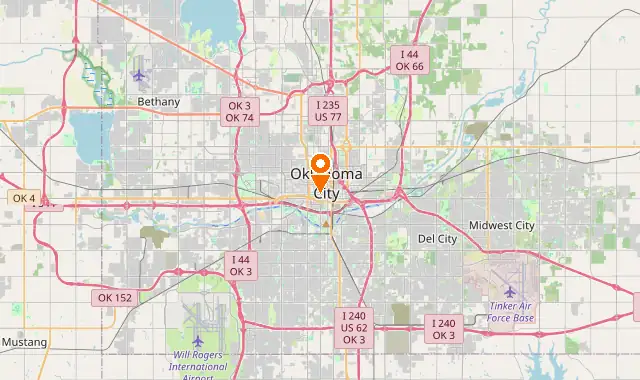
Local facts from Wikipedia and Wikidata, retrieved 2026-10-25. Population and area describe the city itself; the drain coverage counted on this page spans the wider area around it.
FOG: the grease program with your kitchen in it
Oklahoma City Utilities runs a dedicated FOG program, fats, oils, and grease, under its wastewater pretreatment umbrella, and its existence tells you what the city blames for a large share of preventable sewer trouble. Grease poured warm into a kitchen drain cools in the line, coats the wall, and traps food particles until the passage narrows to a fraction of itself. It is the most democratic clog in the city: it builds in a 2015 home as happily as in a 1955 one, because it is made of behavior, not of pipe age.
The household protocol is dull and total. Cool cooking grease in a container and throw it in the trash. Wipe pans before washing. Treat the garbage disposal as a finishing tool for scraps, not as a grease route. Keep wipes of every marketing description out of the toilet. None of this is new advice. Oklahoma City distinction is that the utility organizes enforcement and education around it, which means grease findings in a line are treated locally as a known, named problem with a known, named prevention, and a contractor here will use the word FOG expecting you to know the program it comes from.
When grease is the established finding, the matched tool is scouring, not poking. A cable that opens a channel through a grease plug leaves the coating that built the plug, and the plug rebuilds on the coating schedule. Hydro jetting at $300-$900 strips the wall back toward the pipe, which is why it is the standard recommendation for established kitchen and main line grease. If a quote for a grease line includes jetting, that is the local logic working correctly, not an upsell inventing itself.
Heavy rain, inflow, and the separate system that still fills up
Oklahoma City sewers are a separate system: wastewater in its pipes, stormwater in its own drainage. Separate does not mean rain proof. The city wastewater conversation is full of infiltration and inflow, groundwater and surface water entering the sanitary system through cracks, faulty connections, roof drains tied where they should not be, and manhole defects. The climate supplies the test regularly: 34.8 inches of precipitation a year, 8.6 heavy rain days, 52 freeze days, and 5.8 inches of snow. Plains rain arrives in concentrated events, and a system takes its exam in hours, not weeks.
For a homeowner, the wet weather pattern looks like this. Drains behave in dry spells. During or after a major rain, the lowest fixtures slow, gurgle, or back up, sometimes alongside neighbors reporting the same hour of trouble. That neighborhood synchrony is itself a clue: one house is a private line until proven otherwise, but a street reporting together suggests the main or the shared wet weather load is involved, which is exactly the distinction the city crews will test when they check the main. Report it, with the timing, rather than assuming the bill is yours before anyone has looked.
Your own property can also be an inflow source, and older Oklahoma City homes are the usual suspects: a cracked lateral admitting groundwater along its whole length, a downspout or area drain tied into the sanitary line by a long ago hand, a cleanout cap cracked below the mulch. A camera inspection in wet season, or a contractor who asks about your downspouts before quoting, is hunting these. Every gallon of rain your property keeps out of the sanitary line is a gallon of capacity your own wastewater gets to use during the next storm.
The inflow story has a distinctly Oklahoma City chapter: the roof. In older districts, and in homes that have passed through several owners and several roofers, downspout and area drain connections to the sanitary line survive as inherited plumbing folklore, invisible in dry weather and decisive in a storm. One connected downspout in a plains downpour delivers water at a rate no residential lateral was sized to accept alongside household flow. If your backups are strictly storm synchronized and your line cameras clean, ask the contractor to trace where the roof water actually goes. In this city that question solves a meaningful share of the mysteries the cleaning machine could not.
Odors, traps, and the vapor barrier the city mentions by name
Fort Worth names it a vapor trap, and Oklahoma City plumbing works the same way in practice: every fixture drain holds a water seal whose whole job is keeping sewer gas in the pipe and out of the house. When an Oklahoma City home develops a sewer smell, the first suspects are mechanical, not mysterious. A little used bathroom, a laundry sink that sits for months, or a floor drain in a garage or utility room loses its trap water to evaporation, and the gas path opens. Refilling the trap is the whole repair in the common case, and it costs a bucket of water.
The second odor family lives in the line itself: a sour, organic smell that strengthens when water runs, produced by sludge and grease film decomposing inside an older branch. That smell is a cleaning indication, and in grease country it pairs naturally with the FOG conversation: the film causing the odor is the film narrowing the pipe. Removing it mechanically, $99-$450 for standard work, removes the smell at its source. Scented products layered over a grease film produce a perfumed version of the same problem, on its way to becoming a blockage.
Escalate the third pattern promptly: a strong rotten egg odor that is house wide, new, or paired with gurgling and slow drainage in several fixtures. That combination suggests gas being pushed by a downstream restriction or a vent fault, and it belongs in the same day category. Oklahoma City open plains wind loads roofs and vents in ways sheltered cities feel less, and vent terminals here take weather. Mention any recent roof or storm damage when you call. It is a small detail that occasionally solves the whole puzzle before a cable ever turns.
Renters and landlords split the Oklahoma City experience in a way the law makes concrete. The private line belongs to the property owner, and so does its cleanup after a private side backup, while the tenant lives with the symptom. The city rules make owner response time the whole ballgame for a tenant household, because no city crew is coming to restore a private line at any hour. Owners of Oklahoma City rental stock who keep a standing relationship with a drain contractor, and records of each line condition, are not being fussy. They are pricing the legal structure of this city correctly, in advance, at planned rates instead of emergency ones.
Booking in Oklahoma City, with the law in mind
DrainFlowed is a connection service. At (866) 555-0134 you are connected with an independent local contractor who quotes, schedules, performs, and is responsible for the work. In Oklahoma City that independence has a local echo: just as the city cannot spend ratepayer money inside your line, your contractor relationship is entirely yours, so verify license and insurance with the contractor directly and get the scope in writing, especially where a repair, not just a cleaning, is proposed.
Carry the ranges into the conversation: standard cleaning $99-$450, main line $200-$650, hydro jetting $300-$900, sewer line work $250-$900, camera inspection $125-$500, emergency $150-$700. Then carry the city distinction too. Before private money moves, the location question deserves an answer: private line or city main, established how? The city itself makes that determination when its crews check a main, and a good private contractor makes it with a cleanout test and a camera. Homeowners who ask the location question first rarely overpay for the wrong segment.
And keep the file. In a city where the legal boundary is this clearly drawn, documentation is leverage: dated footage, measured defect locations, and the city response if a main was checked. If a backup ever becomes a claim, the Municipal Counselor process the city describes will ask for exactly that record. Build it while the water is still in the pipes, where it belongs.
Drain services available in Oklahoma City
The services that answer Oklahoma City's lead problems, from the independent contractors who cover the city. Ranges are the national typical ranges used across this site.
| Service | Typical range | What it is |
|---|---|---|
| Drain Cleaning | $99-$450 | The core service: mechanical cleaning that clears the clog and scrapes the pipe walls, not just a hole poked through the blockage.. |
| Clogged Drain Repair | $120-$550 | For the drain that is already blocked: diagnosis first, then the right fix, so the same clog does not come back next month.. |
| Main Line Cleaning | $200-$650 | When every drain in the house slows at once, the problem is the main line. |
| Sewer Line Cleaning | $250-$900 | The buried line from your house to the street: root cutting, scale removal and jetting, with camera proof of the pipe's condition.. |
| Bathroom Drain Cleaning | $99-$400 | Hair, soap scum and toothpaste: tubs, showers and bathroom sinks cleared at the trap and the branch, not just at the surface.. |
| Emergency Drain Cleaning | $150-$700 | Sewage backing up, water rising, guests arriving: what counts as a drain emergency, what to do in the first ten minutes, and how the visit works.. |
Full detail on every service, with signs and causes, is on the services hub, and every range on the site is collected in the cost guide.
Oklahoma City coverage snapshot
Nearby covered cities: Tulsa, Norman, Broken Arrow, Edmond.
Oklahoma City sewer and water resources
The city and utility pages this page's local facts rest on, worth bookmarking if you own a home in Oklahoma City:
Sources for this page
- housing age and mix: Median year built 1982, 21.3 percent pre 1960, 25.9 percent built 1960 to 1979, 30.5 percent post 2000, 306,366 units, 71.0 percent single family (source)
- climate: 34.8 in annual precipitation, 5.8 in snow, 52 freeze days, 8.6 heavy rain days per year, 2014 to 2023 average (source)
- sewer lateral responsibility: Owner is responsible for repairing or replacing the private sewer line; state law prohibits the Utilities Department from using ratepayer money on private property; city crews repair stoppages in the city main (source)
- city programs: Utilities Department FOG (fats, oils and grease) program under wastewater pretreatment; sewer backup page sits in the FOG and Pretreatment section (source)
- local fact cleanup rule: City crews clean up outdoors only, up to the dwelling exterior, when the cause is city infrastructure, and are prohibited from indoor cleanup; reimbursement only where the city had advance knowledge of fault (source)
- Housing age: median year built and build-era shares (US Census Bureau ACS)
- Weather averages: 2014-2023 daily record (Open-Meteo archive, ERA5)
Coverage around Oklahoma City
Areas and neighbourhoods in and around Oklahoma City
Calls also come in from Newalla, Wheatland and the streets between them. Those areas sit inside the same coverage, on the same contractor rounds.
NewallaWheatland
Nearby cities we cover in Oklahoma
- Drain cleaning in Tulsa, OK
- Drain cleaning in Norman, OK
- Drain cleaning in Broken Arrow, OK
- Drain cleaning in Edmond, OK
- Drain cleaning in Lawton, OK
- Drain cleaning in Enid, OK
The full list for the state is on the Oklahoma locations page.
Beyond Oklahoma City
Coverage at this depth continues nearby: see drain cleaning in Tulsa, OK and drain cleaning in Memphis, TN, each written from its own city's data the same way this page is.
Questions, answered
Who pays for a sewer backup in Oklahoma City?
It depends where the stoppage sits. If it is in the city main, city crews repair the main and restore service. If it is in the private sewer line connecting your house to the main, the home or property owner pays for repair or replacement. The city states that state law prohibits the Utilities Department from using ratepayer money for repairs on private property.
Will Oklahoma City clean up after a sewer backup in my home?
Only in a limited way, and never indoors. When the cause is city infrastructure or city personnel, city crews clean up outdoors up to the exterior of the dwelling. They are prohibited from cleanup inside homes. When the cause is a private line, the owner is responsible for all cleanup. Reimbursement for a city main backup requires that the city had advance knowledge its system was at fault and did not fix it.
What is the FOG program I keep hearing about?
FOG stands for fats, oils, and grease, and Oklahoma City Utilities runs a FOG program under its wastewater pretreatment work because grease is a leading preventable cause of sewer blockages. The household rule is simple: cool grease in a container, trash it, wipe pans before washing, and never route grease through the sink or disposal.
Why do my drains back up during Oklahoma City storms if the sewers are separate?
Separate systems still take on rain water through infiltration and inflow: cracks, bad connections, tied in roof drains, and manhole defects. Oklahoma City averages 34.8 inches of rain and 8.6 heavy rain days a year. If several neighbors report trouble in the same storm window, report it to the city so the main can be checked. That is the case where the problem may not be your private line.
How much does drain cleaning cost in Oklahoma City?
National ranges: standard cleaning $99-$450, main line $200-$650, hydro jetting $300-$900, camera inspection $125-$500, emergency service $150-$700. Sprawl matters here. A defect located far across a large lot is a different job from one near the house, so get the measured location with any quote. Connect at (866) 555-0134.
Does Oklahoma City publish a water hardness number?
The city Consumer Confidence Report does not report a hardness figure, which is why this page makes no hardness claim for Oklahoma City. If hardness matters for a decision at your home, such as sizing treatment equipment, a direct test of your tap water is the reliable route rather than a citywide number.
My house was built in the 1970s. Should I camera the sewer line?
It is a reasonable one time investment in this stock. Homes from 1960 to 1979 are 25.9 percent of the city, and their laterals are in the root and joint opening decades. A $125-$500 camera survey gives you a located, dated record of the line you fully own under Oklahoma law, before an emergency chooses the timing for you.
Drain problem in Oklahoma City? Make the call
A live person answers around the clock. Describe the problem, hear the likely range, and get an independent local contractor on the way.
(866) 555-0134 Tap to call nowA live person answers, day or night. Describe the problem, hear the likely range, then decide.