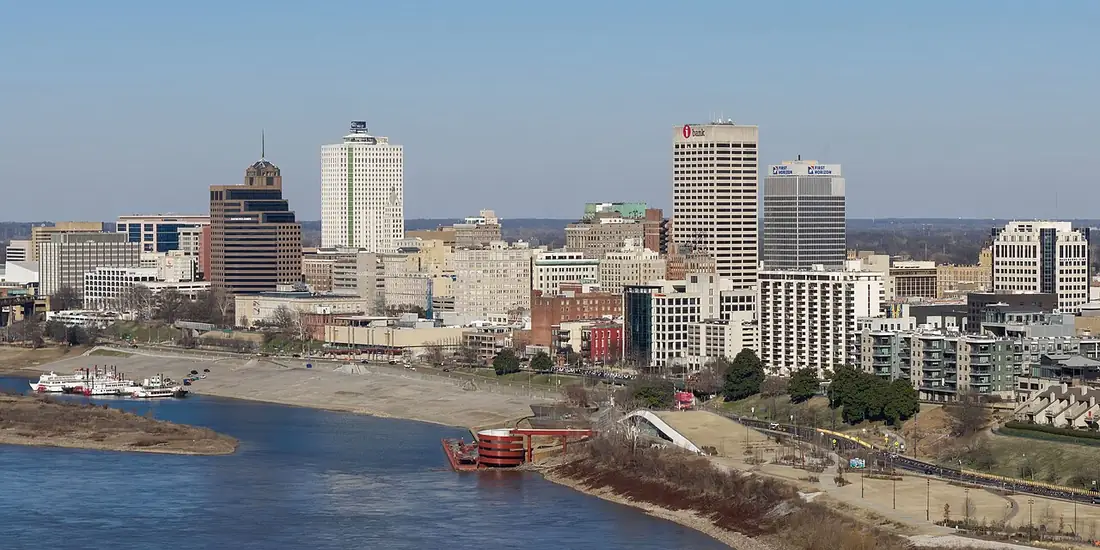
Drain cleaning in Memphis, TN - Shelby County - 61 ZIP codes covered
Drain Cleaning in Memphis, TN
Memphis drain work happens in a city of houses. Single family homes are 64.6 percent of the stock, the highest share in this Tennessee pair, spread across 289,887 housing units with a median build year of 1970. The defining fact for a homeowner is the cleanout in the yard: Shelby County guidance places the line between the house and its connection at the street on the homeowner, and the city or county line under the street on the public side. Add 53.8 inches of rain a year, a Mississippi River setting, and a housing bulge from 1960 to 1979 that is now fully into its root and corrosion years, and Memphis becomes a city of long private runs that reward early attention. This page covers the split, the cleanout trick every Memphis owner should know, and the patterns that separate a house problem from a street main problem.
House to street is yours: the Memphis split and the cleanout that proves it
Shelby County states the Memphis area rule in one sentence worth memorizing. In general, the homeowner is responsible for the line between the house and its connection at the street, and the county or city is responsible for the sewer lines under the street. Most of the collection system inside Memphis is maintained through the City of Memphis, and your sewer provider can be confirmed on your MLGW bill, a Memphis specific detail that settles arguments about who operates the public side at your address.
The same county guidance hands homeowners the single most useful object on their property: the cleanout. In most cases the private line from house to street has an access point called the cleanout, located on the homeowner premises. During a backup, removing the cleanout cap can relieve pressure and protect the home from sewage backflow while help is arranged. It is also the diagnostic divide. A contractor who opens the cleanout can see whether wastewater is standing in the line toward the house, toward the street, or not at all, and that observation assigns the problem faster than any amount of fixture testing inside.
Know where your cleanout is before you need it. In Memphis lots, with mature trees and decades of landscaping, cleanouts get buried, paved near, or hidden under beds, and a contractor billing by the visit will spend your money finding it. The economics around it are the national ones: main line cleaning $200-$650, camera inspection $125-$500, emergency service $150-$700. But the Memphis sequence starts at that cap in the yard. If you suspect the blockage sits in the main under the street instead, the county guidance is to report it to the county engineering section promptly, and a cleanout check is how that suspicion becomes evidence.
Drain problems we handle in Memphis
The problems Memphis's own housing, ground and weather produce most. The full symptom list is on the problems hub; these are the ones that earn their place here.
Recurring Clogs in Memphis
A clog that returns is not bad luck. It is an undiagnosed cause - roots, scale, a belly, or a cleaning that never removed the material..
Slow Drain in Memphis
One slow fixture is a narrowing pipe. Several slow fixtures are a main-line warning. How to tell the difference and what fixes each..
Standing Water in Memphis
Water that will not go down has a blockage at a specific level. Which level decides whether it is a quick clean or a main-line job..
A 1970 median, a 1960 to 1979 bulge, and pipes entering their root years
Memphis housing tells a two generation story. The median home was built in 1970. Before 1960 accounts for 35.3 percent of the stock, the years 1960 to 1979 account for 31.7 percent, a heavier mid century bulge than most cities in this series, and only 11.5 percent of homes are post 2000. Put together, about two thirds of Memphis houses were standing by 1980. As an implication of those dates, a large share of Memphis laterals are now in the age band where joints have cycled through fifty plus summers of soil movement and where root systems from mature lot trees have had decades to find them.
The form of the city amplifies the pipe length involved. With 64.6 percent single family homes across a city proper of 633,104 people counted in the 2020 census, Memphis laterals are typically full length residential runs, house to street across a real yard, not short stubs under a townhouse. Length matters to everything: more joints to open, more tree canopy crossed, more footage for a camera to survey, more trench if a section ever needs renewal. It also means a Memphis main line cleaning is genuinely a main line job, priced in the $200-$650 range, and the footage a contractor reports back is worth writing down.
None of this makes Memphis drains fragile. It makes them scheduled. A 1970s line with a known root joint is a line that can be managed on a planned interval, cleaned before the slow season becomes the backup season. The homeowners who pay emergency rates in Memphis are disproportionately the ones who treated the first two slowdowns as weather. In a city with 53.8 inches of annual rain, the weather alibi is always available, and it is wrong in the specific way this page keeps returning to: private lines fail in dry weeks too, on their own schedule.
The Memphis lot itself is part of the system. Large single family lots under mature canopy mean long shaded runs where soil stays cool and damp, root systems from several trees may cross one lateral, and a cleanout can sit a surprising distance from both the house and the street. When a contractor gives you a measured location for a defect, pace it out once and photograph where it falls in the yard. Future you, standing in that yard in three years with a new contractor, will convert that photograph into saved excavation and saved money. Memphis rewards owners who treat their lot as a mapped utility corridor, because that is precisely what it is.
About Memphis: the local snapshot
Memphis is a city in Shelby County, Tennessee, United States, and its county seat.
Memphis is the county seat of Shelby County, and the snapshot below keeps the city itself separate from the wider coverage area around it.
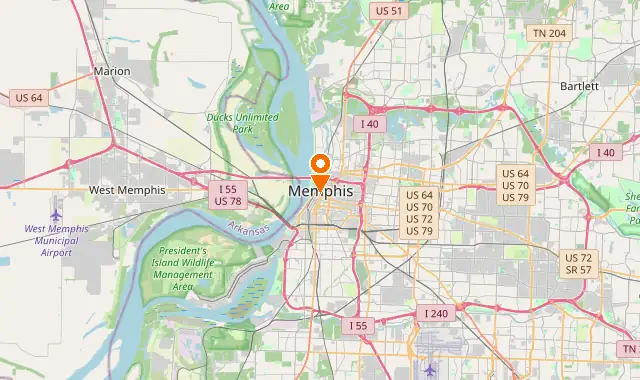
Local facts from Wikipedia and Wikidata, retrieved 2026-10-25. Population and area describe the city itself; the drain coverage counted on this page spans the wider area around it.
53.8 inches of rain, the river plain, and slow water in low places
Memphis climate is generous with water and stingy with cold: 53.8 inches of precipitation, 12.8 heavy rain days, only 42 freeze days, and 3.2 inches of snow in an average year. The ground here is unfrozen and biologically active nearly year round, which means roots grow, soil stays workable, and saturated conditions after storm clusters are a normal operating state for buried pipe. A Memphis lateral lives wet. Joints that seep a little in a dry climate seep steadily here, and groundwater pressure against the line is a background condition, not an event.
The symptom that fits this setting is standing water: a tub that empties in a ring, a shower floor that holds a film, a lowest fixture that drains in minutes rather than seconds. Standing water in one fixture is a branch problem. Standing water behavior across several fixtures, especially if it worsens after rain clusters, describes a main line running at reduced capacity, with a partial restriction that peak flow and wet ground expose together. That is a same week call, escalating to same day if gurgling joins it or a floor drain joins the cast.
Freeze, the northern cities obsession, plays a smaller but real Memphis role. Forty two freeze days will not harden the ground the way a Milwaukee winter does, but a sharp cold snap in a city of raised foundations and exposed plumbing runs catches homes unprepared in a way a Minnesota January never could, precisely because it is rare. If drainage changes suddenly during the coldest nights of the year in Memphis, say so on the call. The contractor differential includes freeze effects on vents and exposed sections, and the timing detail costs you nothing to provide.
The Memphis Sand under the city, and why soft source water changes the diagnosis
Memphis drinks from underground. The United States Geological Survey identifies the Memphis Sand as the principal aquifer supplying the city, with about 180 million gallons a day withdrawn from it, primarily for municipal and industrial use through Memphis Light, Gas and Water well fields. The same USGS work characterizes Memphis Sand water at the MLGW well fields as very low in mineralization, with median dissolved solids of 79 mg/L. Water that starts that soft does not build the heavy mineral scale seen in hard water cities, and it is not the medium in which drain crusts form quickly.
State the diagnostic consequence plainly. When a Memphis drain narrows, mineral scale is low on the suspect list. The high suspects are the organic and mechanical ones: grease films in kitchen branches, hair and soap in bathroom branches, lint in laundry runs, and roots at lateral joints in the 1960 to 1979 housing bulge. Hydro jetting at $300-$900 earns its Memphis keep against grease, not against geology. A contractor who understands the local water will talk about what your household puts into the line and what your trees are doing above it, in that order.
There is a second, practical use for the aquifer fact. Because the city supply is groundwater of notably low mineral content, sudden changes in your water behavior, discoloration, sediment, a new taste, are more likely to be about your service line, your water heater sediment, or a local main event than about source water chemistry shifting. Keep water supply observations and drain observations in separate mental columns when you describe a problem. Contractors diagnose faster when the two stories arrive unmixed, and Memphis is a city where they genuinely are different stories.
The aquifer story has a second household use: expectations for water using appliances and fixtures in Memphis should be set by soft water behavior. Scale crusting on showerheads and inside tank water heaters builds slowly here compared with hard water cities, elements last longer, and soaps lather easily. So when a Memphis fixture does choke with visible crust or a heater does rumble with sediment early in its life, the cause is more likely local, an aging heater shedding its own lining, a single fixture aerator catching debris from a main break, than the city supply changing character. Local causes have local fixes, and the aquifer reputation, properly understood, helps you refuse the wrong, system wide explanation.
Recurring clogs in Memphis: habit, joint, or sag
A clog that returns is a question wearing a disguise, and Memphis gives it three common answers. The first is habit: the same inputs rebuild the same restriction, grease in the kitchen branch, wipes snagging at the same bend, hair matting at the same stopper. The tell is location loyalty with a clean pipe story in between, and the cure is input change plus a thorough mechanical cleaning at $99-$450 that removes the established film rather than perforating it. Chemical openers are at their worst here, opening a temporary channel through soft buildup that closes again on schedule.
The second answer is a joint: one defective connection in the lateral, opened by decades of soil cycling, admitting roots that regrow after every cutting. The tell is whole house slowness returning on a roughly annual rhythm in an older home, often with the cleanout showing the story clearly. The cure path runs through a camera, $125-$500, that locates the joint in measured feet from the cleanout, after which you and the contractor can talk honestly about interval cleaning versus a scoped repair. Guessing the location of a joint under a Memphis yard is how money gets buried, sometimes literally.
The third answer is a sag: a section of line that has settled into a belly, holding water and solids permanently, so the drain runs slow even the week after a cleaning. The tell is exactly that, a line that never quite returns to full speed. No cleaning fixes geometry. The camera shows standing water in the pipe on screen, and the conversation becomes about living with a managed line or correcting the section. Memphis soil and rain make sags a live possibility in the older stock, and naming the possibility early is kinder than selling a third cleaning to a pipe that cannot hold the result.
There is a Memphis rhythm to act on, and it is the opposite of the northern cities. With only 42 freeze days, Memphis drain risk does not concentrate in winter. It distributes across the long warm season, when roots grow fastest, grease liquefies and resets furthest down the line, and storm clusters arrive monthly. A maintenance minded Memphis owner therefore schedules the camera or cleaning in the calm of early spring, before the growth and storm seasons stack up, rather than in a reactive scramble in August. The work is identical. The season chooses whether it is a plan or an emergency, and in this city the calendar gives you the choice more generously than most.
Calling in Memphis: what to have ready and what to expect
When you call (866) 555-0134, DrainFlowed connects you with an independent local contractor. DrainFlowed is the connection, not the crew: the contractor quotes, schedules, performs, and is responsible for the work, and you should confirm their license and insurance details directly. Memphis callers can make that first conversation unusually productive with four facts: the build year of the home, which fixtures are affected, where your cleanout is, and whether symptoms track the rain. Those four facts, in a 1970 median housing stock, are most of the triage.
Expect the visit to use the cleanout early. It is the Memphis diagnostic hinge, the point where house side and street side stories separate. If the problem proves to be yours, the national ranges frame the work: standard cleaning $99-$450, main line $200-$650, jetting $300-$900, camera $125-$500, sewer line work $250-$900, emergency $150-$700. If the evidence points under the street instead, you have a located finding to report through the county or city channel, which is how public side problems get into the public queue with the least friction.
Close the visit like an owner of a long private asset, because in Memphis you are one. Get the finding in plain words, the footage if a camera ran, and the footage measured from the cleanout in feet. File it. The next visit, whether it is next season or in five years, starts from that record instead of from zero, and on a 60 to 100 foot residential run under a mature Memphis lot, starting from the record is the difference between a maintenance plan and a recurring surprise.
Drain services available in Memphis
The services that answer Memphis's lead problems, from the independent contractors who cover the city. Ranges are the national typical ranges used across this site.
| Service | Typical range | What it is |
|---|---|---|
| Drain Cleaning | $99-$450 | The core service: mechanical cleaning that clears the clog and scrapes the pipe walls, not just a hole poked through the blockage.. |
| Clogged Drain Repair | $120-$550 | For the drain that is already blocked: diagnosis first, then the right fix, so the same clog does not come back next month.. |
| Hydro Jetting | $300-$900 | High-pressure water that scours pipe walls clean - the answer for grease, scale and lines that keep re-clogging after cabling.. |
| Drain Camera Inspection | $125-$500 | See inside the pipe before you spend on the fix: roots, cracks, bellies and blockages located precisely, with footage to decide on.. |
| Floor Drain Cleaning | $110-$450 | Basement, laundry and garage floor drains: the house's safety valve, cleaned and trap-checked before it is needed in a flood.. |
Full detail on every service, with signs and causes, is on the services hub, and every range on the site is collected in the cost guide.
Memphis coverage snapshot
Nearby covered cities: Collierville, Ellendale, Knoxville, Chattanooga.
Memphis sewer and water resources
The city and utility pages this page's local facts rest on, worth bookmarking if you own a home in Memphis:
Sources for this page
- housing age and mix: Median year built 1970, 35.3 percent pre 1960, 31.7 percent built 1960 to 1979, 11.5 percent post 2000, 289,887 units, 64.6 percent single family (source)
- climate: 53.8 in annual precipitation, 3.2 in snow, 42 freeze days, 12.8 heavy rain days per year, 2014 to 2023 average (source)
- sewer lateral responsibility: Homeowner is responsible for the line between the house and its connection at the street; city or county is responsible for sewer lines under the street; cleanout on homeowner premises can be opened to relieve backup pressure (source)
- local fact aquifer: Memphis Sand is the principal aquifer supplying the city, about 180 million gallons per day withdrawn; water at MLGW well fields has very low mineralization, median dissolved solids 79 mg/L and median hardness 46 mg/L in the USGS study (source)
- Housing age: median year built and build-era shares (US Census Bureau ACS)
- Weather averages: 2014-2023 daily record (Open-Meteo archive, ERA5)
Coverage around Memphis
Areas and neighbourhoods in and around Memphis
Calls also come in from Cordova and the streets between them. Those areas sit inside the same coverage, on the same contractor rounds.
Cordova
Nearby cities we cover in Tennessee
- Drain cleaning in Collierville, TN
- Drain cleaning in Ellendale, TN
- Drain cleaning in Knoxville, TN
- Drain cleaning in Chattanooga, TN
- Drain cleaning in Clarksville, TN
- Drain cleaning in Murfreesboro, TN
- Drain cleaning in Johnson City, TN
- Drain cleaning in Kingsport, TN
The full list for the state is on the Tennessee locations page.
Beyond Memphis
Coverage at this depth continues nearby: see drain cleaning in Nashville, TN and drain cleaning in Knoxville, TN, each written from its own city's data the same way this page is.
Questions, answered
Who is responsible for the sewer line at a Memphis home?
Per Shelby County guidance, the homeowner is responsible for the line between the house and its connection at the street, and the city or county is responsible for the sewer lines under the street. Inside Memphis, the public system is maintained through the City of Memphis, and your MLGW bill identifies your sewer provider.
What should I do first when sewage backs up in my Memphis home?
County guidance points to the cleanout: the private line usually has a cleanout access point on your premises, and removing its cap can relieve pressure and protect the home from backflow while you arrange help. Stop adding water to the system, locate the cleanout, and call. If you suspect the blockage is in the main under the street, report it to the county engineering section as soon as possible.
Where does Memphis drinking water come from, and does it clog drains?
From the Memphis Sand aquifer. USGS identifies it as the principal aquifer supplying the city, with about 180 million gallons a day withdrawn, and characterizes the water at MLGW well fields as very low in mineralization, median dissolved solids 79 mg/L. That softness means mineral scale is a minor drain factor in Memphis. Grease, hair, wipes, and roots do the narrowing here.
Why do clogs keep returning in my 1970s Memphis home?
Homes from 1960 to 1979 are 31.7 percent of the Memphis stock, and their laterals are in the age band where joints open and roots enter. A returning whole house pattern usually means a joint admitting roots or a settled sag, not bad luck. A camera inspection at $125-$500, measured from your cleanout, locates it so you can choose between a planned cleaning interval and a scoped repair.
How much rain does Memphis get, and does it affect sewer backups?
Memphis averages 53.8 inches of precipitation a year with 12.8 heavy rain days and only 42 freeze days. Saturated ground raises pressure on older joints and exposes partial restrictions, so backups that cluster in wet periods are common. The pattern is still usually a private line with reduced capacity being tested, which is why the cleanout check comes first.
How much does drain cleaning cost in Memphis?
National ranges: standard cleaning $99-$450, main line $200-$650, hydro jetting $300-$900, camera inspection $125-$500, emergency service $150-$700. The independent contractor connected through DrainFlowed at (866) 555-0134 sets your actual price after checking the line, ideally starting at the cleanout.
Can I just keep using a chemical opener for a slow Memphis drain?
It is a poor strategy anywhere, and Memphis patterns punish it. A chemical pour can open a small channel through soft buildup, which closes again, and it does nothing for roots, a sag, or a joint problem. A slow drain is the cheapest stage of a clog. Mechanical cleaning that removes the material is the fix that resets the clock.
Drain problem in Memphis? Make the call
A live person answers around the clock. Describe the problem, hear the likely range, and get an independent local contractor on the way.
(866) 555-0134 Tap to call nowA live person answers, day or night. Describe the problem, hear the likely range, then decide.