
Drain cleaning in Milwaukee, WI - Milwaukee County - 41 ZIP codes covered
Drain Cleaning in Milwaukee, WI
Milwaukee drains work inside one of the oldest housing stocks in this series. The median Milwaukee home was built in 1953, and 63.9 percent of homes predate 1960, which means a large share of laterals and interior drains have been carrying water for seventy years or more. Add 129 freeze days a year, a combined sewer under about a third of the city, and a regional system that still fights basement backups in heavy rain, and the pattern here is specific: old pipe, cold ground, and storm pressure arriving at the same basement. This page explains how those three facts interact, who pays for the lateral, and what the MMSD Pipe Check program can help with before you book a cleaning.
The lateral is yours, and Pipe Check exists because of that
Start with ownership, because it decides the bill. In the Milwaukee region the sanitary sewer lateral that runs from your home to the municipal main is the homeowner responsibility, including when the failure is roots or a structural break in that pipe. MMSD states the point plainly, and it surprises people whose blockage sits under a sidewalk or near the street. The city main is public. The pipe that gets your wastewater to that main is private, all the way to the connection.
That rule is exactly why the MMSD Pipe Check program matters. Pipe Check offers financial incentives to owners of one and two family homes in the MMSD service area for work that reduces clear water entering the sanitary system and lowers backup risk. Published incentive amounts include up to $6,000-$8,000 for full lateral replacement, 1,500 dollars for lateral lining, 3,800 dollars for foundation drain disconnection with a sump pump installed, and smaller amounts for removing a Palmer valve, rerouting a sump discharge, or disconnecting downspouts. The incentives reduce the cost. They do not cover all of it, and the remaining cost stays with the homeowner.
The practical sequence is worth knowing before a backup forces the issue. Under Pipe Check, you contact an approved contractor, pay for the site visit, and the contractor identifies the work that qualifies and goes over the scope and your share of the cost with you. A camera check of the lateral is part of that world, and it fits the diagnosis logic on this page: in a city of pre 1960 laterals, seeing the pipe beats guessing from the symptom. If a contractor finds a cracked or root filled lateral during a cleaning visit, ask whether the repair scope could qualify under Pipe Check before you approve the full price.
Drain problems we handle in Milwaukee
The problems Milwaukee's own housing, ground and weather produce most. The full symptom list is on the problems hub; these are the ones that earn their place here.
Multiple Drains Backing Up in Milwaukee
Several drains failing together is the main line or sewer until proven otherwise. Stop the water, protect the floor, make the call..
Recurring Clogs in Milwaukee
A clog that returns is not bad luck. It is an undiagnosed cause - roots, scale, a belly, or a cleaning that never removed the material..
Gurgling Drains in Milwaukee
Gurgling is air moving where it should not - displaced by a partial blockage or a vent problem. It is one of the earliest main-line warnings..
A 1953 median home, and what seventy winters do to a drain
The Census figures for Milwaukee are stark. Of 259,101 housing units, 63.9 percent were built before 1960 and another 20.4 percent between 1960 and 1979, while only 8.4 percent date from after 2000. Single family homes are 43.4 percent of the stock, so duplexes and multifamily buildings carry much of the drain load here. A median build year of 1953 implies, as an implication of that age rather than a survey of any one house, that many original laterals and cast iron stacks are well past the age where joints stay tight and bores stay smooth.
Climate loads the same pipes. Milwaukee averages 37.7 inches of precipitation and 33.9 inches of snow a year, with 129 days at or below freezing across the 2014 to 2023 record. Freeze and thaw cycles move soil around buried pipe, and a joint that opened a fraction in one winter becomes the entry point roots use in the summer. That is the local rhythm behind recurring clogs in older Milwaukee homes: the clog is cleared, the opening that invited roots or soil stays, and the symptom returns on a schedule that shortens over time.
None of this means every old Milwaukee drain is failing. Plenty of 1950s pipe still flows well. It means the diagnostic question here is different from a newer suburb. Instead of asking only what blocked the line, ask what the line looks like. A camera inspection, priced nationally at $125-$500, earns its keep in this housing stock because it separates a one time buildup from a joint, crack, or sag that will keep collecting material until it is repaired or lined.
One more Milwaukee pattern deserves a name: the winter backup that is not about rain at all. With 129 freeze days, the city ground freezes deep and stays frozen, and a lateral running shallow by modern standards spends months in soil that heaves and settles in slow motion. Symptoms that worsen across the coldest stretch and ease in spring can be that movement talking, opening a joint in January that roots will colonize in June. Mention the season when your problem peaks. A contractor who hears winter hears soil and depth. A contractor who hears summer hears roots and rain. Both may order the same camera, but they will read what it shows through the right Milwaukee lens.
About Milwaukee: the local snapshot
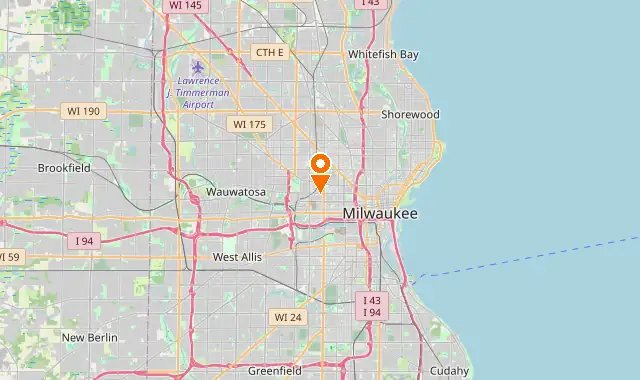
Local facts from Wikipedia and Wikidata, retrieved 2026-10-25. Population and area describe the city itself; the drain coverage counted on this page spans the wider area around it.
Combined sewers, the Deep Tunnel, and why basements still back up
About a third of Milwaukee, plus roughly half of Shorewood, sits on combined sewers: one pipe carrying both sanitary flow and street stormwater. The combined area is about five percent of the MMSD service area but it contains the oldest, densest part of the city. The rest of the region uses separate systems, where stormwater runs untreated to creeks and rivers and only sanitary flow goes to treatment. Which system serves your street changes what a heavy rain does to your basement.
MMSD built the Deep Tunnel to blunt the combined problem. The tunnel system is 28.5 miles long, holds 521 million gallons, and sits as deep as 300 feet in bedrock. Before its first phase opened in 1994, the region averaged 50 to 60 overflows to waterways a year, totaling 8 billion to 9 billion gallons. With the tunnel in service the average fell to about 2.5 overflows a year and 1.4 billion gallons. Those are regional overflow numbers to waterways, not a promise about any individual basement, and MMSD is clear that cutting basement backup risk remains its highest stated priority precisely because the job is unfinished.
The third of the system nobody regional built is yours. MMSD counts roughly 3,000 miles of private laterals alongside 3,000 miles of community sewers and 300 miles of its own regional pipes. In heavy rain, clear water sneaks in through cracked laterals, foundation drains tied to the sanitary line, and downspouts. MMSD notes a single connected downspout can add up to 12 gallons a minute in a storm, and a foundation drain connection up to 10 gallons a minute. When several fixtures back up during rain in Milwaukee, the useful question is how much storm water your own property is feeding into a pipe that was sized for sinks and toilets.
Foundation drains, Palmer valves, and the Milwaukee basement
Older Milwaukee homes without sump pumps often have foundation drains connected directly to the sanitary sewer. In dry weather that connection is invisible. In a long rain it turns your basement drainage into a storm inlet, surcharging the lateral from inside the house side of the system. Pipe Check treats this seriously enough to pay its largest single incentive, 3,800, dollars toward disconnecting the foundation drain, installing a sump pump and discharge piping, and removing the existing Palmer valve, the old basement valve arrangement many of these homes still carry.
For drain symptoms, the signature looks like this. The floor drain or lowest fixtures misbehave during or just after heavy rain, then behave again when the ground dries. A standard cleaning can still be the right first step if material is sitting in the line, and standard drain cleaning runs $99-$450 nationally. But if the pattern tracks rainfall rather than household use, cleaning alone is treating the messenger. The fix that changes the pattern is on the storm side: disconnection, sump routing, or lateral repair, scoped after inspection.
Milwaukee averages 5.2 heavy rain days a year, so a rain linked pattern usually reveals itself within a season or two. Keep a simple note of dates. A contractor who can see that your backups landed on the wettest days of the year, in a pre 1960 house with a foundation drain history, starts the visit several diagnostic steps ahead, and you avoid paying main line prices, $200-$650, for a problem whose driver sits at your own foundation.
There is also a paperwork habit the Pipe Check structure rewards. Incentives are paid against identified work, performed by approved contractors, after a site visit establishes the scope. That means the camera footage and the written finding are not just diagnostics. They are the application itself. Homeowners who arrive at a cleaning visit and leave with footage, a located defect in measured feet, and a contractor willing to map the repair to the incentive categories are positioned to recover thousands. Homeowners who approve a verbal repair on the spot often discover the incentive conversation should have happened first. Sequence is money in Milwaukee: look, document, check eligibility, then cut.
Hard water at 140 mg/L, and what scale does and does not explain
Milwaukee Water Works publishes typical values for city water, and total hardness sits at a median of about 140 mg/L as CaCO3, roughly 8.2 grains per gallon. That is moderately hard water. Over years it leaves visible scale on fixtures and inside water heaters, and inside older drain pipes a rough mineral film can give grease and soap something extra to grip. In a housing stock full of older metal pipe, that roughness is one more reason kitchen and bathroom lines narrow gradually rather than blocking all at once.
Scale should not become the explanation for everything, though. Hardness builds slowly and evenly. It does not produce a sudden backup, a toilet that gurgles when the washer drains, or several fixtures failing together. Those patterns point downstream, to the main line or lateral, and they call for main line cleaning at $200-$650 or a camera look rather than descaling talk. Keeping the two stories separate saves money in both directions: you do not jet a line, $300-$900, for a scale film that was not the problem, and you do not blame water chemistry for a root mass.
Where scale genuinely belongs in the Milwaukee conversation is maintenance rhythm. In a pre 1960 home with original interior drains, a slow bathroom sink that creeps back every year is often a layered problem, hair and soap bound onto a roughened pipe wall. Mechanical cleaning that removes the material, rather than a chemical pour that opens a temporary channel through it, is the approach that resets the clock. Tell the contractor the age of the house and how fast the slowness returned last time. That history shapes the tool choice more than the fixture brand does.
Finally, a word about the duplexes and small multifamily buildings that make up so much of this stock. With single family homes at 43.4 percent, most Milwaukee laterals serve more than one household, and a restriction in a shared building main announces itself in the lowest unit first, which is rarely the unit whose habits built it. Landlords who treat a lower unit complaint as a tenant problem miss the building problem it usually is. The lateral rule does not change with the number of kitchens above it: the owner carries the pipe, and the fastest resolution for everyone is a building level cleaning and camera, documented once, rather than a season of unit by unit skirmishes with a shared restriction.
What a Milwaukee drain call involves, in plain terms
DrainFlowed is a connection service. It does not send its own crews. When you call (866) 555-0134, you are connected with an independent local contractor who quotes, schedules, and performs the work, and who is responsible for that work. That structure matters in Milwaukee because the best visit here often mixes cleaning with local program knowledge: whether a lateral finding could fit Pipe Check, whether a foundation drain is in play, and whether your street is combined or separate. Ask about those three things on the call.
National price ranges keep expectations grounded. Standard drain cleaning runs $99-$450, main line work $200-$650, hydro jetting $300-$900, sewer line work $250-$900, camera inspection $125-$500, and emergency service $150-$700. Where your job lands inside a range depends on access, how established the blockage is, and what the camera finds. In a 1953 median housing stock, get the finding in plain language before approving repair work beyond cleaning. A located, recorded defect you can get a second view on is worth more than a verbal warning delivered while the machine is still running.
Two habits protect Milwaukee homeowners specifically. First, act on the rain pattern early, while the conversation is about incentives and scheduling rather than cleanup. Second, keep whatever footage and paperwork a visit produces. Pipe Check participation, a future lateral lining decision, and even a home sale all go better with a dated record of what your lateral looked like. Paperwork is unglamorous. In a city where the homeowner owns the pipe to the main, it is also the closest thing to a warranty file your drain system will ever have.
Drain services available in Milwaukee
The services that answer Milwaukee's lead problems, from the independent contractors who cover the city. Ranges are the national typical ranges used across this site.
| Service | Typical range | What it is |
|---|---|---|
| Main Line Cleaning | $200-$650 | When every drain in the house slows at once, the problem is the main line. |
| Sewer Line Cleaning | $250-$900 | The buried line from your house to the street: root cutting, scale removal and jetting, with camera proof of the pipe's condition.. |
| Hydro Jetting | $300-$900 | High-pressure water that scours pipe walls clean - the answer for grease, scale and lines that keep re-clogging after cabling.. |
| Drain Camera Inspection | $125-$500 | See inside the pipe before you spend on the fix: roots, cracks, bellies and blockages located precisely, with footage to decide on.. |
| Emergency Drain Cleaning | $150-$700 | Sewage backing up, water rising, guests arriving: what counts as a drain emergency, what to do in the first ten minutes, and how the visit works.. |
Full detail on every service, with signs and causes, is on the services hub, and every range on the site is collected in the cost guide.
Milwaukee coverage snapshot
Nearby covered cities: Madison, Racine, Kenosha, Sheboygan.
Milwaukee sewer and water resources
The city and utility pages this page's local facts rest on, worth bookmarking if you own a home in Milwaukee:
Sources for this page
- housing age and mix: Median year built 1953, 63.9 percent pre 1960, 20.4 percent built 1960 to 1979, 8.4 percent post 2000, 259,101 units, 43.4 percent single family (source)
- climate: 37.7 in annual precipitation, 33.9 in snow, 129 freeze days, 5.2 heavy rain days per year, 2014 to 2023 average (source)
- sewer lateral responsibility: Homeowner is responsible for the sanitary sewer lateral, including backup costs from roots or structural failure in the lateral (source)
- city programs: MMSD Pipe Check incentives: lateral replacement $6,000-$8,000, lining 1,500, dollars foundation drain disconnection 3,800, dollars Palmer valve removal 400, dollars downspout disconnection 25 dollars each, for one and two family homes in the MMSD area (source)
- combined sewer status: Combined sewers in about one third of Milwaukee, about five percent of MMSD service area; Deep Tunnel 28.5 miles, 521 million gallons, overflows down from 50 to 60 per year to about 2.5 per year (source)
- water hardness: Milwaukee Water Works typical total hardness median about 140 mg/L as CaCO3, 8.2 grains per gallon (source)
- local fact foundation drains: Homes without sump pumps typically have foundation drains connected to the sanitary sewer, adding up to 10 gallons per minute in heavy rain; a connected downspout can add up to 12 gallons per minute (source)
- Housing age: median year built and build-era shares (US Census Bureau ACS)
- Weather averages: 2014-2023 daily record (Open-Meteo archive, ERA5)
Coverage around Milwaukee
Nearby cities we cover in Wisconsin
- Drain cleaning in Madison, WI
- Drain cleaning in Racine, WI
- Drain cleaning in Kenosha, WI
- Drain cleaning in Sheboygan, WI
- Drain cleaning in Janesville, WI
- Drain cleaning in Waukesha, WI
The full list for the state is on the Wisconsin locations page.
Beyond Milwaukee
Coverage at this depth continues nearby: see drain cleaning in Madison, WI and drain cleaning in Providence, RI, each written from its own city's data the same way this page is.
Questions, answered
Who pays for a blocked sewer lateral in Milwaukee, me or the city?
You do. The sanitary sewer lateral from your home to the municipal main is the homeowner responsibility in the Milwaukee region, including failures caused by roots or structural damage in that pipe. The city and MMSD maintain the mains. MMSD states this rule directly, and it is the reason the Pipe Check incentive program exists.
What is the MMSD Pipe Check program and what does it pay toward?
Pipe Check is an MMSD program offering financial incentives to owners of one and two family homes in its service area for work that keeps clear water out of the sanitary sewer. Published amounts include $6,000-$8,000 for full lateral replacement, 1,500 dollars for lateral lining, 3,800 dollars for foundation drain disconnection with a sump pump, 400 dollars for Palmer valve removal, and 25 dollars per disconnected downspout. The incentive reduces your cost. It does not cover the whole job.
Why do my drains back up mainly when it rains hard?
Milwaukee averages 5.2 heavy rain days a year, and about a third of the city uses combined sewers that carry stormwater and sewage together. On top of that, cracked laterals, foundation drains tied to the sanitary line, and connected downspouts can pour storm water into your own lateral. MMSD notes one downspout can add up to 12 gallons a minute in a storm. A rain linked pattern deserves an inspection aimed at those entry points, not just a cleaning.
Does Milwaukee have combined sewers where I live?
Possibly. Combined sewers serve about one third of Milwaukee and roughly half of Shorewood, around five percent of the MMSD service area, concentrated in the older central city. The Deep Tunnel, 28.5 miles long with 521 million gallons of storage, cut regional overflows from 50 to 60 a year before 1994 to about 2.5 a year. Your contractor or MMSD can confirm which system serves your street.
My house was built in the 1940s. Should I get a camera inspection?
It is a sensible step in this stock. With 63.9 percent of Milwaukee homes built before 1960, many laterals are decades old, and a camera shows whether a recurring clog is simple buildup or a crack, root entry, or sag that will keep refilling the line. A camera inspection runs $125-$500 nationally. The footage also helps if you later pursue Pipe Check incentives or a lining decision.
Is Milwaukee tap water hard enough to clog my drains?
Milwaukee Water Works lists typical total hardness around 140 mg/L, about 8.2 grains per gallon, which is moderately hard. It builds scale slowly on fixtures and inside older pipes, and that roughness can help grease and soap accumulate. It does not cause sudden backups. A fast change in drainage points to a blockage or lateral problem, not water chemistry.
How much does drain cleaning cost in Milwaukee?
National ranges apply: standard drain cleaning $99-$450, main line cleaning $200-$650, hydro jetting $300-$900, and emergency service $150-$700. Your independent contractor sets the actual price after seeing access and the blockage. Through DrainFlowed at (866) 555-0134 you are connected with a local independent contractor, and the quote and the work are theirs.
Drain problem in Milwaukee? Make the call
A live person answers around the clock. Describe the problem, hear the likely range, and get an independent local contractor on the way.
(866) 555-0134 Tap to call nowA live person answers, day or night. Describe the problem, hear the likely range, then decide.