
Drain cleaning in Richmond, VA - Richmond County - 17 ZIP codes covered
Drain Cleaning in Richmond, VA
Richmond drains flow toward one of the oldest sewer arrangements in America. Parts of the city system are over 150 years old and were built as a combined sewer, one network carrying wastewater and stormwater together across about 19 square miles, with 25 overflow points on the James River and Gillies Creek. Above ground, the housing stock matches that age profile: median build year 1959, with 51.2 percent of homes before 1960. A Richmond drain call therefore sits at the meeting point of an old house system and an old city system, and heavy rain, 45.1 inches a year of it, is the force that tests both at once. This page separates what belongs to the house, what belongs to the city system, and what the Shockoe storage works actually do.
A combined system under a 1959 housing stock
Richmond Department of Public Utilities describes the arrangement without romance. Parts of the city sewer system are over 150 years old and were designed as a combined sewer system, built to transport wastewater and stormwater in the same pipes, with the vast majority of wet weather flow being stormwater. The combined area covers 19 square miles and includes 25 combined sewer outfalls. In dry weather the system behaves like any other: your drains flow to the treatment plant, which can treat up to 75 million gallons a day. In wet weather the same pipes must also swallow the rain falling on streets and roofs across those 19 square miles.
Your side of the wall is nearly as old. Richmond housing counts 114,293 units with a median build year of 1959: 51.2 percent predate 1960, 19.8 percent come from 1960 to 1979, and 16.7 percent are post 2000. Single family homes are 52.2 percent. A pre 1960 Richmond house draining into a combined street main is old pipe meeting old pipe, and the junction between them, your sewer service, is where the two systems negotiate. The city permit paperwork for a sanitary sewer lateral states that construction of sanitary sewer services is the responsibility of the property owner, which is the practical rule: building and renewing the service connection is owner work, done by a licensed contractor with a city permit.
The implication to carry into any drain visit is that Richmond problems often have two addresses. A restriction can live in your service line, or the street system can be running at combined capacity in a storm, and the symptoms at your lowest fixture can look similar for an hour. Timing separates them. Trouble that tracks a storm and resolves as the system drains down points one way. Trouble on a dry Tuesday points firmly at your own pipes. Give the contractor the weather context unprompted. In Richmond it is half the diagnosis.
The housing geography overlays the sewer geography in a way Richmond homeowners feel physically. The combined area, 19 square miles of the oldest city, is also where the pre 1960 housing concentrates, so the oldest private pipes discharge into the oldest public ones, and storm pressure travels the whole chain from street main to basement fixture with nothing modern in between to absorb it. A Church Hill or Shockoe area homeowner and a far West End homeowner live in the same city and different drainage centuries. Advice, and contractor expectations, should be set by which Richmond the house sits in, and the combined sewer maps the city publishes through its CSO program materials are the way to check.
Drain problems we handle in Richmond
The problems Richmond's own housing, ground and weather produce most. The full symptom list is on the problems hub; these are the ones that earn their place here.
Multiple Drains Backing Up in Richmond
Several drains failing together is the main line or sewer until proven otherwise. Stop the water, protect the floor, make the call..
Drain Odors in Richmond
Sewer smell, rotten-egg smell, sour buildup smell.
Gurgling Drains in Richmond
Gurgling is air moving where it should not - displaced by a partial blockage or a vent problem. It is one of the earliest main-line warnings..
Shockoe: 50 million gallons of first flush, and its limits
Richmond answer to combined overflow is storage, and its centerpiece has a name every homeowner here should know: the Shockoe Retention Basin, a 50 million gallon facility that captures the first rush of storm flow, the dirtiest part of a storm, washing accumulated oil, grease, litter, and debris off the streets. Supporting works include the Hampton Street and McCloy Street tunnel with about 7 million gallons of capacity, completed in 2003, and expanded pipes adding roughly 15 million gallons more, for system storage in the neighborhood of 57 to 72 million gallons depending on how the components are counted. Captured flow drains to the treatment plant over about four days after a storm, as plant capacity allows.
Storage changed the arithmetic without ending it. City reporting puts the combined overflow capture rate at approximately 91 percent, a reduction of more than 3 billion gallons a year reaching the James River compared with the uncontrolled past. The remaining overflows concentrate at the Shockoe outfall, the largest drainage area at 12.5 square miles. Virginia law passed in 2020 requires the city to complete an Interim Plan by 2027 and a Final Plan by 2035, with projects including a new high rate disinfection facility at Shockoe and additional storage on the Southside and at Gillies Creek, priced in the hundreds of millions of dollars.
What does any of this mean for a basement in Richmond? Directly, this: during the biggest storms, the street system can be legitimately full, and a home whose lowest fixtures sit low, especially near the Shockoe Bottom and riverfront lowlands, can feel the system pressure even with a perfectly clean private line. The memory of Tropical Storm Gaston in August 2004, which dropped about 11 inches of rain and flooded Shockoe Bottom, is the extreme marker. The proportionate homeowner responses are unglamorous: know your lowest fixture elevation, keep the private line clean so it is never the weak link, and treat storm hour backups as timing events to report and document rather than automatically as private pipe failures.
About Richmond: the local snapshot
Richmond is the capital city of the U.S. state of Virginia.
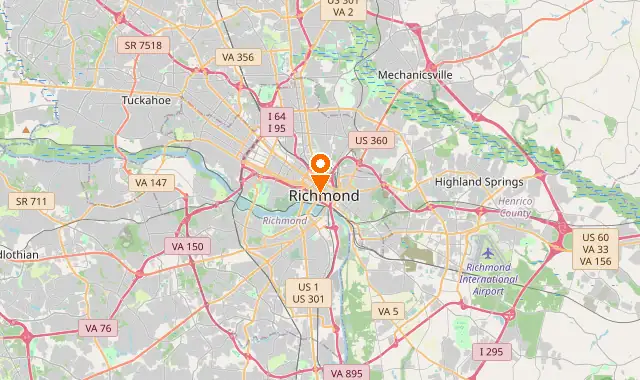
Local facts from Wikipedia and Wikidata, retrieved 2026-10-25. Population and area describe the city itself; the drain coverage counted on this page spans the wider area around it.
Rain, the James, and reading a Richmond backup correctly
Richmond averages 45.1 inches of precipitation a year with 8.1 heavy rain days, 57 freeze days, and 10.5 inches of snow. That is a mid Atlantic load: enough intense rain to fill a combined system several times a year, enough cold to matter to exposed pipes, and a river that sets the drainage mood for the lowest neighborhoods. Against that background, the single most valuable diagnostic habit is timestamping. Note when the backup started relative to the rain, which fixture showed it first, and whether neighbors on the same street saw the same thing at the same hour.
A private line failure has a different signature. It builds across days or weeks, in dry weather as readily as wet: a shower that drains slower each month, a toilet that gurgles when the washer empties, odors that strengthen as a partial blockage matures. Those are your pipes talking, and they are priced in the familiar ranges: standard cleaning $99-$450, main line $200-$650, camera $125-$500 to see the cause. A storm synchronized event that vanishes by morning belongs first to the system story, and the city publishes its combined sewer information through RVAH2O for exactly this reason.
There is a middle case, and it is the most common Richmond story of all: a marginal private line, partially narrowed by roots or scale from a 1960s bore, that copes in dry weeks and fails when storm load removes its margin. Cleaning it is right. Stopping there is wrong. The camera answer, whether the narrowing is regrowable roots at a joint or a section losing its shape, is what converts a rainy season ritual into a decision. Richmond will supply the rain. Your job is to meet it with a known line.
There is a homeowner sized version of the capture rate worth understanding. The city captures about 91 percent of combined flow because storage takes the first, dirtiest portion of each storm. Your basement experiences the same storm from the other end: the system protects itself, in part, by using every connected pipe as temporary storage, and a low private lateral with a partial restriction is storage that fills toward your fixtures. Keeping your line fully open is therefore not just maintenance. It is your personal capture rate, the margin that decides whether a given storm is a city statistic or a household event. No other city in this series makes that relationship quite so direct.
Odors in an old system: dry traps, sludge, and sewer gas paths
Drain odors deserve their own section in Richmond because the housing stock sets traps, literally. With over half the homes predating 1960, many houses carry little used basement drains, spare bathrooms, and laundry sinks whose trap water evaporates across weeks, opening a straight path for sewer gas from a system that, in the combined districts, also carries street storm air. A constant sewer smell in a basement here is a dry floor drain trap until proven otherwise, and the fix is a bucket of water, with a little mineral oil floated on top to slow the next evaporation.
The second Richmond odor is a working smell: sour, organic, blooming when water runs. That one lives inside the pipe, in the sludge and grease film coating an older kitchen or bathroom branch. It strengthens as a partial blockage matures, and it clears when the material causing it is physically removed by cleaning, not when it is perfumed. If odor arrives together with slowness and gurgling, read the trio as one message: the line has a restriction, it is downstream if several fixtures share it, and it belongs on the same day call list, not the someday list.
The third odor pattern is the one to escalate: a strong rotten egg note that is house wide, new after years of none, or paired with a trap that loses its water seal repeatedly. Those can indicate a vent problem or a cracked line letting gas escape where it should not, and they justify diagnostic work, including a camera, rather than another bottle of scented cleaner. In a combined sewer city, respecting the trap and vent system is not fastidiousness. It is the barrier between your living space and a 150 year old shared pipe network doing exactly what it was built to do.
Hardness at 76 ppm, a 1924 water plant, and the James River source
Richmond drinks from the James. The city water treatment plant, in operation since 1924 and capable of treating up to 132 million gallons a day, draws from the river at the city own intake. The published consumer confidence figures list hardness at 76 ppm for the reported year, with alkalinity at 53 ppm and total dissolved solids at 125 ppm. That places Richmond water in the moderately soft to medium band: enough mineral to leave light spotting over time, not enough to make heavy scale the prime suspect when a drain narrows.
For drain diagnosis, that number earns its place by ruling things out. In a 1959 median housing stock, the narrowing inside a line is far more likely to be the classic organic load, grease, soap, hair, plus corrosion roughening in older metal pipe, than a mineral crust from 76 ppm water. Hydro jetting at $300-$900 still has its Richmond role, stripping established grease and sludge films from main lines. But a contractor attributing a sudden Richmond backup primarily to water hardness is reaching past the evidence, and a camera at $125-$500 will settle the question with pictures.
The river connection has one more household implication. A combined system means the city storm story and the drinking water story share a watershed, which is why the city capture rate and the 2035 Final Plan matter to residents beyond the sewer bill. None of that changes what you do about a slow drain this week. It does explain why Richmond asks residents to mind what goes down drains and into gutters alike: in a combined city, the distinction between the two is thinner than anywhere else in this series.
A note on the water plant age completes the Richmond picture. A treatment plant operating since 1924, capable of 132 million gallons a day, serving a combined sewer city from a river intake, is infrastructure from the same era as the sewers themselves, and the city recent history includes well publicized water plant failures in January and May of 2025 that left the system under state oversight and a corrective action plan. None of that is a drain issue, and this page does not pretend otherwise. It is context for why Richmond residents hear so much utility news, and why separating a household drain symptom from a city system headline, calmly and by timing, is a genuinely useful local skill.
Booking a Richmond visit: separate the house problem from the system problem
DrainFlowed connects Richmond homeowners with independent local contractors. It is a connection service, reachable at (866) 555-0134, not the contractor who arrives. The contractor quotes, schedules, performs, and stands behind the work. Because Richmond problems so often have two candidate addresses, the most valuable thing you can hand that contractor is a timeline: when symptoms started, whether they track storms, which fixture is lowest, and what the line has done in previous rainy seasons.
Hold the national frame while you talk: standard drain cleaning $99-$450, main line $200-$650, hydro jetting $300-$900, sewer line work $250-$900, camera inspection $125-$500, emergency service $150-$700. A dry weather, single house, multi fixture slowdown is a private line job in that frame, and it should be diagnosed and priced as one. A storm hour event that hit the whole street belongs in a different first conversation, with the city combined sewer information and your documentation, before private repair money is discussed at all.
Whatever the visit finds, keep the record: dates, rainfall context, footage, and the contractor stated location of any defect. In a city mid way through a state mandated, multi year combined sewer program, with Interim Plan work running to 2027 and Final Plan projects to 2035, the boundary between private and public findings will matter again. Homeowners with dated, located evidence are the ones whose questions get answered quickly, whichever side of the wall the answer favors.
Drain services available in Richmond
The services that answer Richmond's lead problems, from the independent contractors who cover the city. Ranges are the national typical ranges used across this site.
| Service | Typical range | What it is |
|---|---|---|
| Drain Cleaning | $99-$450 | The core service: mechanical cleaning that clears the clog and scrapes the pipe walls, not just a hole poked through the blockage.. |
| Main Line Cleaning | $200-$650 | When every drain in the house slows at once, the problem is the main line. |
| Sewer Line Cleaning | $250-$900 | The buried line from your house to the street: root cutting, scale removal and jetting, with camera proof of the pipe's condition.. |
| Drain Camera Inspection | $125-$500 | See inside the pipe before you spend on the fix: roots, cracks, bellies and blockages located precisely, with footage to decide on.. |
| Bathroom Drain Cleaning | $99-$400 | Hair, soap scum and toothpaste: tubs, showers and bathroom sinks cleared at the trap and the branch, not just at the surface.. |
| Emergency Drain Cleaning | $150-$700 | Sewage backing up, water rising, guests arriving: what counts as a drain emergency, what to do in the first ten minutes, and how the visit works.. |
Full detail on every service, with signs and causes, is on the services hub, and every range on the site is collected in the cost guide.
Richmond coverage snapshot
Nearby covered cities: Chesapeake, Arlington, Norfolk, Roanoke.
Richmond sewer and water resources
The city and utility pages this page's local facts rest on, worth bookmarking if you own a home in Richmond:
Sources for this page
- housing age and mix: Median year built 1959, 51.2 percent pre 1960, 19.8 percent built 1960 to 1979, 16.7 percent post 2000, 114,293 units, 52.2 percent single family (source)
- climate: 45.1 in annual precipitation, 10.5 in snow, 57 freeze days, 8.1 heavy rain days per year, 2014 to 2023 average (source)
- combined sewer status: Combined system parts over 150 years old, about 19 square miles, 25 outfalls, capture rate about 91 percent, Shockoe Retention Basin 50 million gallons (source)
- sewer lateral responsibility: DPU sanitary sewer lateral permit states construction of sanitary sewer services is the responsibility of the property owner (source)
- water hardness: Richmond consumer confidence figures list hardness 76 ppm, alkalinity 53 ppm, TDS 125 ppm, James River source, plant in operation since 1924 treating up to 132 million gallons per day (source)
- local fact CSO plan: Final Plan projects include a Shockoe high rate disinfection facility and storage at Gillies Creek and Southside, with Interim Plan due 2027 and Final Plan due 2035 under 2020 Virginia law (source)
- Housing age: median year built and build-era shares (US Census Bureau ACS)
- Weather averages: 2014-2023 daily record (Open-Meteo archive, ERA5)
Coverage around Richmond
Nearby cities we cover in Virginia
- Drain cleaning in Chesapeake, VA
- Drain cleaning in Arlington, VA
- Drain cleaning in Norfolk, VA
- Drain cleaning in Roanoke, VA
- Drain cleaning in Fredericksburg, VA
- Drain cleaning in Newport News, VA
- Drain cleaning in Virginia Beach, VA
The full list for the state is on the Virginia locations page.
Beyond Richmond
Coverage at this depth continues nearby: see drain cleaning in Virginia Beach, VA and drain cleaning in Chesapeake, VA, each written from its own city's data the same way this page is.
Questions, answered
Does Richmond really have combined sewers, and what does that mean for my home?
Yes. Parts of Richmond system are over 150 years old and were built as a combined sewer system carrying wastewater and stormwater together across about 19 square miles, with 25 outfalls to the James River and Gillies Creek. In heavy rain the shared pipes can run at capacity, which is why a backup that tracks a storm and clears afterward may be a system event, while a dry weather slowdown is your private line.
What is the Shockoe Retention Basin?
It is a 50 million gallon storage facility that captures the first flush of storm flow in the combined system, holding it so it can drain to the treatment plant over about four days instead of overflowing to the James River. Together with tunnel and pipe storage, Richmond reports a combined overflow capture rate of about 91 percent.
Who is responsible for my sewer service line in Richmond?
The property owner carries the private side. City permit paperwork for a sanitary sewer lateral states that construction of sanitary sewer services is the responsibility of the property owner, done through a licensed contractor with a permit. The city operates the mains and the combined system. If a contractor proposes service line work, ask for the located defect and the permit plan.
Why does my basement smell like sewer in Richmond?
The most common cause in older Richmond homes is a dry floor drain trap: the water seal evaporates in a little used drain and lets sewer gas in. Refill it with water. A smell that blooms when water runs usually means sludge buildup in the line, and a strong, house wide rotten egg smell that is new deserves prompt diagnosis for a vent or crack problem.
Is Richmond tap water hard?
Moderately soft. The city published consumer confidence figures list hardness at 76 ppm, alkalinity 53 ppm, and total dissolved solids 125 ppm, from James River water treated at the plant operating since 1924. That level does not make heavy scale the leading drain suspect. Grease, organic buildup, roots, and aging pipe are the usual Richmond causes.
How much does drain cleaning cost in Richmond?
National ranges: standard cleaning $99-$450, main line $200-$650, hydro jetting $300-$900, camera inspection $125-$500, emergency $150-$700. Your independent contractor sets the actual price. Reach the connection service at (866) 555-0134 and describe whether symptoms track rainfall, which helps sort a house problem from a system event.
What is Richmond required to do about combined overflows by 2035?
Under Virginia law enacted in 2020, Richmond must complete Interim Plan projects by 2027 and a Final Plan by 2035 to further cut combined sewer overflows, including a high rate disinfection facility at Shockoe and added storage at Gillies Creek and on the Southside. City reporting puts the current capture rate near 91 percent, with most remaining overflow at the Shockoe outfall.
Drain problem in Richmond? Make the call
A live person answers around the clock. Describe the problem, hear the likely range, and get an independent local contractor on the way.
(866) 555-0134 Tap to call nowA live person answers, day or night. Describe the problem, hear the likely range, then decide.