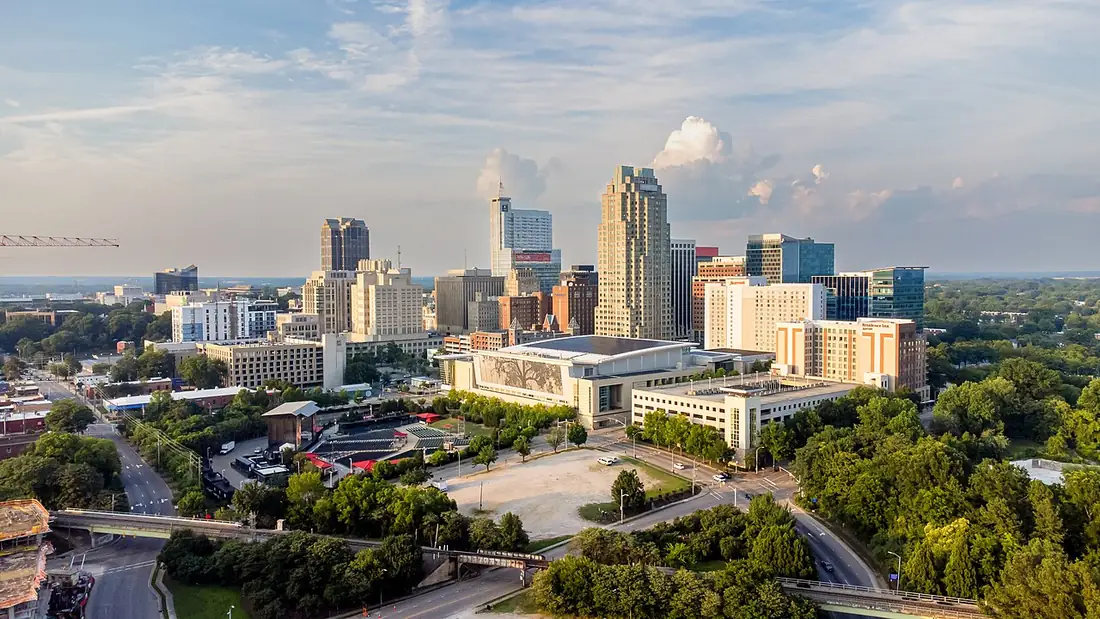
Drain cleaning in Raleigh, NC - Wake County - 44 ZIP codes covered
Drain Cleaning in Raleigh, NC
Raleigh breaks the pattern of this series. Where most flagship cities fight old pipe, Raleigh fights growth: the median home was built in 1997, only 7.4 percent of housing predates 1960, and 45.1 percent was built after 2000. The water is soft too, at about 25 mg/L of hardness, so scale is a minor character here. The drain story is instead about tree roots in the established districts, grease and wipes everywhere, a private lateral that Raleigh Water assigns entirely to the owner, and 50.2 inches of rain a year with 10.2 heavy rain days to test it all. This page is the Raleigh version of the drain conversation, younger, wetter, and more about habits and roots than corrosion.
A 1997 median home changes what a clog usually means
Read the Raleigh housing numbers as a diagnostic shortcut. Of 224,853 housing units, 45.1 percent were built after 2000, 15.7 percent between 1960 and 1979, and just 7.4 percent before 1960. Single family homes are 58.1 percent of the stock. In plain terms, most Raleigh drains run through modern plastic pipe with smooth bores and tight joints. When a newer Raleigh home clogs, the likely authors are the things going down the drain: grease cooled into a coating, hair bound with soap, wipes that never broke down, or an object that took a wrong turn at a bend.
The older minority writes the other Raleigh story. The pre 1980 districts carry the cast iron and clay era systems, where corrosion roughens the bore, joints open, and the mature tree canopy Raleigh is proud of sends roots looking for exactly those openings. Same city, two pipe generations, two different first suspicions. This is why a good Raleigh booking starts with one question: what year was the house built? The answer tells the contractor whether to lead with cleaning tools or with a camera, $125-$500, and it tells you whether a recurring clog is a habit problem or a pipe problem.
Growth adds a third, quieter theme: connections. A city adding this much housing adds laterals, taps, and cleanouts at pace, and newer subdivisions generally drain well until a construction era defect, a settled section, or a landscaping root finds the line. If a whole street of similar age homes shares a symptom era, that is worth mentioning on the call. Patterns across neighboring houses built by the same hands in the same years are real diagnostic evidence, not neighborhood gossip.
Drain problems we handle in Raleigh
The problems Raleigh's own housing, ground and weather produce most. The full symptom list is on the problems hub; these are the ones that earn their place here.
Recurring Clogs in Raleigh
A clog that returns is not bad luck. It is an undiagnosed cause - roots, scale, a belly, or a cleaning that never removed the material..
Slow Drain in Raleigh
One slow fixture is a narrowing pipe. Several slow fixtures are a main-line warning. How to tell the difference and what fixes each..
Multiple Drains Backing Up in Raleigh
Several drains failing together is the main line or sewer until proven otherwise. Stop the water, protect the floor, make the call..
Raleigh Water puts the whole lateral on you. Here is the exact split.
Raleigh Water published a plain language explainer in 2025 under the title Know Your Pipes, and every Raleigh homeowner should absorb its core sentence. You are responsible for the portion of the sewer line that runs from your home to the point where it connects to the city main sewer line. That run is your sewer lateral. The city is responsible for maintaining the main sewer lines within the public right of way, the streets and sidewalks. Notice what the split is not: it is not at your property line. The lateral segment passing under the sidewalk on its way to the main is still your pipe and your bill.
The city guidance also names the first move in a backup, and it is not the city phone number. Most backups, Raleigh Water says, trace to grease, tree roots, or wipes, and the first step is a licensed plumber who can tell a blockage from a pipe failure. Only if the problem turns out to sit in the public right of way system does the city customer care line enter the picture. That ordering saves everyone time: the plumber visit establishes where the problem lives, and location is what assigns the cost.
For pricing, the implication of full lateral ownership is that main line money is homeowner money here: $200-$650 for main line cleaning, $250-$900 for sewer line work, $125-$500 to camera the line when the cause is unclear. Those are national ranges, and your contractor sets the actual figure. But knowing the entire run is yours before the visit removes the most common Raleigh misunderstanding, the hope that the section near the street belongs to someone else. It does not. Plan, and budget, accordingly.
A Raleigh specific wrinkle follows from the boundary cleanout question in nearby towns, and it is worth stating carefully because it causes real confusion in the metro. Responsibility splits differ by utility across Wake County: Raleigh Water places the whole lateral on the owner, while some neighboring towns divide the run at a property line cleanout. Homeowners who move within the county, or who take advice from a neighbor on a different utility, can import the wrong rule with total confidence. The rule that governs your bill is the one published by the utility whose main your lateral reaches. In Raleigh proper, that is Raleigh Water, and its published answer is the full run, house to main.
About Raleigh: the local snapshot
Raleigh is the capital city of the U.S. state of North Carolina.
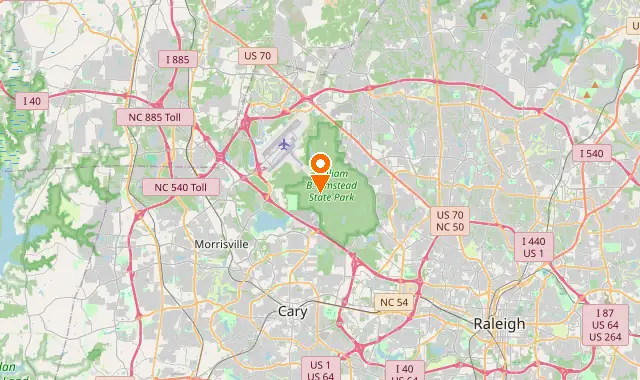
Local facts from Wikipedia and Wikidata, retrieved 2026-10-25. Population and area describe the city itself; the drain coverage counted on this page spans the wider area around it.
Soft water at 25 mg/L: the clog causes Raleigh actually has
Raleigh Water reports hardness of about 25 mg/L as CaCO3, roughly 1.5 grains per gallon, which is soft water by any scale. Monthly finished water reports from the E.M. Johnson plant land in the same neighborhood, around 29 to 32 mg/L. Soft water is kind to Raleigh plumbing: it leaves little scale in water heaters, fixtures stay cleaner, and the slow mineral narrowing that haunts hard water cities is a minor theme here. If a Raleigh contractor opens a conversation by blaming your clog on hard water scale, ask a follow up question, because the local numbers do not support scale as a leading act.
What the soft water does not prevent is the organic trio. Grease still cools and coats a kitchen line regardless of mineral content. Hair still mats at a stopper. Roots still enter an older joint, because roots chase water and nutrients, not hardness. And Raleigh adds rain to the recipe: 50.2 inches a year with 10.2 heavy rain days, pushing groundwater against every lateral joint in the older districts. A Raleigh clog is therefore usually a story about inputs and openings, not chemistry, and the fix is matched to that: mechanical cleaning for the coating, cutting for the roots, a camera for the joint that keeps inviting them back.
One water quality rhythm is worth knowing so it is not mistaken for a drain problem. Raleigh Water disinfects with chloramine most of the year and switches to chlorine only for a period each spring, roughly the last week of February through the first week of April, which can bring a stronger chlorine taste or smell and brief discoloration as lines are flushed. That is a scheduled treatment change at the plant, announced by the utility. A spring chlorine note at the tap is not a drain failure, and it does not call for a drain visit. Save the call for drainage behavior: speed, sound, and where water appears.
Fifty inches of rain and the Wake County root problem
Raleigh rain rarely makes national news, but its totals do quiet work underground. An average year brings 50.2 inches, with 10.2 days heavy enough to saturate soil thoroughly, and just 41 freeze days and 6.0 inches of snow, so the ground spends most of the year unfrozen, biologically active, and root friendly. Tree roots grow toward moisture all year here. In the older districts, where clay and early plastic laterals run under mature oaks, the root intrusion cycle is the defining maintenance rhythm: clear the line, watch it slow again as roots regrow through the same joint, clear it again a little sooner.
Breaking that cycle is a decision, not a cleaning setting. The camera shows the entry point and the condition of the joint. If the pipe around it is sound, a contractor may talk about a maintenance interval: planned main line cleanings at $200-$650 on a schedule you choose, instead of emergency calls at $150-$700 on a schedule the roots choose. If the joint is offset, cracked, or the line has a sag holding water, the honest conversation turns to repair or lining options in the $250-$900 sewer range and beyond, scoped from footage rather than fear. Either way, the footage is the fork in the road, and skipping it is how homeowners buy the same cleaning four times.
Rain also explains the backup that arrives with a storm in a house whose drains behaved all month. A lateral with a partial root mass runs at reduced capacity on its best day. Add household peak use during a storm, groundwater pressing in at the same joints, and the margin disappears. The fix sequence stays calm: limit water, call the same day, clean the main, and get the camera answer while the line is open. Raleigh weather guarantees the test will come again. The goal is to meet it with a known pipe, not a mystery.
The tree canopy that makes older Raleigh neighborhoods desirable deserves its own management note. Roots do not need a broken pipe. They need a joint with a hairline opening and a reliable moisture signal, and a lateral under a mature oak in a 1960s district provides both for decades. Pruning the root mass inside the pipe without addressing the joint is lawn care, not repair: it will look wonderful and recur on the tree schedule. The two durable options are the ones the camera informs, sealing or renewing the joint zone, or accepting a planned cutting interval as the cost of keeping the tree. Either is respectable. What is not respectable, financially, is paying emergency prices to rediscover the same tuft at the same joint every second year.
One slow drain, several slow drains: reading a Raleigh symptom map
Raleigh homes, being mostly newer and mostly single family, produce clean symptom maps. One slow fixture almost always means a local narrowing: hair and soap at that bathroom, grease in that kitchen branch, lint in the laundry line. It is the cheapest problem in the trade, squarely in the $99-$450 standard cleaning range, and it is fixed by removing the material from that branch and flow testing the fixture at full volume. Do not let anyone sell you a main line scope for a one fixture symptom without evidence that connects the two.
Several slow fixtures redraw the map. The restriction now sits where the lines join, in the main or the lateral, and the tools change with the address of the problem. Add gurgling, especially a toilet bubbling when another fixture drains, and the main line reading strengthens, because air is being pushed back through traps by a downstream restriction. Add odor at a little used floor drain and you may simply have a dry trap asking for water, the smallest fix in this entire page, before any contractor is called at all.
The move that keeps Raleigh visits honest is insisting on the test at the end: fixtures run together, at full flow, while the lowest drain in the house is watched. A line that copes with one tap and fails under a tub discharge plus a toilet flush has told you it is still restricted, whatever the first minutes suggested. Contractors expect this test. Homeowners who ask for it by name get visits that end with a verdict, not a vibe, and a verdict is what the next decision, clean, jet, camera, or repair, should be built on.
Newer Raleigh construction contributes one more pattern worth knowing: the shared lateral and the builder cleanout. In fast built subdivisions, several homes may drain through runs installed in the same week by the same crew, and an installation era quirk, a slightly flat section, a joint that was never fully seated, can repeat across a street. If your post 2000 home develops a slow main in its first decades and two neighbors mention the same, treat the cluster as evidence and say so when you book. Contractors who know a street shares a vintage will check the known weak points first, and a problem that looked like your private misfortune sometimes resolves as a five minute fix at a predictable location.
What booking through DrainFlowed means in Raleigh
DrainFlowed is a connection service for Raleigh homeowners, not a plumbing company with Raleigh crews. One call to (866) 555-0134 connects you with an independent local contractor. That contractor quotes your job, books the visit, does the work, and answers for it. Verify license and insurance with the contractor directly, the way you would with any hire, and expect the quote to be built from your specific access and findings rather than from this page.
The national ranges are your frame: standard drain cleaning $99-$450, main line $200-$650, hydro jetting $300-$900, sewer line work $250-$900, camera inspection $125-$500, emergency $150-$700. In Raleigh the two questions that sort most jobs are the age of the home and the count of affected fixtures. A 2015 home with one slow shower is a small, calm job. A 1968 home with three slow fixtures and a root history is a main line job with a camera conversation attached, and pricing it as the first kind of job helps nobody.
Use the city own guidance as your backstop. Raleigh Water itself tells homeowners to start with a licensed plumber, to expect the lateral to be theirs to the main, and to suspect grease, roots, and wipes before exotic causes. A contractor whose findings line up with that published picture is easy to work with. And if the visit ends with the problem located in the city main or right of way system after all, you now have a located, documented finding to take to the city customer care line, which is exactly the evidence the city process asks for.
Drain services available in Raleigh
The services that answer Raleigh's lead problems, from the independent contractors who cover the city. Ranges are the national typical ranges used across this site.
| Service | Typical range | What it is |
|---|---|---|
| Drain Cleaning | $99-$450 | The core service: mechanical cleaning that clears the clog and scrapes the pipe walls, not just a hole poked through the blockage.. |
| Clogged Drain Repair | $120-$550 | For the drain that is already blocked: diagnosis first, then the right fix, so the same clog does not come back next month.. |
| Main Line Cleaning | $200-$650 | When every drain in the house slows at once, the problem is the main line. |
| Sewer Line Cleaning | $250-$900 | The buried line from your house to the street: root cutting, scale removal and jetting, with camera proof of the pipe's condition.. |
| Hydro Jetting | $300-$900 | High-pressure water that scours pipe walls clean - the answer for grease, scale and lines that keep re-clogging after cabling.. |
| Drain Camera Inspection | $125-$500 | See inside the pipe before you spend on the fix: roots, cracks, bellies and blockages located precisely, with footage to decide on.. |
Full detail on every service, with signs and causes, is on the services hub, and every range on the site is collected in the cost guide.
Raleigh coverage snapshot
Nearby covered cities: Holly Springs, Wake Forest, Apex, Cary.
Raleigh sewer and water resources
The city and utility pages this page's local facts rest on, worth bookmarking if you own a home in Raleigh:
Sources for this page
- housing age and mix: Median year built 1997, 7.4 percent pre 1960, 15.7 percent built 1960 to 1979, 45.1 percent post 2000, 224,853 units, 58.1 percent single family (source)
- climate: 50.2 in annual precipitation, 6.0 in snow, 41 freeze days, 10.2 heavy rain days per year, 2014 to 2023 average (source)
- sewer lateral responsibility: Owner is responsible for the sewer line from the home to the connection with the city main; the city maintains mains in the public right of way (source)
- water hardness: Raleigh Water reports hardness about 25 mg/L as CaCO3 (1.47 gpg), soft; monthly E.M. Johnson plant reports show about 29 to 32 mg/L (source)
- local fact disinfection switch: Raleigh Water disinfects with chloramine most of the year and switches to chlorine only roughly late February through early April, which can raise chlorine smell and cause brief discoloration during flushing (source)
- Housing age: median year built and build-era shares (US Census Bureau ACS)
- Weather averages: 2014-2023 daily record (Open-Meteo archive, ERA5)
Coverage around Raleigh
Nearby cities we cover in North Carolina
- Drain cleaning in Holly Springs, NC
- Drain cleaning in Wake Forest, NC
- Drain cleaning in Apex, NC
- Drain cleaning in Cary, NC
- Drain cleaning in Winston Salem, NC
- Drain cleaning in Durham, NC
- Drain cleaning in Greensboro, NC
- Drain cleaning in Fayetteville, NC
The full list for the state is on the North Carolina locations page.
Beyond Raleigh
Coverage at this depth continues nearby: see drain cleaning in Charlotte, NC and drain cleaning in Winston Salem, NC, each written from its own city's data the same way this page is.
Questions, answered
Who owns the sewer lateral in Raleigh, and where does the city responsibility start?
You own the lateral for its full run, from your home to the point where it connects to the city main, per Raleigh Water Know Your Pipes guidance. The city maintains the mains within the public right of way. The segment of your lateral passing under a sidewalk is still yours, which is the detail that surprises most Raleigh homeowners.
What does Raleigh Water say causes most sewer backups?
Grease, tree roots, and wipes marketed as flushable. The city guidance names those three directly and advises calling a licensed plumber first, since a plumber can distinguish a blockage from a pipe failure and locate which side of the system the problem sits on.
Is Raleigh water hard? Should I worry about scale in my drains?
No, Raleigh water is soft. Raleigh Water reports hardness around 25 mg/L, about 1.5 grains per gallon, and monthly plant reports sit near 29 to 32 mg/L. Scale is a minor issue here. Raleigh clogs are far more often grease, hair, wipes, or roots in older lines than mineral buildup.
Why does my tap water smell more like chlorine in spring?
Raleigh Water uses chloramine disinfection most of the year and switches to chlorine only for a period each spring, roughly late February through early April. A stronger chlorine smell and brief discoloration during flushing are expected parts of that scheduled change. It is a treatment matter, not a drain problem.
How much does drain cleaning cost in Raleigh?
National ranges: standard cleaning $99-$450, main line $200-$650, hydro jetting $300-$900, camera inspection $125-$500, emergency $150-$700. The independent contractor connected through DrainFlowed at (866) 555-0134 sets your actual price based on access and what the line shows.
Roots keep coming back in my older Raleigh home. What actually ends the cycle?
A camera inspection that locates the entry joint and judges the pipe around it. If the joint is sound, a planned cleaning interval can manage regrowth on your schedule. If the joint is offset or cracked, repair or lining addresses the opening itself. Without the footage, you are buying the same cleaning on the roots schedule, typically every year or two.
Several drains slowed during a heavy rain week. Is that a city problem?
Not necessarily. Raleigh gets 50.2 inches of rain and 10.2 heavy rain days a year, and a partially restricted private lateral often fails first under storm week load and groundwater pressure. Raleigh Water guidance is to start with a plumber to locate the problem. If it proves to be in the city main or right of way system, you take that located finding to the city.
Drain problem in Raleigh? Make the call
A live person answers around the clock. Describe the problem, hear the likely range, and get an independent local contractor on the way.
(866) 555-0134 Tap to call nowA live person answers, day or night. Describe the problem, hear the likely range, then decide.