
Drain cleaning in Charlotte, NC - Mecklenburg County - 73 ZIP codes covered
Drain Cleaning in Charlotte, NC
Charlotte is the newest city in this group by a wide margin, and that youth shapes everything about its drains. The median home was built in 1995, only 10.4 percent predate 1960, and 42.6 percent were built after 2000, the highest modern share here. Most Charlotte laterals are PVC, and most Charlotte drain calls are about grease, growth and settling rather than antique pipe. But the city grew around older pockets where clay tile, cast iron and even Orangeburg pipe from the mid twentieth century still serve whole streets, and those pockets behave like a different, older city hiding inside the new one. Add soft water at 32 parts per million, heavy rain at 9.3 heavy rain days a year, and Charlotte Water design rules that require cleanouts outside the right of way and backwater valves on low lying lots, and you have a page that has to serve two Charlottes at once. Standard drain cleaning runs $99-$450.
Soft water changes the diagnosis, so start somewhere else
Charlotte Water puts its hardness at an average of 32 parts per million and calls the water soft, a fraction of the mineral load in the Ohio cities on this list. That single fact deletes the most overused explanation in drain work. Scale is not narrowing Charlotte's pipes at any meaningful rate. Fixtures stay cleaner, water heaters accumulate less sediment, and a slow drain here is almost never a mineral story. When a Charlotte drain slows, the working list is shorter and more physical: grease cooling in a kitchen run, hair and soap in a bathroom branch, roots where an older line gives them entry, a belly where a newer line settled, or wipes where someone believed a label.
That clarity is a consumer advantage, if you use it. Any pitch that leads with water treatment as the answer to a Charlotte sewer problem is solving a problem your utility data says you do not have. Put the money into diagnosis instead. A camera inspection, at $125-$500, shows the actual interior of the actual pipe, and in a soft water city the footage tends to be unusually readable, because the walls are not furred with scale. What you see is the pipe itself: joints, slope, intrusions, deformation.
Soft water has one subtler effect worth knowing. Without mineral armour, older metal pipe interiors face household chemistry more directly, and in the pre 1960 and mid century pockets that still run cast iron drains, corrosion thinning is a when, not an if. The camera answers that too. If the iron is channelled or paper thin at the invert, cleaning restores flow for now, and the repair conversation belongs on your planned list rather than your emergency list.
Drain problems we handle in Charlotte
The problems Charlotte's own housing, ground and weather produce most. The full symptom list is on the problems hub; these are the ones that earn their place here.
Slow Drain in Charlotte
One slow fixture is a narrowing pipe. Several slow fixtures are a main-line warning. How to tell the difference and what fixes each..
Recurring Clogs in Charlotte
A clog that returns is not bad luck. It is an undiagnosed cause - roots, scale, a belly, or a cleaning that never removed the material..
Standing Water in Charlotte
Water that will not go down has a blockage at a specific level. Which level decides whether it is a quick clean or a main-line job..
Gurgling Drains in Charlotte
Gurgling is air moving where it should not - displaced by a partial blockage or a vent problem. It is one of the earliest main-line warnings..
Two Charlottes: the post 2000 majority and the older pockets
The census split is stark. Of 399,305 housing units, 42.6 percent were built after 2000 and the median year is 1995. Homes from 1960 to 1979 are 17.5 percent, and pre 1960 homes just 10.4 percent. Single family homes are 60.3 percent of the stock. In the post 2000 majority, laterals are PVC with glued joints that roots rarely penetrate, and stoppages trace to behaviour and bedding: grease, wipes, a section that sagged as trench fill consolidated, or debris left from construction. Those lines clean well, stay clear when habits change, and seldom need structural talk. A standard cleaning at $99-$450 plus honest advice is the whole job, most of the time.
The older pockets run on different materials and a different clock. Local inspection guidance for the Charlotte area describes the usual suspects in older neighbourhoods as clay tile that cracks and admits roots, aging cast iron, and, in homes built from roughly the 1940s through the early 1970s, Orangeburg pipe, a tar paper based material that deforms and collapses with age. Orangeburg deserves its reputation. It does not crack like clay. It ovals, blisters and flattens until flow strangles, and no cleaning restores a shape the pipe itself has lost. If your home falls in that build window and the drains have a history, the camera is not optional equipment. It is how you find out whether you are maintaining a pipe or postponing a replacement.
Because the two Charlottes interleave street by street, never let a contractor price your job from your neighbourhood's reputation in either direction. A 2010 house can hide a settled belly. A 1955 house can have a sound, previously replaced PVC lateral. The build year sets the prior expectation. The footage sets the truth, and in this city the footage is cheap relative to every decision that follows it.
About Charlotte: the local snapshot
Charlotte is the most populous city in the U.S. state of North Carolina.
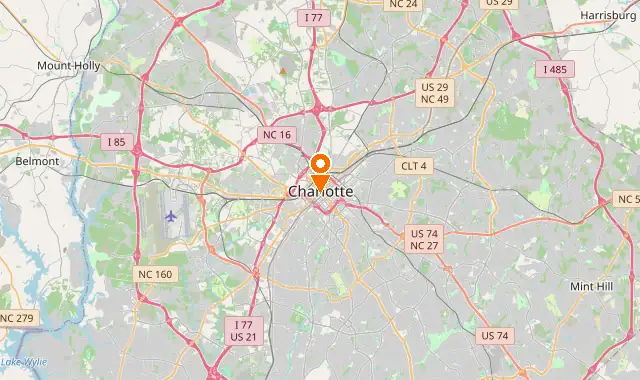
Local facts from Wikipedia and Wikidata, retrieved 2026-10-25. Population and area describe the city itself; the drain coverage counted on this page spans the wider area around it.
Cleanouts and backwater valves are written into Charlotte's own standards
Charlotte Water's gravity sewer design standards give homeowners two concrete facts to check against their own properties. First, laterals are to terminate with a cleanout or manhole located outside the road right of way or sewer easement, and no closer than three feet from the side property line. That means a Charlotte home should have an accessible cleanout on the private side of the system, positioned so a contractor can run the full lateral without entering the house. If yours is buried under mulch, a deck or a driveway extension, finding and exposing it before an emergency is some of the cheapest preparation available to you. Crews clean faster and more completely through a proper cleanout, and pricing reflects that access.
Second, the standards require a backwater valve in a defined situation: when the building finished floor elevation is at or below the ground elevation at the sewer main connection, the lateral must include a private sewer backwater valve located after the property line cleanout, plus a cleanout between the valve and the building. Charlotte's terrain makes that situation real. Lots that sit low relative to the street, and homes with plumbing fixtures below street level, are exactly the geometry a backwater valve exists for. If your home matches that description, ask whether the valve is present and functional. A valve that exists but is jammed with debris is decoration, not protection.
Responsibility follows the familiar pattern, confirmed by local practice: the owner maintains the lateral from the foundation to the connection at the city main, and the city maintains the main itself. Bring that map to the booking call. When you ring (866) 555-0134, mention your home's build era, whether you have located the cleanout, and whether the lowest fixtures sit below street level. Those three facts let the independent contractor arrive with the right plan instead of discovering your system one fitting at a time.
Nine heavy rain days and what they test
Charlotte averaged 45.1 inches of precipitation a year over 2014 to 2023, with 9.3 heavy rain days, the second highest count in this group after Kansas City, and only 40 freeze days and 5.0 inches of snow. Winter is a minor character here. Rain is the stress test. Heavy downpours test every weakness that lets surface and ground water into sanitary lines: cracked joints in the older pockets, imperfect connections, and low lying laterals. A line already narrowed by grease or roots has the least margin exactly when the surrounding soil is saturated and every household on the street is running water after being home all day in the storm.
Creek geography sharpens the point locally, but the homeowner version needs no map. If your drains slow only during and after major rain, the system is telling you water is entering or backing up somewhere it should not. Record the timing, check whether the lowest fixtures are the ones complaining, and get a camera run scheduled for a dry day with that history in hand. The contractor should look for infiltration points and standing water in the line, not only for the blockage of the week. Main line cleaning runs $200-$650, and cleaning paired with that specific inspection brief is worth considerably more than cleaning alone.
Growth adds a final Charlotte wrinkle. Construction across the metro means new connections, disturbed soil and young trees planted thoughtfully near houses and thoughtlessly near laterals. Roots from fast growing landscape trees reach clay joints in the older pockets within years. If your street has both older pipes and new planting, shorten your assumptions: have the line looked at when the first recurring slowdown appears, not after the backup that proves the point at your floor drain's expense.
Renters feel this city's split too, in a simpler form. A tenant in an older pocket home who reports a slow drain early is reporting a possible clay or Orangeburg condition while it is still a cleaning. The same report delayed by months of drain opener use can arrive as a collapse. Owners of older Charlotte rentals should ask for early reporting explicitly, and owners of newer rentals should solve the grease conversation at move in, with the container by the sink rather than the lecture after the backup. Charlotte's housing is young enough that most of its drain future is still a choice, which is a genuinely enviable position among the cities on this list.
Kitchen grease in a young city
It would be tidy to say Charlotte's drain problem is old pipe in old pockets and nothing elsewhere, but the service pattern refuses. In the post 2000 stock, the dominant call is the kitchen line, narrowed by cooking grease that entered as hot liquid and set as a solid lining, then caught the food solids that should have been scraped to the bin. Modern open plan homes cook more at home, run dishwashers daily, and dispose of more through the sink than the housing of 1970 did. Garbage disposals, used as bins, add ground food to the grease film, and the combination builds a restriction that chemical openers melt a pinhole through and call fixed, until next month.
The correct tool depends on the deposit. A cable with a blade suits a defined clog. Hydro jetting, at $300-$900, scours a grease coated run back to the wall, which is what a line needs when the whole length is filmed rather than blocked at a point. In PVC, jetting is generally well tolerated. In the older pockets, the contractor should camera first and jet second, because jetting a collapsing Orangeburg section or a separated clay joint can worsen a pipe whose problem is structure, not coating. Sequence is the mark of competence in a two material city: inspect, then choose force, then verify flow under load before leaving.
Habits decide the interval afterward. Grease in a container, solids in the bin, wipes never in the toilet regardless of packaging, and a strainer in the kitchen sink will keep a cleaned Charlotte line clear for a long stretch, because the pipe underneath is usually sound. That is the optimistic truth about a young housing stock. Most of its drain problems are reversible behaviour layered on good infrastructure, which is more than the older cities on this list can say.
Buying, selling and booking in a boom city
Charlotte's transaction pace makes the sewer scope a local institution in the making, and inspection guidance aimed at buyers here recommends it plainly for homes on public sewer with any age on them, on the logic that the lateral is the owner's, failures are expensive, and a camera before closing costs a fraction of a collapse after it. Sellers should hear the same point from the other side. A recent camera file in the disclosure packet converts a buyer's worst case assumption into a known condition, and for the many homes with sound PVC laterals, that file is pure value.
For booking routine work, give the contractor the facts this page has used: build year, pipe material if known, cleanout location, lowest fixture elevation relative to the street, and whether symptoms track rain. Emergency service runs $150-$700, and during a live backup the rules are simple. Stop adding water, protect the lowest floor area, and do not run the dishwasher or laundry to test whether it has cleared. It has not cleared. It is waiting.
DrainFlowed is a connection service that links you with independent local contractors who set their own prices within the published ranges and stand behind their own work. Verify license and insurance with the contractor you hire, keep their camera footage and invoice with your closing documents if you have them, and treat the lateral as part of the house you actually bought. In Charlotte, that pipe is usually young, sound and worth maintaining properly, which is the best starting position of any city in this group.
Drain services available in Charlotte
The services that answer Charlotte's lead problems, from the independent contractors who cover the city. Ranges are the national typical ranges used across this site.
| Service | Typical range | What it is |
|---|---|---|
| Drain Cleaning | $99-$450 | The core service: mechanical cleaning that clears the clog and scrapes the pipe walls, not just a hole poked through the blockage.. |
| Clogged Drain Service | $120-$550 | For the drain that is already blocked: diagnosis first, then the right fix, so the same clog does not come back next month.. |
| Main Drain Cleaning | $200-$650 | When every drain in the house slows at once, the problem is the main line. |
| Hydro Jetting | $300-$900 | High-pressure water that scours pipe walls clean - the answer for grease, scale and lines that keep re-clogging after cabling.. |
| Sewer Camera Inspection | $125-$500 | See inside the pipe before you spend on the fix: roots, cracks, bellies and blockages located precisely, with footage to decide on.. |
| Floor Drain Cleaning | $110-$450 | Basement, laundry and garage floor drains: the house's safety valve, cleaned and trap-checked before it is needed in a flood.. |
Full detail on every service, with signs and causes, is on the services hub, and every range on the site is collected in the cost guide.
Charlotte coverage snapshot
Nearby covered cities: Huntersville, Raleigh, Winston Salem, Durham.
Charlotte sewer and water resources
The city and utility pages this page's local facts rest on, worth bookmarking if you own a home in Charlotte:
Sources for this page
- sewer lateral responsibility: Charlotte Water design standards: laterals terminate with a cleanout outside the road right of way or sewer easement, backwater valve required when finished floor is at or below ground elevation at the main connection (source)
- water hardness: Charlotte Water average hardness 32 parts per million, soft water (source)
- local facts: Older Charlotte homes may have clay tile, aging cast iron and Orangeburg pipe from roughly the 1940s to early 1970s, lateral belongs to homeowner (source)
- housing age: Median year built 1995, 10.4 percent pre 1960, 42.6 percent post 2000, ACS 2024 5 year (source)
- Housing age: median year built and build-era shares (US Census Bureau ACS)
Coverage around Charlotte
Areas and neighbourhoods in and around Charlotte
Calls also come in from Newell, Paw Creek and the streets between them. Those areas sit inside the same coverage, on the same contractor rounds.
NewellPaw Creek
Nearby cities we cover in North Carolina
- Drain cleaning in Huntersville, NC
- Drain cleaning in Raleigh, NC
- Drain cleaning in Winston Salem, NC
- Drain cleaning in Durham, NC
- Drain cleaning in Greensboro, NC
- Drain cleaning in Fayetteville, NC
- Drain cleaning in Concord, NC
The full list for the state is on the North Carolina locations page.
Beyond Charlotte
Coverage at this depth continues nearby: see drain cleaning in Raleigh, NC and drain cleaning in Winston Salem, NC, each written from its own city's data the same way this page is.
Questions, answered
Who is responsible for the sewer line from my house to the street in Charlotte?
In the Charlotte metro the property owner is responsible for the lateral from the foundation to the connection at the city main, while Charlotte Water maintains the public main. Charlotte Water design standards require laterals to terminate with a cleanout or manhole outside the road right of way or sewer easement. Knowing where that cleanout is, and keeping it accessible, speeds every visit.
Does my Charlotte home need a backwater valve?
Charlotte Water's own design standards require one in that situation. When the building finished floor elevation is at or below the ground elevation at the sewer main connection, the lateral must have a private sewer backwater valve located after the property line cleanout, with an additional cleanout between the valve and the building. If your lowest floor sits low relative to the street, ask your contractor to check whether your home was built with one and whether it still works.
Is Charlotte water hard, and could that be slowing my drains?
Charlotte Water describes its tap water as soft, with an average hardness of 32 parts per million. At that level, mineral scale is a minor issue. Slow drains in Charlotte are far more often grease, roots in older lines, settling bellies, or wipes than scale, which is why diagnosis here starts with a camera rather than a water treatment conversation.
Should I scope the sewer line before buying an older Charlotte home?
On any Charlotte home with age on it, yes. Local inspection guidance notes the lateral belongs to the homeowner, that older areas can contain clay tile and aging cast iron, and that homes built from roughly the 1940s through the early 1970s may have Orangeburg pipe, a tar paper material that deforms and collapses with age. A pre purchase camera inspection, $125-$500, costs a fraction of a post closing lateral replacement.
What does drain cleaning cost in Charlotte?
Standard drain cleaning runs $99-$450, main line cleaning $200-$650, hydro jetting $300-$900, sewer line services $250-$900, camera inspection $125-$500, and emergency service $150-$700. The independent contractor you are connected with confirms the figure for your line, material and access before work begins. DrainFlowed is a connection service only.
My subdivision is new. Is a camera inspection still useful?
Ask for it anyway. In the older pockets it reveals clay joints with roots, Orangeburg sections losing shape, and cast iron condition. In newer subdivisions it reveals bellies holding water, construction debris, and grease patterns. Either answer guides the right spend: an interval cleaning plan, a targeted repair, or simple habit changes with no further work at all.
Drain problem in Charlotte? Make the call
A live person answers around the clock. Describe the problem, hear the likely range, and get an independent local contractor on the way.
(866) 555-0134 Tap to call nowA live person answers, day or night. Describe the problem, hear the likely range, then decide.