
Drain cleaning in Saint Louis, MO - St. Louis County - 40 ZIP codes covered
Drain Cleaning in Saint Louis, MO
St. Louis owns the oldest housing stock in this batch and does not hide it. The median home was built in 1938, about 75.5 percent of homes predate 1960, and the city itself notes that many of its sewer lines are over 100 years old and made of clay pipe. Clay is a decent material that becomes a fragile one: joints shift as ground settles, roots find the seams, and a line that has drained since before the Second World War starts to behave like it. Layer on a combined sewer system in the city, where stormwater and sewage share a pipe, about 52.8 inches of precipitation a year and 85 freeze days, and St. Louis drain work becomes a discipline of its own, with one unusual advantage. This city runs a Sewer Lateral Repair Program that can pay for the right kind of break in the right place.
The lateral program St. Louis homeowners should know by name
Start with the program, because it changes what a diagnosis is worth. The City of St. Louis states that the entire sewer lateral from your home to the Metropolitan St. Louis Sewer District main is private property. Its Sewer Lateral Repair Program exists to help with one specific part of that burden: severe damage under the public right of way. Owners of residential property with six or fewer units pay a 28 dollars fee on their real estate taxes into the program, and if a break under the right of way is confirmed, the repair is made at no additional fee when taxes are paid and the property is assessed the lateral fee.
The limits matter as much as the benefit. The program does not cover breaks under private property, and it does not cover clearing clogs or tree roots along any portion of the lateral. Its goal is severe damage causing cave ins in the right of way or backups in the home. The route in runs through evidence: a licensed plumber inspects the line, and the plumber statement and video go to the Street Department. That is why a camera inspection in St. Louis is not an upsell. It is the admission ticket to a program that can save an owner thousands on the most expensive segment of the line.
Notice what the program asks for, because it tells you how the city thinks. It does not ask for a story, it asks for a licensed plumber report and a video. That standard protects everyone: the homeowner from a guessed diagnosis, the city from funding the wrong repair, and the honest contractor from competing with a cheaper guess. If a contractor resists filming your line or putting findings in writing, that resistance is itself a finding. In St. Louis more than most cities, the paper trail is part of the plumbing, and the owners who keep it are the ones the system serves fastest when a real break arrives.
Drain problems we handle in Saint Louis
The problems Saint Louis's own housing, ground and weather produce most. The full symptom list is on the problems hub; these are the ones that earn their place here.
Recurring Clogs in Saint Louis
A clog that returns is not bad luck. It is an undiagnosed cause - roots, scale, a belly, or a cleaning that never removed the material..
Multiple Drains Backing Up in Saint Louis
Several drains failing together is the main line or sewer until proven otherwise. Stop the water, protect the floor, make the call..
Slow Drain in Saint Louis
One slow fixture is a narrowing pipe. Several slow fixtures are a main-line warning. How to tell the difference and what fixes each..
Clay pipe, a century old and still on duty
The city own words set the scene: many sewer lines in St. Louis are over 100 years old and made from clay pipe, susceptible to shifting as ground settles, and no pipe is entirely without defects. With a median build year of 1938 and three quarters of homes predating 1960, that description covers most of the housing stock, about 174,111 units, a little under half of them single family in form, with the rest in the small multi family buildings that fill much of the city.
Clay fails in recognizable ways. Joints separate in small steps that catch paper and waste. Roots enter a joint, thicken, and become a net. A section sags into a belly that holds water permanently, so every flush leaves sediment behind. Cleaning restores flow in all three cases for a while, which is why St. Louis homeowners can spend years on repeat clearings that each work. The camera ends the cycle by showing which failure you actually own, and whether it sits under your yard, where it is your cost, or under the right of way, where the city program may take it.
Buyers should treat the lateral as a priced item in this city, not a footnote. A camera inspection during the inspection period, in the $125-$500 range, can reveal a right of way break that the city program will fund, a private break that belongs in the negotiation, or a sound line that lets everyone relax. Sellers who have already filmed their line hold an advantage for the same reason. In a market built in 1938, underground information is scarce, and scarce information is value. The footage belongs with the house, transferred like any other record of a major system.
About Saint Louis: the local snapshot
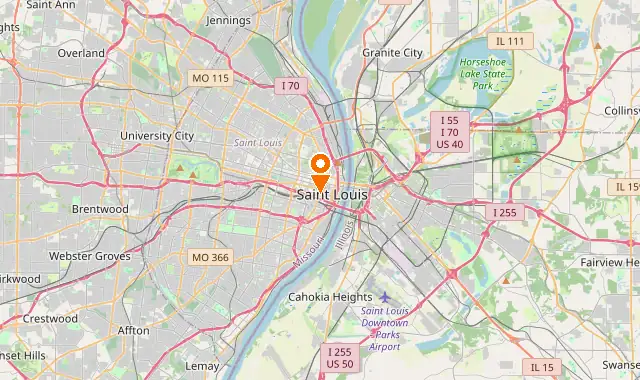
Local facts from Wikipedia and Wikidata, retrieved 2026-10-25. Population and area describe the city itself; the drain coverage counted on this page spans the wider area around it.
A combined sewer city, and what that means at your floor drain
The Metropolitan St. Louis Sewer District draws the map plainly. Most of St. Louis County is served by separate systems, one pipe for wastewater and one for stormwater. The City of St. Louis is served by a combined sewer system, where wastewater and stormwater share the same pipe, and different solutions are needed in those areas. During heavy rain, a combined system carries both flows at once, and its capacity is shared with the weather in a way a separate system is not.
For a homeowner, the translation is about timing and teamwork. About 11.5 heavy rain days a year appear in the climate record, alongside roughly 52.8 inches of annual precipitation. A marginal lateral that drains acceptably all month can back up during a storm because the combined main it feeds is running full. MSD also runs stormwater disconnection work in combined areas and covers those project costs as part of its capital program, which is worth knowing if your property is ever included. The private half of the defence remains yours: a sound lateral, clear of roots, gives storm water the least reason to visit your basement.
The combined system also explains a St. Louis habit worth copying: neighbors talk after storms. If several homes on a block backed up in the same rain, the shared system is implicated and reporting together strengthens every case with MSD and the city. If only your house was affected, the evidence points back at your lateral, and the sooner a camera confirms that, the sooner the right fix starts. Either way, the pattern across the street is diagnostic information that costs nothing to gather, and in a combined sewer city it is some of the most useful information there is.
MSD stormwater disconnection work in combined areas is the public half of that same logic: every downspout or connection moved out of the combined pipe frees capacity the next storm will need. If your property is offered that work, take the meeting. It costs the homeowner nothing under the capital program the district describes, it reduces the load your own lateral drains into, and it is one of the few drain improvements in any city that arrives funded by someone else program rather than your savings.
Freeze days, river city weather and old joints
St. Louis records about 85 freeze days a year and roughly 13 inches of snow, so its old clay lines cycle through freeze and thaw every winter on top of their age. Ground movement is the slow enemy of rigid pipe: each cycle can open a joint a fraction more, and each opening admits a little more soil and a few more root hairs. By the time a line announces itself with a backup, the defect producing it may have been growing for a decade.
Seasonal habits help. Autumn is the honest season to clear and film a doubtful line, before leaves, holiday use and winter weather stack their loads on it. Watch for the early dialect of a failing clay lateral: a drain that gurgles after rain, a cleanout that holds water higher than it should, a patch of yard that stays green and soft over the line route in a dry spell. Each is information arriving early, while the fix is still a cleaning in the $99-$450 range or a planned repair, rather than an emergency in the $150-$700 range with sewage already indoors.
Yard signs matter in clay country. A depression forming over the lateral route, soil that stays damp without rain, or a section of lawn that outgrows the rest in August all suggest a leaking joint feeding the ground. Left alone, a leak washes soil out from around the pipe, the pipe loses support, and a joint problem graduates into the kind of severe damage that caves in ground above it. Early attention keeps you in the world of cleaning and spot repair. Delay moves you toward excavation, and in the right of way, toward the program queue, which moves at the speed of severity rather than the speed of your plans.
What is yours, what is the program, what is MSD
Responsibility in St. Louis has three chairs and it pays to seat everyone correctly. The lateral, all of it, is private property, so its maintenance and its clogs belong to the owner. Severe lateral damage under the public right of way, for eligible properties of six or fewer units with taxes paid, belongs to the city Sewer Lateral Repair Program, which prioritizes properties with wastewater backups and works through cases in registered order apart from that priority. The public mains belong to the Metropolitan St. Louis Sewer District, which also handles the combined system strategy for the city.
Practically, that means your first call depends on symptoms. A cave in in the street or alley gets reported to the city. A backup at home starts with a licensed plumber inspection, because that report and video decide whether you are buying a private repair or filing into the program. DrainFlowed connects you with independent local contractors for the private side of this work. It does not administer the city program, and no contractor can promise you its outcome. What a good contractor can do is produce exactly the evidence the program asks for.
Renters in the small multi family buildings that make up much of the city should know the shape of this too. The program eligibility attaches to the property and its tax status, which the owner controls, while the backup lands on the tenant daily life. A tenant who reports promptly, documents damage and tells the owner in writing has done the three things that let the owner act, whether that action is a private clearing or a program filing. Owners of six unit and smaller buildings should treat that 28 dollars fee line on the tax bill as what it is: insurance they already bought, valuable only if the evidence habit exists when it is needed.
St. Louis drain costs in ranges, with the program in view
For private work, the ranges are the national ones used across DrainFlowed: standard drain cleaning $99-$450, main line cleaning $200-$650, sewer line work $250-$900, hydro jetting $300-$900, camera inspection $125-$500 and emergency service $150-$700. In St. Louis the camera line deserves emphasis, because its $125-$500 buys both a repair plan and, where a right of way break exists, the documentation the Sewer Lateral Repair Program requires. Spending it before authorizing any dig is the closest thing this trade has to a rule.
DrainFlowed is a connection service. The contractors it connects you with are independent local businesses, responsible for their own work, pricing and permits, including the city licensing the program expects for inspection reports. Verify license and insurance, agree your range in writing, and keep the video file. In most cities that video is a convenience. In St. Louis, with a century of clay under the streets and a public program keyed to evidence, it is an asset. Call (866) 555-0134 and say plainly if you suspect a break, a cave in or a rain linked backup, because each routes differently.
Finally, a word on sequencing a St. Louis job. Clear the line if it is blocked, film it once it is open, locate any defect at the surface, and only then talk repair money. Each step narrows the next price honestly. Jobs sold in the reverse order, repair first and diagnosis later, are how homeowners in old pipe cities end up paying to dig in the wrong place. The ranges on this page exist so you can hold any proposal up against them and ask a simple question: which range does this work fall in, and what did the camera show to put it there. A straight answer is the mark of the contractor you want.
Drain services available in Saint Louis
The services that answer Saint Louis's lead problems, from the independent contractors who cover the city. Ranges are the national typical ranges used across this site.
| Service | Typical range | What it is |
|---|---|---|
| Drain Cleaning | $99-$450 | The core service: mechanical cleaning that clears the clog and scrapes the pipe walls, not just a hole poked through the blockage.. |
| Main Line Cleaning | $200-$650 | When every drain in the house slows at once, the problem is the main line. |
| Sewer Line Cleaning | $250-$900 | The buried line from your house to the street: root cutting, scale removal and jetting, with camera proof of the pipe's condition.. |
| Hydro Jetting | $300-$900 | High-pressure water that scours pipe walls clean - the answer for grease, scale and lines that keep re-clogging after cabling.. |
| Drain Camera Inspection | $125-$500 | See inside the pipe before you spend on the fix: roots, cracks, bellies and blockages located precisely, with footage to decide on.. |
| Emergency Drain Cleaning | $150-$700 | Sewage backing up, water rising, guests arriving: what counts as a drain emergency, what to do in the first ten minutes, and how the visit works.. |
Full detail on every service, with signs and causes, is on the services hub, and every range on the site is collected in the cost guide.
Saint Louis coverage snapshot
Nearby covered cities: Chesterfield, Florissant, Kansas City, Springfield.
Saint Louis sewer and water resources
The city and utility pages this page's local facts rest on, worth bookmarking if you own a home in Saint Louis:
Sources for this page
- sewer lateral responsibility: Entire lateral from home to MSD main is private property; city program assists with the public right of way section (City of St. Louis) (source)
- city programs: Sewer Lateral Repair Program funded by a 28 dollars fee on real estate taxes for properties of 6 or fewer units; covers severe right of way damage, excludes private property breaks and all clog or root clearing (source)
- combined sewer: City of St. Louis is served by a combined sewer system; most of the county is separate (Metropolitan St. Louis Sewer District) (source)
- housing age: Median year built 1938, 75.5 percent pre 1960, 174111 housing units, 47.4 percent single family (ACS 2024 5-year) (source)
- climate: 52.8 in annual precipitation, 11.5 heavy rain days, 85 freeze days, 13.0 in snow (Open-Meteo ERA5 2014 to 2023) (source)
- water hardness: Omitted. No hardness figure from a St. Louis utility water quality report was verified in this pass. (source)
- Housing age: median year built and build-era shares (US Census Bureau ACS)
- Weather averages: 2014-2023 daily record (Open-Meteo archive, ERA5)
Coverage around Saint Louis
Nearby cities we cover in Missouri
- Drain cleaning in Chesterfield, MO
- Drain cleaning in Florissant, MO
- Drain cleaning in Kansas City, MO
- Drain cleaning in Springfield, MO
- Drain cleaning in Columbia, MO
- Drain cleaning in Independence, MO
- Drain cleaning in Lees Summit, MO
- Drain cleaning in O Fallon, MO
The full list for the state is on the Missouri locations page.
Beyond Saint Louis
Coverage at this depth continues nearby: see drain cleaning in Kansas City, MO and drain cleaning in Springfield, MO, each written from its own city's data the same way this page is.
Questions, answered
What does the St. Louis Sewer Lateral Repair Program actually cover?
Severe damage to the lateral under the public right of way, for residential properties of six or fewer units with real estate taxes paid. The city says the entire lateral is private property, the program funds the right of way section, and it does not cover breaks under private property or clearing clogs and roots anywhere on the line.
How do I get into the lateral repair program?
Have a plumber licensed in the City of St. Louis inspect the line, then submit the plumber statement and video to the Street Department. If the break is confirmed under the right of way and the property is eligible, the repair carries no additional fee beyond the 28 dollars annual lateral fee paid through real estate taxes.
Is St. Louis on a combined sewer system?
The city is, according to the Metropolitan St. Louis Sewer District: the City of St. Louis is served by a combined system where wastewater and stormwater share a pipe, while most of the county uses separate systems. That is why heavy rain and backups can arrive together here.
How much does drain cleaning cost in St. Louis?
Standard cleaning typically runs $99-$450, main line work $200-$650, hydro jetting $300-$900, camera inspection $125-$500 and emergency service $150-$700. The contractor confirms the final range after inspection.
Why does my clay sewer line keep clogging?
The city notes many St. Louis lines are over 100 years old and made of clay, which shifts as ground settles. Separated joints, roots and sags each catch debris, so clearing works until the defect catches the next load. A camera inspection shows which defect you have and where it sits.
Who do I call for a cave in over a sewer line?
Report street or alley cave ins to the City of St. Louis through its problem reporting service. Cave ins over a lateral are a priority signal for the Sewer Lateral Repair Program, and properties with wastewater backups are prioritized within the program.
Can DrainFlowed get my lateral repaired by the city?
No. DrainFlowed is a connection service for independent local contractors who handle private work and inspections. Call (866) 555-0134 to arrange the licensed inspection and video that the city program itself requires as evidence.
Drain problem in Saint Louis? Make the call
A live person answers around the clock. Describe the problem, hear the likely range, and get an independent local contractor on the way.
(866) 555-0134 Tap to call nowA live person answers, day or night. Describe the problem, hear the likely range, then decide.