
Drain cleaning in Hartford, CT - Capitol County - 43 ZIP codes covered
Drain Cleaning in Hartford, CT
Hartford is small, old, and dense: 121,054 people in 46.8 square kilometers, 56,435 housing units, a median build year of 1951, and only 21.0 percent single family homes, the most rental and multifamily stock in this series. Its sewers are combined, its storm history includes an August 2021 event that dropped 7 inches of rain in under 8 hours, and its utility, the Metropolitan District, runs a backwater valve program because basement backups here are a known, named problem. The homeowner owns the lateral and the backwater valve both, per the MDC own statement. Add 111 freeze days, 33.7 inches of snow, and very soft water, and Hartford becomes a distinct drain city: old shared buildings, old shared pipes, and weather that periodically overwhelms both. This page maps that terrain.
The MDC statement every Hartford homeowner should read once
In January 2023 the Metropolitan District published a statement on sewage and flooding issues in Hartford, and two of its sentences govern most private drain economics in the city. The maintenance and repair of the sewer lateral from the house to the main sewer, as well as the backwater valve device, are the responsibility of the homeowner. That is the whole split, stated by the utility itself: the pipe is yours, and the valve that protects your basement from the main is also yours, to maintain and to repair.
The same statement explains why the valve matters so much here. Hartford runs a combined sewer and stormwater system, and the MDC Clean Water Project mandate from the EPA and the Connecticut DEEP is designed to control up to a 1 year storm for that system. Bigger storms exceed the design, by regulatory choice and by cost, which is why the backwater valve on your lateral is not a formality. It is the device standing between a surcharged main in a major rain and your basement fixtures. A valve that has never been inspected, in a pre 1960 house, is a hope rather than a defense.
Context for renters and landlords fills the rest of the picture. With only 21.0 percent single family homes, most Hartford drainage serves multifamily buildings where the lateral and valve belong to the property owner while the symptoms land on tenants. If you rent and your lowest level fixtures misbehave in storms, the useful report to your landlord names the pattern and the MDC rule: lateral and valve are owner maintenance items. If you own a small multifamily, budget for the valve inspection the way you budget for the roof. It is the same category of unglamorous, loss preventing spend.
Drain problems we handle in Hartford
The problems Hartford's own housing, ground and weather produce most. The full symptom list is on the problems hub; these are the ones that earn their place here.
Multiple Drains Backing Up in Hartford
Several drains failing together is the main line or sewer until proven otherwise. Stop the water, protect the floor, make the call..
Gurgling Drains in Hartford
Gurgling is air moving where it should not - displaced by a partial blockage or a vent problem. It is one of the earliest main-line warnings..
Drain Odors in Hartford
Sewer smell, rotten-egg smell, sour buildup smell.
Combined sewers, the Clean Water Project, and separating the pipes
Hartford is one of the clearest combined sewer stories in this series. One pipe in the street carries both sewage and stormwater, a design the MDC North Hartford project pages describe as built for a far smaller population than the one it now serves. When rain exceeds capacity, the combined flow has to go somewhere: to waterways as overflow, or backward toward the lowest connected fixtures. The Clean Water Project, described by the MDC as the largest wastewater infrastructure construction project in New England, is the multi decade answer: combined sewer separation, treatment plant expansion, and an 18 foot diameter underground storage tunnel to mitigate overflows during defined storm events.
The numbers show both progress and scale. Ratepayers approved 1.6 dollars billion for wastewater upgrades across the first phases of the project, and the MDC states that more than half of the combined sewer overflows to local waterways have been eliminated since the project began. The current Integrated Plan phase, approved by CT DEEP in the fall of 2022, runs over several decades and extends project funds to rehabilitating existing infrastructure, including expedited sewer separation, lining and rehabilitation, and private property work in North Hartford, where lining projects alone cover about 97,000 linear feet and roughly 3,300 house connections, with work expected to complete by the end of 2026.
For a homeowner, the translation is timing. Separation will reach streets on the project schedule, not on yours, and until your street is separated, your defenses are the private ones: a clean lateral, a working backwater valve, and fixtures used with the weather in mind. During the largest storms, the MDC own framing is candid that stormwater, not sewage volume, drives most basement backups, and that the Clean Water Project alone cannot address street flooding. Plan your basement around that honesty. Finished floors and stored belongings below the backup line are a bet against Hartford rain statistics, and the statistics in the next section are not kind.
The Integrated Plan phasing carries a practical instruction for Hartford owners: ask which side of the project timeline your street sits on. North Hartford areas named in the current work, including the North Branch Park River and Granby and Blue Hills areas and the North Meadows areas, are receiving separation, lining, and house connection rehabilitation on a published schedule running through 2026. A homeowner inside an active project area may find public work about to change the very lateral connection they were budgeting to repair privately. A homeowner outside those areas should plan as if no cavalry is scheduled, because on the multi decade timeline the MDC describes, there may not be. The project maps exist precisely so this question can be answered by address.
About Hartford: the local snapshot
Hartford is the capital city of the U.S. state of Connecticut.
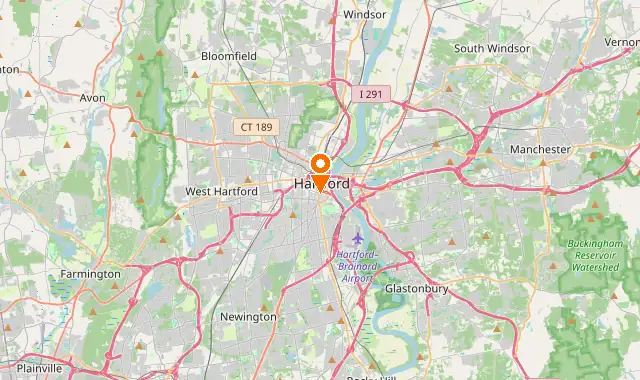
Local facts from Wikipedia and Wikidata, retrieved 2026-10-25. Population and area describe the city itself; the drain coverage counted on this page spans the wider area around it.
Seven inches in eight hours: the storm that defines Hartford risk
On August 19, 2021, a storm dropped about 7 inches of rain on the Hartford region in less than 8 hours. The MDC recounts 2 to 3 feet of water in Albany Avenue from that event alone, with further storms on August 22 and September 1. The utility classifies the August event as a 200 year storm, against a system whose regulatory design target is a 1 year storm. Further rain in December 2022 surcharged a Tower Avenue area property, where the investigation found the direct cause was a blockage 10 feet outside the foundation walls, squarely inside the homeowner lateral responsibility, and a failed backwater valve completed the damage.
Hold both halves of that story at once, because Hartford homeowners need both. Half one: storms beyond design capacity exist, they have happened twice in recent memory, and no private maintenance prevents a street scale flood. Half two: in the investigated December case, the proximate causes were private and maintainable, a blockage in the owner stretch of lateral and a valve that did not protect. The difference between an unavoidable flood and an avoidable backup is often exactly those two private items, and they are checkable in calm weather for ordinary money: a main line cleaning at $200-$650 and a camera at $125-$500, plus a valve inspection conversation with the contractor.
Hartford regular weather supports the same preparation. An average year brings 47.6 inches of precipitation, 9.7 heavy rain days, 33.7 inches of snow, and 111 freeze days. Snowmelt and spring rain load the combined system in the same season when frozen and thawing ground stresses old lateral joints. The Tower Avenue lesson generalizes: the time to learn the state of your lateral and valve is a dry week in any season, when the learning is cheap and the schedule is yours.
1951 median, 21 percent single family: drainage in a rental city
Hartford housing numbers describe a city of buildings more than a city of houses. Median build year 1951; 59.7 percent of units predate 1960; 20.4 percent come from 1960 to 1979; only 6.8 percent are post 2000. And single family homes are just 21.0 percent of 56,435 units. The drain consequence is that most Hartford systems are shared systems: stacks and building mains serving multiple units, where one household habits become every household symptom, and where the lowest unit absorbs the evidence of a building wide restriction first.
Reading symptoms in shared housing takes one extra step. If your unit alone is slow, the cause is likely your branch. If several units, especially lower ones, slow together, or if a ground floor tub fills when upper floors discharge, the restriction is in the shared main or the lateral, and no amount of work inside your own bathroom will change it. Document the shared pattern with dates and tell the property owner the pattern, not just the complaint. Building mains are priced in the main line world, $200-$650 for cleaning, and the bill belongs with the building, which is to say with the owner who also owns the lateral under the MDC rule.
Age adds the final Hartford layer. A 1951 median building has plumbing that has survived 111 freeze days a year for seven decades, in a city where winter does real work on vents, traps in unheated spaces, and shallow sections. Gurgling that appears in deep winter across an older Hartford building can be a vent terminal closing with frost, a classic cold climate behavior, rather than a new blockage. Report the seasonality. The fix for a vent story and the fix for a main story share almost nothing except the phone number that starts them.
Hartford small scale cuts both ways, and the good edge is information speed. In a city of 46.8 square kilometers, a storm backup pattern is rarely yours alone for long: neighbors on the same combined segment experience the same surcharge in the same hour, and comparing notes the next morning is genuine diagnostics, not small talk. If the whole street lowest fixtures misbehaved together, the event belongs first to the system story, and it should be reported as a cluster. If yours alone misbehaved, the Tower Avenue precedent says to look ten feet outside your own foundation before looking anywhere else, and to check the valve while you are looking.
Backwater valves and the MDC program that funds the conversation
The MDC treats backwater valves as infrastructure, not accessories, and funds them accordingly. Alongside the Clean Water Project, the District added 2 dollars million a year to its annual sewer operating budget for sewer backup issues in its towns, including Hartford, and its existing backwater valve program protects basement fixtures from sewer backups during rain events when the pipes no longer have adequate capacity. The District says it proactively reaches out to customers in flood prone areas about the program, directly and through town officials.
A backwater valve does one job: it lets your wastewater out and refuses entry to a surcharging main pushing back. Like every mechanical device in a wet, gritty environment, it needs its flapper and seals kept clear and functional, and the MDC statement is explicit that maintaining the device is the homeowner responsibility even where the program helped put it there. Grease and debris in the valve body are the common failure mode, which ties this section back to kitchen habits: the same FOG discipline that protects your line protects the valve that protects your basement.
If your Hartford home has basement fixtures and no backwater valve, that gap is the single most consequential drain fact about the property, ahead of any current symptom. Ask about it on your next contractor visit, and ask the MDC program pages whether your area is one the District is actively working in, because North Hartford private property work under the Integrated Plan is proceeding area by area. A valve conversation in a dry month is a modest, plannable job. The same conversation after a surcharge is a cleanup, a claim, and a renovation, in that order.
One Hartford habit protects the valve that protects everything else. The flapper mechanism fails most often from debris, and debris arrives from the house side: grease that solidified at the valve seat, wipes that snagged on the mechanism, grit that settled in the valve body during a low flow season. A household that keeps grease out of the kitchen line and wipes out of the toilet is not merely being tidy. It is performing the only routine maintenance a backwater valve receives in most homes, keeping its moving parts free to move on the one night in five years when the whole investment is decided. In Hartford, kitchen discipline is basement flood prevention, by a short and traceable chain.
Soft water, old iron, and what actually narrows Hartford drains
Hartford water is very soft. Utility reported figures place MDC water hardness at about 15.9 mg/L, under 1 grain per gallon, which means mineral scale is close to a non factor in Hartford drain behavior. Fixtures stay clean, heaters accumulate little sediment, and the narrowing inside Hartford pipes comes from the other sources: corrosion products in old iron, grease films, hair and soap, and the root and joint story of a 1951 building stock. A contractor selling descaling as the answer to a Hartford slowdown is working from a script written for a different water supply.
Old iron deserves its paragraph. In pre 1960 galvanized and cast iron drainage, the bore roughens and narrows from the wall inward as corrosion builds, catching hair and grease at a rate smooth pipe never would. Cleaning restores flow, and the roughness explains why flow degrades again faster than it would in plastic. That rhythm, clean, good flow, slow return across a season or two, is normal for the material and is managed by interval and by honest expectations, with a camera, $125-$500, used when the return speeds up, because accelerating return is how a narrowing bore announces that cleaning is nearing the end of its usefulness.
Booking in Hartford works like this. DrainFlowed, at (866) 555-0134, connects you with an independent local contractor who quotes, schedules, does, and answers for the work. Lead with the Hartford facts: build year, whether the building is multifamily, whether basement fixtures exist, whether a backwater valve exists and when it was last checked, and whether symptoms track storms. Those five answers route the visit better in Hartford than in any other city in this series, because they separate the three cities worth of problems, house, building, and combined system, that share one Hartford symptom: water where it should not be.
Drain services available in Hartford
The services that answer Hartford's lead problems, from the independent contractors who cover the city. Ranges are the national typical ranges used across this site.
| Service | Typical range | What it is |
|---|---|---|
| Drain Cleaning | $99-$450 | The core service: mechanical cleaning that clears the clog and scrapes the pipe walls, not just a hole poked through the blockage.. |
| Main Line Cleaning | $200-$650 | When every drain in the house slows at once, the problem is the main line. |
| Sewer Line Cleaning | $250-$900 | The buried line from your house to the street: root cutting, scale removal and jetting, with camera proof of the pipe's condition.. |
| Drain Camera Inspection | $125-$500 | See inside the pipe before you spend on the fix: roots, cracks, bellies and blockages located precisely, with footage to decide on.. |
| Bathroom Drain Cleaning | $99-$400 | Hair, soap scum and toothpaste: tubs, showers and bathroom sinks cleared at the trap and the branch, not just at the surface.. |
| Emergency Drain Cleaning | $150-$700 | Sewage backing up, water rising, guests arriving: what counts as a drain emergency, what to do in the first ten minutes, and how the visit works.. |
Full detail on every service, with signs and causes, is on the services hub, and every range on the site is collected in the cost guide.
Hartford coverage snapshot
Nearby covered cities: New Britain, Bridgeport, New Haven, Waterbury.
Hartford sewer and water resources
The city and utility pages this page's local facts rest on, worth bookmarking if you own a home in Hartford:
Sources for this page
- housing age and mix: Median year built 1951, 59.7 percent pre 1960, 20.4 percent built 1960 to 1979, 6.8 percent post 2000, 56,435 units, 21.0 percent single family (source)
- climate: 47.6 in annual precipitation, 33.7 in snow, 111 freeze days, 9.7 heavy rain days per year, 2014 to 2023 average (source)
- sewer lateral responsibility: Maintenance and repair of the sewer lateral from the house to the main, and of the backwater valve, are the homeowner responsibility, per MDC (source)
- combined sewer status: Combined sewer and stormwater system; Clean Water Project 1.6 dollars billion approved in earlier phases, more than half of CSOs eliminated; system design target is a 1 year storm (source)
- city programs: MDC backwater valve program, with 2 dollars million a year added to the sewer operating budget for backup issues; North Hartford Integrated Plan separation, lining of about 97,000 linear feet and about 3,300 house connections (source)
- water hardness: Utility reported hardness about 15.9 mg/L (0.9 gpg) for the Metropolitan District Commission, soft (source)
- local fact 2021 storm: August 19, 2021 storm delivered about 7 inches of rain in under 8 hours, a 200 year event, with 2 to 3 feet of water in Albany Avenue (source)
- Housing age: median year built and build-era shares (US Census Bureau ACS)
- Weather averages: 2014-2023 daily record (Open-Meteo archive, ERA5)
Coverage around Hartford
Areas and neighbourhoods in and around Hartford
Calls also come in from West Hartford and the streets between them. Those areas sit inside the same coverage, on the same contractor rounds.
West Hartford
Nearby cities we cover in Connecticut
- Drain cleaning in New Britain, CT
- Drain cleaning in Bridgeport, CT
- Drain cleaning in New Haven, CT
- Drain cleaning in Waterbury, CT
- Drain cleaning in Danbury, CT
- Drain cleaning in Norwich, CT
- Drain cleaning in Stamford, CT
The full list for the state is on the Connecticut locations page.
Beyond Hartford
Coverage at this depth continues nearby: see drain cleaning in Bridgeport, CT and drain cleaning in New Haven, CT, each written from its own city's data the same way this page is.
Questions, answered
Who is responsible for the sewer lateral and backwater valve in Hartford?
The homeowner, for both. The MDC states directly that maintenance and repair of the sewer lateral from the house to the main sewer, and of the backwater valve device, are the responsibility of the homeowner. In multifamily buildings that means the property owner, even though tenants see the symptoms first.
What is the MDC backwater valve program?
It is a Metropolitan District program that protects basement fixtures from sewer backups during rain events when the combined pipes run out of capacity. The MDC added 2 dollars million a year to its sewer operating budget for backup issues in its towns including Hartford, and it proactively contacts customers in flood prone areas about the program. Maintaining the valve afterward remains the homeowner job.
Does Hartford have combined sewers?
Yes. Hartford uses a combined sewer and stormwater system, where one pipe carries both. The MDC Clean Water Project, with 1.6 dollars billion approved in its earlier phases and a storage tunnel among its works, has eliminated more than half of combined sewer overflows since it began, and the current Integrated Plan phase continues separation and rehabilitation work over several decades.
What happened in Hartford in August 2021?
A storm on August 19, 2021 dropped about 7 inches of rain in under 8 hours, which the MDC classifies as a 200 year event, producing 2 to 3 feet of water in Albany Avenue. The combined system regulatory design target is a 1 year storm, so events of that size exceed what the system is built to hold. It is the reference storm for why backwater valves and basement planning matter in Hartford.
I rent in Hartford and my tub backs up in storms. What should I do?
Document the pattern with dates and tell your landlord precisely that: which fixtures, which storms, and whether other units are affected. Under the MDC rule, the lateral and backwater valve are the property owner maintenance responsibility. A shared pattern across units points to the building main or lateral, priced in the main line range of $200-$650 for cleaning, and it is an owner side repair conversation.
Is Hartford water hard?
No, it is very soft. Utility reported figures for MDC water put hardness around 15.9 mg/L, under 1 grain per gallon. Scale is a minor factor in Hartford drains. The narrowing here comes mainly from corrosion in old iron pipe, grease, hair, and root or joint problems in a housing stock whose median build year is 1951.
How much does drain cleaning cost in Hartford?
National ranges: standard cleaning $99-$450, main line $200-$650, hydro jetting $300-$900, camera inspection $125-$500, emergency service $150-$700. Mention your backwater valve status and whether symptoms track storms when you connect through DrainFlowed at (866) 555-0134. In Hartford those details change what the visit should check first.
Drain problem in Hartford? Make the call
A live person answers around the clock. Describe the problem, hear the likely range, and get an independent local contractor on the way.
(866) 555-0134 Tap to call nowA live person answers, day or night. Describe the problem, hear the likely range, then decide.