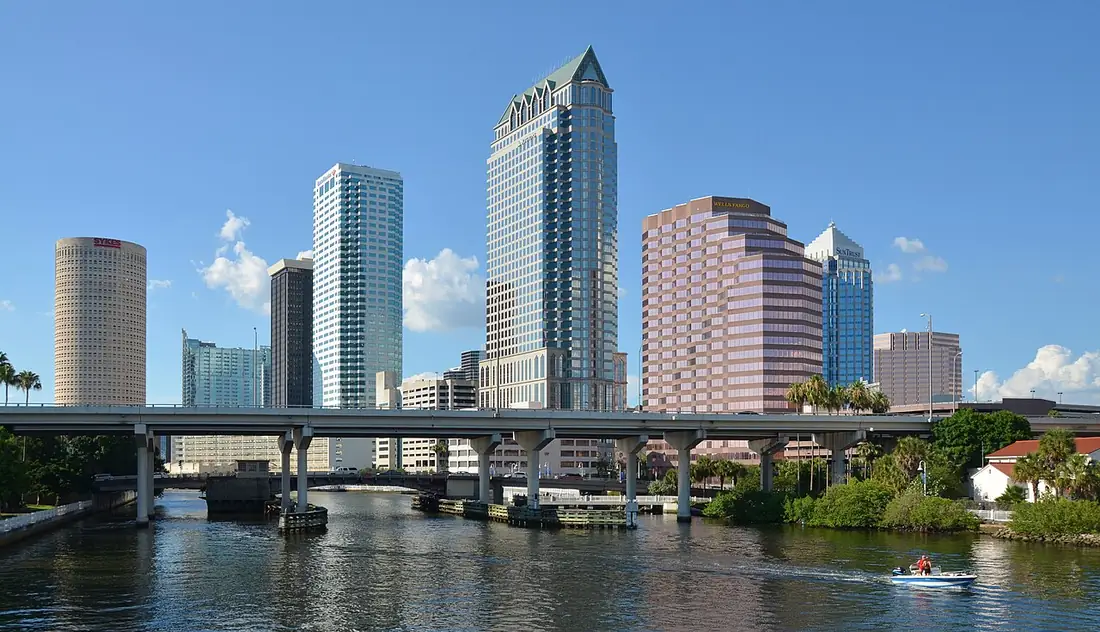
Drain cleaning in Tampa, FL - Hillsborough County - 104 ZIP codes covered
Drain Cleaning in Tampa, FL
Tampa's drain rule is the cleanest one in this set: the city maintains the sewer from your property line out to the main, and everything on the house side of that line is yours. The complication is the weather. Tampa takes 55.0 inches of rain a year, the most in these ten cities, with about 8.3 heavy rain days, onto a housing stock where a quarter of homes predate 1960 and a third were built after 2000. Old pipe on your side, heavy water from the sky, and a bright line at the lawn's edge. DrainFlowed connects homeowners here with an independent local contractor. Call (866) 555-0134 and describe the fixtures and whether storms are part of the story.
The property line is the whole ballgame in Tampa
Tampa's wastewater department describes its side of the arrangement in one tidy statement: the City maintains the sanitary sewer system from your property line toward the street, easement, or alley where the main sewer line is located. Read it backwards and you have the homeowner's share: the lateral from the house to the property line, every foot of it, is yours to keep clear and in repair. There is no split inspection arrangement and no notification process to learn. The line at the edge of your lot is the line.
That clarity changes what good evidence looks like. In a city where a break three feet one side of a boundary is your bill and three feet the other side is the city's maintenance problem, a camera inspection should always come with distances. A contractor who televises your line and reports a fault at a measured distance from the cleanout has told you whose problem it is. A contractor who reports a fault somewhere out there has told you almost nothing billable. Ask for the footage with the counter on it, priced in the usual $125-$500 camera range.
Cleaning follows the same boundary in practice. Blockages on the house side are yours to clear even when they sit close to the line, and blockages in the main or the city's stretch belong to the city to resolve. If every home on the street shares your symptoms at the same moment, that pattern itself suggests the shared system, and a call to the city belongs alongside your call to a contractor. If it is only your house, it is only your pipe, and the ladder of causes below applies.
Drain problems we handle in Tampa
The problems Tampa's own housing, ground and weather produce most. The full symptom list is on the problems hub; these are the ones that earn their place here.
Multiple Drains Backing Up in Tampa
Several drains failing together is the main line or sewer until proven otherwise. Stop the water, protect the floor, make the call..
Recurring Clogs in Tampa
A clog that returns is not bad luck. It is an undiagnosed cause - roots, scale, a belly, or a cleaning that never removed the material..
Standing Water in Tampa
Water that will not go down has a blockage at a specific level. Which level decides whether it is a quick clean or a main-line job..
Slow Drain in Tampa
One slow fixture is a narrowing pipe. Several slow fixtures are a main-line warning. How to tell the difference and what fixes each..
Fifty five inches: rain is Tampa's drain season
Tampa's climate figures lead this set of cities. Annual precipitation averages 55.0 inches, snow is zero, freeze days are zero, and about 8.3 days a year qualify as heavy rain days. The rain arrives warm and intense, in downpours that test everything connected to the ground: soil that saturates and shifts around older pipe joints, groundwater that rises and finds any crack in a lateral, and household lines that are asked for their best flow at exactly the moment they have the least help from gravity fed street systems under load.
A house drain does not need a combined sewer to misbehave in this weather, and Tampa's system is sanitary rather than combined. It needs only a partial restriction. A line narrowed by grease to half its bore drains a quiet Tuesday without complaint and fails on the Saturday a storm, a houseful of guests and a running washing machine arrive together. Owners here learn to read the correlation: if your drains only misbehave when it pours, the restriction is real but partial, and the storm is the messenger rather than the cause. Cleaning the line in dry weather, at standard $99-$450 rates, is a better plan than meeting the same restriction during the next downpour at emergency rates of $150-$700.
The warm wet climate also keeps the ground biology switched on all year. Roots grow in every month. Organic mats in a line do not get a winter pause. Tampa drain maintenance is therefore a calendar without an off season, which suits a city where the treatment plant at the end of the system, the Howard F. Curren Advanced Wastewater Treatment Plant, is designed for 96 million gallons a day and discharges to Hillsborough Bay or into reclaimed water use. The system is built for volume. Your lateral just has to reach it in good order.
About Tampa: the local snapshot
Tampa is a major city on the Gulf Coast of the U.S. state of Florida and the county seat of Hillsborough County.
Tampa is the county seat of Hillsborough County, and the snapshot below keeps the city itself separate from the wider coverage area around it.
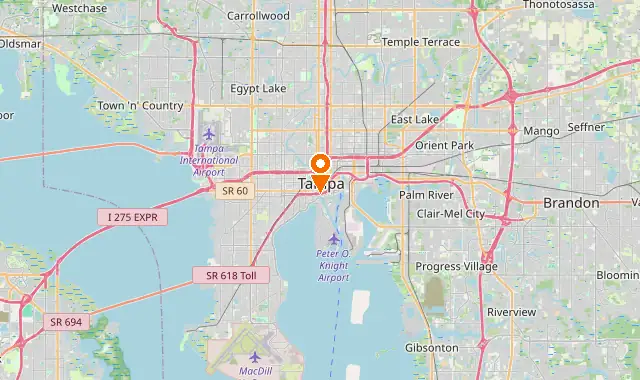
Local facts from Wikipedia and Wikidata, retrieved 2026-10-25. Population and area describe the city itself; the drain coverage counted on this page spans the wider area around it.
Two Tampas: the pre 1960 core and the post 2000 ring
Tampa's 182,425 housing units divide into eras with different drain personalities. A quarter of the stock, 25.5 percent, predates 1960, and 19.0 percent dates from 1960 to 1979, which together give the older districts laterals in clay and cast iron that have spent 45 to 100 years in wet, sandy, shifting soil. The median home was built in 1985, and a striking 34.3 percent of homes were built after 2000, the largest new share among the older cities in this set, draining through modern plastic on shorter, cleaner runs. Single family homes are 57.0 percent of the stock.
For the older core, the diagnosis hierarchy starts with joints. Sandy soil that moves with the water table worries old clay sections against each other, opening the gaps roots are waiting for. A recurring clog in a pre 1960 Tampa home is a root or offset story until a camera proves it is merely grease, and owners in that stock do well to hold camera footage from any first major cleaning, because it becomes the baseline every later symptom is compared against.
For the newer ring, problems run the other way: the pipe is sound and the inputs are not. Grease, wipes and the accumulated habits of a household close plastic lines that have no structural excuse, and a single thorough cleaning with a habit reset can hold for years. The same symptom, the same city, the opposite prescription. The detail that separates them costs nothing to provide: the year the house was built. Say it on the first call and the contractor arrives with the right first hypothesis.
The two cleanout check Tampa teaches its own homeowners
Tampa's wastewater department publishes a diagnostic its residents can run before any contractor is called, and it exploits a feature of local construction: many Tampa homes have two cleanouts, one near the foundation of the house and a second at or near the property line. The city's guidance walks the logic plainly. Check the cleanout next to the house first. If it holds no water, the blockage sits somewhere in the house plumbing itself. If water stands in it, the restriction is downstream, in the line running from the house toward the main.
The second cleanout then splits the verdict along the same line the city's maintenance rule uses. If the property line cleanout also shows standing water, the problem is likely in the city sewer line, and the city's instruction is to stop using your facilities and contact the Wastewater Department, which takes those calls around the clock. If there is no property line cleanout and water stands in the one on your property, the matter stays in the homeowner and plumber world. The same page adds the boundary in so many words: Wastewater Collection Division personnel are not permitted to work on private property, so anything between the right of way and the house belongs to the homeowner to resolve.
The city pairs the check with a warning worth repeating in a warm, wet city: go easy on water while drains run slow, because a washing machine discharges 15 to 20 gallons per load, and that slug of water arriving at a restricted line is exactly what pushes backup water into toilets and showers. Eliminating water input is the first move in the city's own advice, ahead of any tool.
A homeowner who runs this check before calling arrives at the conversation with a location hypothesis already formed: house side, lateral, or city line. That turns the contractor's visit from exploration into confirmation, and it can turn a would be private bill into a city work order when the evidence points that way. Five minutes at two cleanout caps is the highest value diagnostic in Tampa plumbing, and the city itself wrote the instructions.
Seasonal hardness from the Hillsborough River
Tampa's water story has a rhythm other cities do not. The city draws its supply mainly from the Hillsborough River, and published city material describes hardness that fluctuates with the seasons, lower during the wet season and higher during the dry, across a range of roughly 140 to 300 ppm, or 8 to 17 grains per gallon. That puts Tampa in the moderately hard to very hard band depending on the month, and it means scale is a genuine, if seasonal, contributor to drain narrowing here.
Scale's role is best understood as the accomplice rather than the lead. On a kitchen line it roughens the wall so grease keys in faster. On a bathroom branch it gives hair and soap a mineral scaffold. Because the input rises and falls with the river's seasons, the coating rate does too, which is one reason Tampa lines can seem to foul faster across a dry year. None of this calls for panic or for treatment purchases made in a panic. It calls for thorough cleaning, the kind that scrapes a wall back rather than poking through the middle of a mat, with hydro jetting in the $300-$900 range as the heavy option for established coating.
There is a diagnostic trap worth naming. Homeowners sometimes attribute every slowdown to the water because hardness is easy to look up, while the actual culprit is roots in a joint ten feet out. Hardness numbers describe the water in every home in the city. Your line's problem is specific to your line, and only eyes inside it, a cable's return or a camera's footage, can say which of Tampa's two narrowing agents, mineral or organic, owns your particular clog.
When several drains talk at once
The single most valuable diagnostic skill a Tampa homeowner can learn is counting fixtures. One slow sink is a branch problem and a small bill. Two or more fixtures misbehaving together, gurgling sounds from a tub when a toilet flushes, or water standing in the lowest shower in the house are the signature of the main house line, and they should move your call from a standard cleaning conversation to a main line conversation in the $200-$650 range, with a camera strongly advised.
In Tampa that count carries the second question with it: which side of the property line? A main line problem inside your stretch is your job. A main line problem that resolves into a blockage or break in the city maintained stretch is the city's. The camera answers it with a distance measurement, and the answer decides who schedules the repair and who pays it. This is the one city in the set where the footage is not merely diagnostic but jurisdictional, and it is worth the $125-$500 every time a main line fault is on the table.
Standing water and active backups complete the ladder. Stop running water into a system that cannot move it, keep clear of any sewage for health reasons, and make the call an urgent one. In a city of warm downpours, also note the weather when you call. If the backup arrived with a storm that has half the street watching their floor drains, say that too. Shared timing is data, and the city and the contractor both reason better with it than without it.
What drain work costs in Tampa, and how the call works
The ranges here are the national ranges DrainFlowed publishes everywhere. Applied to Tampa: a standard drain cleaning at $99-$450; main line cleaning, $200-$650; sewer line cleaning, $250-$900; hydro jetting, $300-$900; a camera inspection, $125-$500; and an emergency visit, $150-$700. A single fixture in a newer home sits low. A main line on an older lot with a camera to settle the property line question sits in the middle of two ranges, and it is money spent on certainty in the one city where certainty about location is literally worth a repair bill.
DrainFlowed is a connection service. The contractor at your door is an independent local business, sets their own final price inside the range you discuss, and should be asked for their licence and insurance before work begins. Call (866) 555-0134 with the build year, the fixtures involved, and whether rain is part of the pattern. Those three facts, in this city, are the whole first page of the diagnosis.
Keep whatever footage and paperwork the visit produces, marked with distances. Tampa's property line rule makes your drain file a boundary document as much as a maintenance record, and the owner who can show where a fault sits, on which side of the line, starts every future conversation, with a contractor or with the city, already holding the answer.
Drain services available in Tampa
The services that answer Tampa's lead problems, from the independent contractors who cover the city. Ranges are the national typical ranges used across this site.
| Service | Typical range | What it is |
|---|---|---|
| Drain Cleaning | $99-$450 | The core service: mechanical cleaning that clears the clog and scrapes the pipe walls, not just a hole poked through the blockage.. |
| Main Line Cleaning | $200-$650 | When every drain in the house slows at once, the problem is the main line. |
| Sewer Line Cleaning | $250-$900 | The buried line from your house to the street: root cutting, scale removal and jetting, with camera proof of the pipe's condition.. |
| Hydro Jetting | $300-$900 | High-pressure water that scours pipe walls clean - the answer for grease, scale and lines that keep re-clogging after cabling.. |
| Drain Camera Inspection | $125-$500 | See inside the pipe before you spend on the fix: roots, cracks, bellies and blockages located precisely, with footage to decide on.. |
| Emergency Drain Cleaning | $150-$700 | Sewage backing up, water rising, guests arriving: what counts as a drain emergency, what to do in the first ten minutes, and how the visit works.. |
Full detail on every service, with signs and causes, is on the services hub, and every range on the site is collected in the cost guide.
Tampa coverage snapshot
Nearby covered cities: Town 'n' Country, Riverview, Brandon, Orlando.
Tampa sewer and water resources
The city and utility pages this page's local facts rest on, worth bookmarking if you own a home in Tampa:
Sources for this page
- housing age and mix: Median year built 1985, 25.5 percent pre 1960, 19.0 percent built 1960 to 1979, 34.3 percent post 2000, 182,425 units, 57.0 percent single family (source)
- climate: 55.0 in annual precipitation, 0 in snow, 0 freeze days, 8.3 heavy rain days per year (2014 to 2023 average) (source)
- sewer lateral responsibility: The City of Tampa maintains the sanitary sewer system from the property line toward the street, easement or alley where the main is located; the house side of the property line is the owner's (source)
- local fact: All Tampa wastewater is treated at the Howard F. Curren Advanced Wastewater Treatment Plant, design capacity 96 million gallons per day, effluent discharged to Hillsborough Bay or used as reclaimed water (source)
- water hardness: City hardness fluctuates seasonally, lower in the wet season and higher in the dry, roughly 140 to 300 ppm (8 to 17 grains per gallon), supply mainly from the Hillsborough River (source)
- cleanout diagnostic: Many Tampa homes have two cleanouts (house and property line); standing water in the property line cleanout indicates a likely city sewer line problem to report to the Wastewater Department, and city personnel are not permitted to work on private property (source)
- Housing age: median year built and build-era shares (US Census Bureau ACS)
- Weather averages: 2014-2023 daily record (Open-Meteo archive, ERA5)
Coverage around Tampa
Nearby cities we cover in Florida
- Drain cleaning in Town 'n' Country, FL
- Drain cleaning in Riverview, FL
- Drain cleaning in Brandon, FL
- Drain cleaning in Orlando, FL
- Drain cleaning in Jacksonville, FL
- Drain cleaning in Cape Coral, FL
- Drain cleaning in Palm Bay, FL
- Drain cleaning in Port Saint Lucie, FL
The full list for the state is on the Florida locations page.
Beyond Tampa
Coverage at this depth continues nearby: see drain cleaning in Orlando, FL and drain cleaning in Miami, FL, each written from its own city's data the same way this page is.
Questions, answered
Who maintains my sewer line in Tampa, me or the city?
The property line. Tampa's wastewater department maintains the system from your property line toward the street, easement or alley where the main runs. Your side of that line, from the house out to it, is your responsibility to maintain and clear. A camera inspection with distances marked settles which side of the line a problem sits on.
Can Tampa's heavy rain make my drains back up?
It can, and here is the local shape of it. Tampa averages 55.0 inches of rain a year with about 8.3 heavy rain days, and downpours are part of the warm season routine. A house line already narrowed by grease or roots has no spare capacity when the system around it is stressed. Slow drainage that tracks storms deserves a camera look, not just a cleaning.
Is Tampa water hard?
It is seasonal. City reporting describes hardness swinging with the seasons, lower in the wet season and higher in the dry, roughly 140 to 300 ppm or 8 to 17 grains per gallon, with supply drawn mainly from the Hillsborough River. Scale matters here, but grease and roots in older lines matter as much.
How much does drain cleaning cost in Tampa?
Standard cleaning: $99-$450. Main line work: $200-$650. A camera inspection: $125-$500. Because Tampa splits responsibility at the property line, that camera footage can decide whether a repair belongs to you or falls on the city's maintained section. You agree the range with the independent contractor before work begins at (866) 555-0134.
Are tree roots really a year round problem in Tampa?
Yes, more than in colder or drier cities. Tampa has no freeze days and a long growing season, so roots grow all year and find every open joint in the older housing stock, where a quarter of homes predate 1960. Recurring clogs at the same line usually mean roots until a camera says otherwise.
There is a sewer smell in a spare bathroom. What causes that in Tampa?
A dried out trap is the most likely cause. Floor drains and fixtures in little used rooms lose their water seal to evaporation, and sewer gas walks straight in. Run water into each fixture in the room and repeat monthly. If the smell remains with full traps, book an inspection for a vent or pipe fault.
Where does Tampa wastewater actually go?
Head to the city's wastewater pages for the system side of the story. Tampa treats all of its wastewater at the Howard F. Curren Advanced Wastewater Treatment Plant, with a design capacity of 96 million gallons a day, discharging treated effluent to Hillsborough Bay or reusing it as reclaimed water. For a home line problem, though, the property line rule is the fact that matters.
Drain problem in Tampa? Make the call
A live person answers around the clock. Describe the problem, hear the likely range, and get an independent local contractor on the way.
(866) 555-0134 Tap to call nowA live person answers, day or night. Describe the problem, hear the likely range, then decide.